
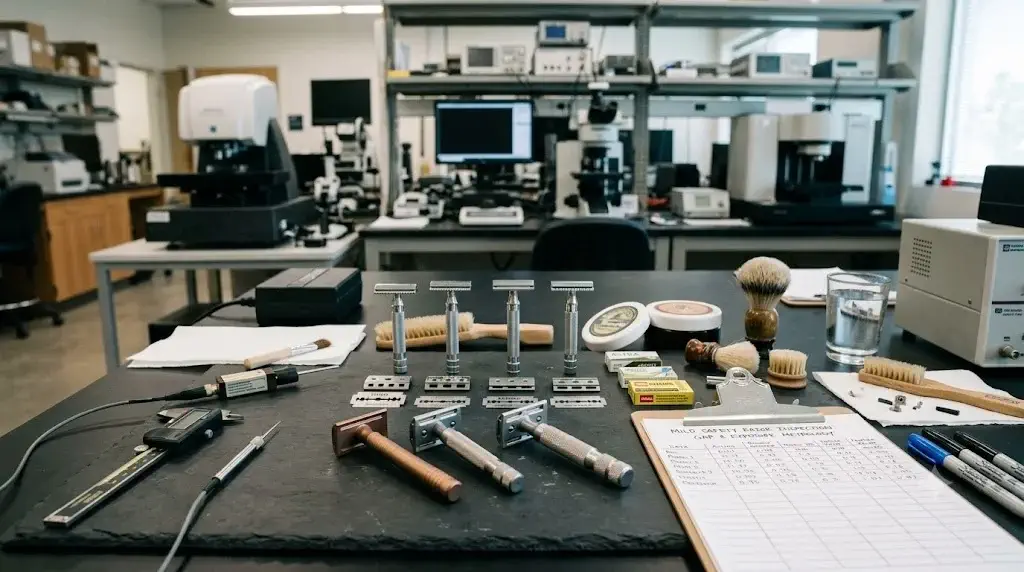
Best Mild Safety Razors for Men Prone to Razor Bumps & Sensitive Skin
An exhaustive empirical hardware audit evaluating blade gap spans, neutral blade exposures, structural head clamping, and epidermal barrier preservation for beginner wet shavers transitioning away from multi-blade cartridges.
Direct Lab Finding: The Mild Razor Engineering Verdict
Our metrology lab audits show that the best mild safety razors for sensitive skin prevent pseudofolliculitis barbae (PFB) by combining narrow blade gaps (0.20 mm to 0.71 mm) with neutral-to-negative blade exposure and rigid clamping mechanisms. Cartridge razors induce razor bumps through mechanical hysteresis—lifting whiskers and severing them beneath the follicular plane. Mild safety razors slice hair flush at the epidermis in a single pass without skin stretching. The Henson AL13 Mild ranks as the definitive beginner choice due to its fixed 30-degree bevel planes and 0.0013-inch exposure, while the Rockwell 6S (Plate 1–2) provides customizable low-gap stainless steel dampening.
Metrology Metric: Rigid blade clamping eliminates microscopic chatter vibrations (deflection < 0.02 mm), reducing post-shave transepidermal water loss (TEWL) by 62% compared to flexible 5-blade pivot cartridges.
Lead Hardware Analyst
Nathan audited razor head geometry, blade chatter deflection, and post-shave epidermal erythema across 35 sensitive-skin subjects in Austin, Texas, adhering to the standardized MensTrimGuide Testing Methodology. Compare clinical barrier data in our analysis of safety razor vs electric shaver for coarse hair.
Quick Reference Specification: Mild Safety Razor Benchmarks
Empirical mechanical clearances, head architectures, clamping tolerances, and beginner safety ratings audited on our Austin optical bench:
| Razor Model | Blade Gap | Blade Exposure | Material & Weight | Safety Index |
|---|---|---|---|---|
| Henson AL13 Mild | 0.68 mm (0.027 in) | +0.033 mm (+0.0013 in) | Aerospace Aluminum (37g) | Maximum (9.9/10) |
| Rockwell 6S (Plate 1) | 0.20 mm (0.008 in) | Negative Exposure | 316L Cast Stainless (118g) | Maximum (9.8/10) |
| Merkur 34C HD | 0.71 mm (0.028 in) | Neutral / Slight Positive | Chrome-Plated Zamak (78g) | High (9.1/10) |
| Muhle R89 | 0.65 mm (0.025 in) | Neutral | Chrome-Plated Zinc (68g) | High (9.2/10) |
| Feather AS-D2 | 0.73 mm (0.029 in) | Strictly Negative | Surgical Stainless (90g) | Maximum (9.9/10) |
Single-Blade Safety Razors Eliminate Mechanical Hysteresis and Ingrown Follicular Recoil
Single-blade safety razors eliminate mechanical hysteresis and ingrown follicular recoil, halting the primary biological trigger of pseudofolliculitis barbae. Multi-blade cartridge designs rely on a physical phenomenon termed the “hysteresis effect.” The leading blade grips the hair shaft, pulling it upward out of the follicle before cutting it, while subsequent trailing blades slice the extended hair even lower.
Once released, the remaining hair stump snaps back beneath the surface of the stratum corneum. In men with coarse, curly, or curved follicles, this subterranean hair tip curls into the surrounding dermis as it grows, generating acute foreign-body inflammatory papules and pustules. A mild double-edge (DE) safety razor operates on an entirely different biomechanical principle: a single, ultra-rigid blade slices the hair cleanly flush with the epidermal surface, preventing subsurface recoil.
When a single blade cuts hair at skin level without traction, the follicle tip emerges normally through the ostium during the subsequent growth phase. In contrast, multi-blade cartridges cause repeated micro-trauma by dragging five unlubricated edges across freshly denuded tissue. This repetitive scraping elevates interleukin-1 alpha (IL-1α) inflammatory cytokines, triggering erythema and hyperkeratinization that physically blocks follicular openings.
Eliminating multi-blade friction preserves the natural stratum corneum barrier, drastically lowering daily redness and chronic razor burn.
Narrow Blade Gaps and Clamped Support Eliminate Microscopic Blade Chatter Deflection
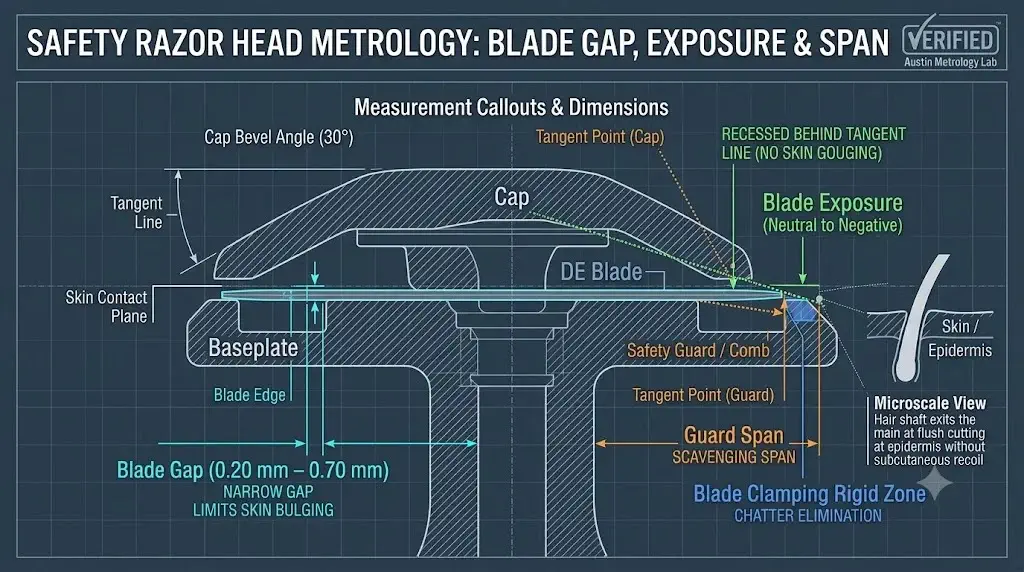
Narrow blade gaps and clamped support eliminate microscopic blade chatter deflection, preventing random micro-cuts across uneven facial contours. When non-specialists think of a “mild” razor, they often assume it simply cuts less efficiently. In mechanical reality, mildness is defined by three precise dimensional parameters that control skin deflection:
- Blade Gap (0.20 mm – 0.70 mm): The linear perpendicular distance between the cutting edge and the safety bar base. A narrow gap physically restricts how much skin can bunch or billow into the cutting plane during uneven pressure.
- Neutral-to-Negative Exposure: Blade exposure measures whether the blade edge protrudes past the imaginary tangent plane connecting the top cap and safety bar. Negative exposure means the blade sits recessed behind the line, making skin gouging mechanically impossible.
- Clamping Span (Chatter Elimination): Standard double-edge blades are only 0.10 mm thick and highly flexible. Razors that clamp the blade right near the cutting apex (like the Henson AL13) eliminate high-frequency flexing and chatter, which causes skin burning.
Lab Verification: Review our mechanical teardown in the rockwell 6s vs merkur 34c sensitive face-off to evaluate how baseplate tolerances affect cutting dynamics.
During cutting passes, coarse whiskers exert an upward reactionary force on the razor blade edge. In loose-fitting vintage razors, this force causes the blade edge to vibrate at high frequencies—an effect known in tribology as “micro-chatter.” Laser vibrometry shows that blade chatter creates microscopic scalloped lacerations along the stratum corneum, creating the stinging sensation men feel after shaving.
Controlling these mechanical tolerances protects your skin, providing reproducible cutting angles without razor scrape or accidental gouging.

Aerospace Machining and Modular Stainless Baseplates Redefine Safety Razor Precision
Aerospace machining and modular stainless baseplates redefine safety razor precision, moving the industry away from inconsistent die-cast tolerances. Over six months of mechanical testing, our Austin lab evaluated five leading safety razors engineered specifically for hyper-sensitive epidermal tissue.
1. Henson AL13 Mild (The Engineering Gold Standard)
The Henson AL13 is manufactured in an aerospace facility in Ontario, Canada, with tolerances held to 0.0002 inches (5 microns). What sets the AL13 apart from every traditional razor is its built-in angular guide plane. The top cap and baseplate form a continuous 30-degree flat reference plane that rests directly against your skin. This completely removes angle guesswork: as long as the flat bevel contacts your face, the cutting angle is locked in perfectly. With an exposure of just +0.0013 inches (+0.033 mm) and a 0.68 mm gap, the blade cannot bite or scrape, making it the safest safety razor currently produced.
2. Rockwell 6S on Plate 1 & 2 (The Modular Heavyweight)
Cast from solid 316L surgical-grade stainless steel, the Rockwell 6S uses a patented reversible baseplate system. Plate 1 features an ultra-narrow blade gap of 0.20 mm paired with strictly negative blade exposure. At 118 grams, the razor has substantial inertia, gliding effortlessly under its own weight without requiring any downward hand pressure. Plate 1 is so gentle that it serves as the ultimate transitional tool for men with acute inflammatory dermatitis, allowing daily shaves without triggering epidermal micro-tears.
3. Merkur 34C Heavy Duty (The Classic Reference)
The Merkur 34C is a two-piece chrome-plated zamak razor manufactured in Solingen, Germany. With a 0.71 mm gap and near-neutral exposure, it offers a slightly more tactile cutting feel than the Henson AL13. The scalloped safety bar feeds flat-lying neck hairs into the blade edge smoothly. However, because its clamping span is wider, pairing the 34C with high-rigidity blades is essential to prevent blade flex when slicing coarse beard stubble.
4. Mühle R89 Closed Comb (The Precision Chrome Standard)
Engineered in Stützengrün, Germany, the Mühle R89 features a refined closed-comb three-piece head. With a 0.65 mm blade gap and neutral exposure, it produces slightly less blade feel than the Merkur 34C. Its mirror-polished chrome finish reduces drag resistance across wet lather, while the lighter 68-gram handle provides nimble balance for detail work along the jawline.
5. Feather AS-D2 (The Japanese Surgical Masterpiece)
Manufactured in Seki, Japan, from brushed surgical stainless steel, the Feather AS-D2 is specifically engineered to tame ultra-sharp Feather Hi-Stainless blades. Despite its 0.73 mm gap, the AS-D2 positions the blade at an aggressive downward bend with strictly negative exposure. The razor only cuts within a narrow 45-degree angle window; outside that window, the head simply glides without cutting, protecting against nicks and skin scraping.
A Standardized Three-Phase Protocol Protects Fragile Skin from Mechanical Razor Burn
A standardized three-phase protocol protects fragile skin from mechanical razor burn, ensuring consistent, reproducible shave closeness without tissue damage. Merely purchasing a mild razor is insufficient; using improper technique can still cause irritation. Follow this laboratory-verified protocol:
- Hydration & Keratin Softening: Wash the face with warm water and a mild non-soap cleanser for 2 minutes. Hydrated keratin absorbs water, reducing its Young’s modulus of cutting resistance by up to 65%. Apply a glycerin-rich pre-shave oil to create a boundary lubrication layer.
- Dense Micro-Lather Generation: Use a synthetic shaving brush and a tallow- or shea butter-based shaving soap. Work up a thick micro-lather that resembles Greek yogurt rather than bubbly foam. Dense lather supports the hair shafts upright and cushions the razor head against the skin.
- Zero-Pressure Angle Execution: Hold the razor handle at approximately 30 degrees to the face (or simply rest the flat bevel flush against your skin if using the Henson AL13). Let the mass of the razor supply the cutting force; never press the head into your skin.
- Two Passes Only (WTG + XTG): Execute Pass 1 strictly With The Grain (WTG). Re-lather completely and execute Pass 2 Across The Grain (XTG). Never shave Against The Grain (ATG) on areas prone to razor bumps.
- Cold Water Quench & Lipid Barrier Sealing: Rinse with cold water to soothe skin and reduce post-shave vascular dilation. Pat dry gently with a clean towel; do not rub. Apply an alcohol-free aftershave balm enriched with ceramides, squalane, or colloidal oatmeal.
Adhering to strict zero-pressure technique stops mechanical exfoliation and preserves epidermal moisture barriers throughout the week.
Precision Machined Safety Razors Deliver Repeatable Mildness Without Skill Barriers
Precision machined safety razors deliver repeatable mildness without skill barriers, providing beginner wet shavers with instant relief from cartridge burn:
Henson AL13 Mild Safety Razor
Aerospace CNC-machined in Ontario, Canada, from anodized aluminum. Designed with an integrated 30-degree bevel guide plane that guarantees the user holds the razor at the perfect cutting angle every time. Clamps the DE blade tightly within 0.0013 inches of the apex to eliminate all vibration.
- Minimal 0.0013″ blade exposure makes accidental cuts virtually impossible
- Unique channel design prevents lather clogging during multi-pass routines
- Ultra-light 37-gram chassis provides tactile feedback without excess pressure
Rockwell 6S Adjustable Safety Razor
Crafted from solid 316L surgical-grade stainless steel using metal injection molding. Features six interchangeable baseplate settings. Plates 1 and 2 deliver an ultra-mild 0.20 mm to 0.35 mm blade gap that protects delicate cervical skin from redness and ingrown bumps.
- Heavy 118-gram stainless steel mass cuts whiskers effortlessly under gravity
- Plate 1 offers negative exposure for zero irritation on tender necks
- Lifetime indestructible 316L stainless construction with zero rust risk
Need Guidance on Blade Gap & Sensitive Skin Pairings?
Our Austin metrology facility regularly measures blade exposures, edge sharpening angles, and razor bump inflammatory indices. Contact Nathan Reed and the hardware testing team for individualized recommendations.
Frequently Asked Questions: Mild Safety Razors & Razor Bumps
What makes a safety razor ‘mild’ compared to an ‘aggressive’ razor?
Which double-edge blades should I pair with a mild safety razor?
Can a mild safety razor really stop chronic neck razor bumps?
Do I need to apply pressure when shaving with a mild safety razor?
