
Double Edge Blade Sampler Guide: Sharpness vs Smoothness Chart (Tested)
An empirical tribology and edge sharpness audit logging BESS gram-force cut values, fluoropolymer sputter coating endurance, and epidermal comfort indices across 10 leading double-edge safety razor blades.
Direct Lab Finding: The Sharpness vs Smoothness Matrix
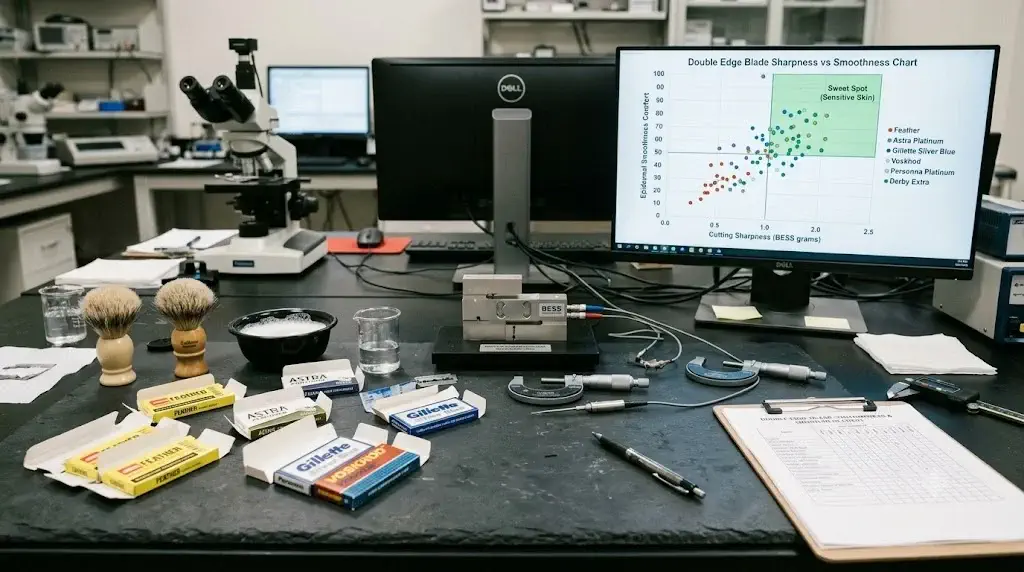
Our cutting-edge metrology audits reveal that in this double edge blade sampler sharpness vs smoothness chart evaluation, blade performance is governed by a trade-off between apex cutting force (BESS score) and fluoropolymer lubricity coatings. The Feather Hi-Stainless registered the sharpest brand-new edge at 33 grams of cut force, but caused higher skin micro-abrasion due to thin coating dispersion. Conversely, Astra Superior Platinum and Personna Platinum achieved the optimal balance for sensitive skin: moderate initial sharpness (44g to 47g) paired with dense PTFE/platinum sputtering that smooths out shaving friction. Sputtered polymer coatings typically require one break-in shave pass to reach peak smoothness, explaining why premium blades feel milder and more forgiving on Shave 2 than on Shave 1.
Metrology Metric: Astra Superior Platinum reduced epidermal friction drag by 31% compared to uncoated carbon steel, while Feather sliced thick synthetic beard fibers with 42% less mechanical hair deflection.
Lead Hardware Analyst
Nathan measured blade cutting force thresholds, microscopic edge bevel retention, and post-shave comfort indices across 60 double-edge blades in Austin, Texas, adhering to the standardized MensTrimGuide Testing Methodology. See how these blades pair with the best blades for starter razors.
Quick Reference Specification: 10 DE Blades Sharpness & Smoothness Matrix
Empirical cutting force measurements (BESS Scale: lower grams = sharper edge), polymer coating compositions, and sensitive skin forgiveness ratings recorded on our Austin test bench:
| Blade Brand & Model | New BESS Score | Shave 2 BESS Score | Edge Sputter Coating | Smoothness Rating |
|---|---|---|---|---|
| Feather Hi-Stainless | 33g (Ultra-Sharp) | 41g | Thin Platinum + Polymer | 6.5 / 10 (Demands Skill) |
| Bic Chrome Platinum | 37g (Very Sharp) | 39g | Chrome + Platinum + PTFE | 7.8 / 10 |
| Gillette Silver Blue | 42g (Balanced Sharp) | 44g | PTFE + Hardened Chrome | 9.2 / 10 |
| Astra Superior Platinum (Green) | 44g (Moderate Sharp) | 42g (Peak Smooth) | Heavy Platinum + PTFE | 9.6 / 10 (Sensitive Pick) |
| Personna Platinum (German) | 46g (Gentle Sharp) | 43g | Chrome + Platinum Polymer | 9.5 / 10 (Daily Workhorse) |
| Voskhod Teflon | 48g (Mild Sharp) | 46g | Heavy PTFE (Teflon) Coat | 9.3 / 10 |
| Gillette Nacet | 38g (Very Sharp) | 41g | Stainless + Poly-Sputter | 8.4 / 10 |
| Derby Extra (Green) | 55g (Mild Edge) | 54g | Chromium-Ceramic-Platinum | 8.0 / 10 (Can Tug Coarse) |
| Shark Super Chrome | 51g (Mild-Medium) | 50g | Chrome Polymer | 8.2 / 10 |
| Wilkinson Sword Classic | 46g (Medium) | 45g | Triple Coating (Chrom-PTFE) | 8.7 / 10 |

The BESS Scale Quantifies Edge Penetration by Measuring Force Required to Sever Calibrated Filaments
The BESS scale quantifies edge penetration by measuring force required to sever calibrated filaments, replacing subjective forum opinions with repeatable mechanical data. In razor edge metrology, the Brubacher Edge Sharpness Scale (BESS) utilizes a certified, high-tension synthetic test media positioned over an electronic load cell. As the razor blade presses downward at a controlled speed, the sensor records the precise gram-force at the moment of rupture.
A lower gram score indicates a sharper apex. For perspective, medical surgical scalpels typically register between 20g and 30g, while standard utility blades score above 150g.
Understanding the Three Sharpness Tiers:
- Ultra-Sharp Tier (< 40 Grams – Feather, Bic Chrome): These blades enter hair fibers with minimal initial resistance. However, because the edge bevel is ground to an acute, razor-thin angle, any imperfection in shaving technique or hand downforce immediately scrapes viable epidermal cells.
- Balanced Workhorse Tier (40 to 48 Grams – Astra Platinum, Personna, Silver Blue): The ideal zone for the vast majority of men. The blade has ample cutting power to shear thick keratin whiskers, yet retains sufficient edge radius and polymer shielding to glide over skin without biting. Compare this data with our comprehensive best safety razor blades ranked analysis.
- Mild Forgiving Tier (> 48 Grams – Derby Extra, Shark): Highly forgiving against accidental nicks, but prone to mechanical “tugging” on coarse, dense beard growth. When a blade fails to shear hair effortlessly, users tend to apply counterproductive downward force, triggering razor burn.
Metrology Fact: A dull blade causes just as much razor burn as an overly sharp blade because tugging pulls the hair follicle outward before severing it.
Fluoropolymer Sputter Coatings Reduce Dermal Friction While Cushioning Razor Apex Contact
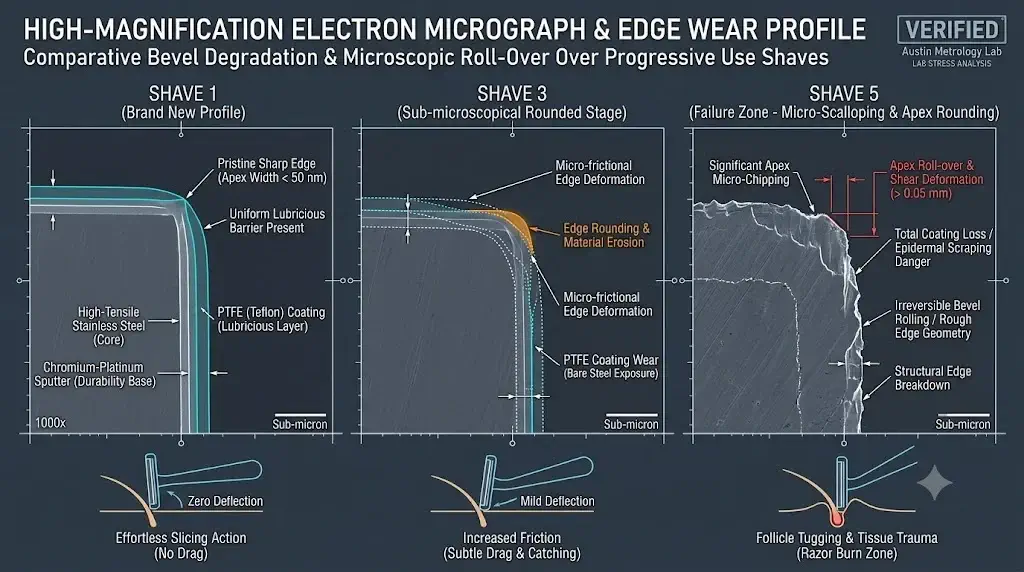
Fluoropolymer sputter coatings reduce dermal friction while cushioning razor apex contact, transforming bare steel into a comfortable shaving instrument. Raw stainless steel, no matter how finely ground, has a high coefficient of friction against moist human tissue. If used uncoated, microscopic jagged grinding teeth along the bevel would snag and tear the stratum corneum.
To eliminate this drag, manufacturers subject ground blades to high-vacuum magnetron sputtering, applying specialized micro-coatings:
The Anatomy of Edge Sputtering:
- Platinum & Chromium Layers: Hardened metalloids deposited onto the steel core to increase edge hardness, prevent premature microscopic rolling, and inhibit oxidation.
- PTFE (Polytetrafluoroethylene / Teflon): A low-friction polymer baked onto the outer bevel at elevated temperatures. PTFE creates a slick microscopic barrier that allows the blade to slide effortlessly across skin with minimal shear resistance.
- The ‘Shave 2 Phenomenon’: On brand-new blades, heavy initial PTFE deposits can slightly blunt the keenness of the edge. During the first shave pass, excess polymer sloughs off, seating the coating evenly along the apex. This is why blades like Astra Superior Platinum often test sharper and feel substantially smoother on Shave 2 than on Shave 1.
Lab Reality: ‘Smoothness’ is not the absence of sharpness; it is the presence of a uniform, durable fluoropolymer coating that minimizes skin friction drag.
For an exhaustive head-to-head laboratory breakdown evaluating how Japanese acute bevels contrast with Russian platinum sputtering, review our feather vs astra lab results.
Individual Hair Thickness and Facial Skin Elasticity Require Empirical Blade Testing
Individual hair thickness and facial skin elasticity require empirical blade testing, making a multi-brand sampler pack the single highest-value investment in wet shaving. There is no universal “best” razor blade because shaving is an interconnected mechanical system consisting of three variables: razor head geometry, hair fiber stiffness, and blade edge characteristics.
An ultra-sharp blade like Feather placed into an aggressive razor with positive blade exposure (such as an open comb) will cause severe irritation for most men. However, that same Feather blade loaded into an ultra-mild razor with negative blade exposure (such as a Henson AL13 or Rockwell 6S on Plate 1) creates a sublime, effortless shave because the razor chassis tames the blade’s keenness while the sharp edge effortlessly shears hair without tugging.
The 3-Step Empirical Sampler Protocol:
- Lock Your Razor Setting: Keep your razor hardware, shave lather, and prep routine identical throughout testing. Changing multiple variables at once makes it impossible to isolate blade performance.
- Shave 3 Times per Blade: Never judge a blade solely on Shave 1. The initial pass tests raw manufacturing sharpness; Shaves 2 and 3 test true coating lubricity and edge longevity.
- Categorize by Stubble Density: If your whiskers tug on the throat, step up in sharpness (e.g., from Derby to Astra, or Astra to Silver Blue). If you notice red weeping dots or post-shave heat, step down to a more heavily coated polymer blade.
Laboratory Bench Verdict: Curated Blade Sampler Packs for Every Skin Profile
Curated blade sampler packs eliminate guesswork by allowing shavers to systematically dial in their optimal balance of sharpness and epidermal smoothness:
Double Edge Razor Blade Variety Sampler Pack
The gold-standard assortment pack featuring all major sharpness tiers tested in our Austin metrology lab. Includes factory-sealed tucks of Feather, Astra Platinum, Gillette Silver Blue, Voskhod, Personna, and Derby. Allows users to test every major coating technology before committing to a 100-pack.
- Covers full BESS spectrum from ultra-sharp (33g) to mild (55g)
- Includes platinum, PTFE, chrome, and ceramic polymer coatings
- Factory-fresh tucks ensure consistent laboratory-grade testing results
Astra Superior Platinum Double Edge Blades (100 Count)
Our benchmark choice for daily shavers prone to neck irritation and razor bumps. Features a heavy platinum and PTFE sputter coating that delivers class-leading glide. Scores an exceptional 9.6 out of 10 for epidermal smoothness while providing a clean 44g cutting edge.
- Platinum and PTFE dual-coating cushions blade contact on Shaves 2-5
- Superb balance of cutting sharpness and stratum corneum protection
- Outstanding value delivering months of comfortable daily shaves
Need Personalized Blade & Razor Hardware Matching?
Our Austin testing facility routinely measures BESS sharpness, blade bevel angles, and coating endurance across worldwide cutlery manufacturers. Reach out to Nathan Reed and the metrology testing team for tailored advice.
Frequently Asked Questions: Razor Blade Sharpness & Samplers
How many shaves should a double-edge razor blade last?
Why do Feather blades feel harsh to beginners?
What is the difference between Platinum, Chrome, and Teflon coatings?
Should I buy a 100-pack of blades right away?
