
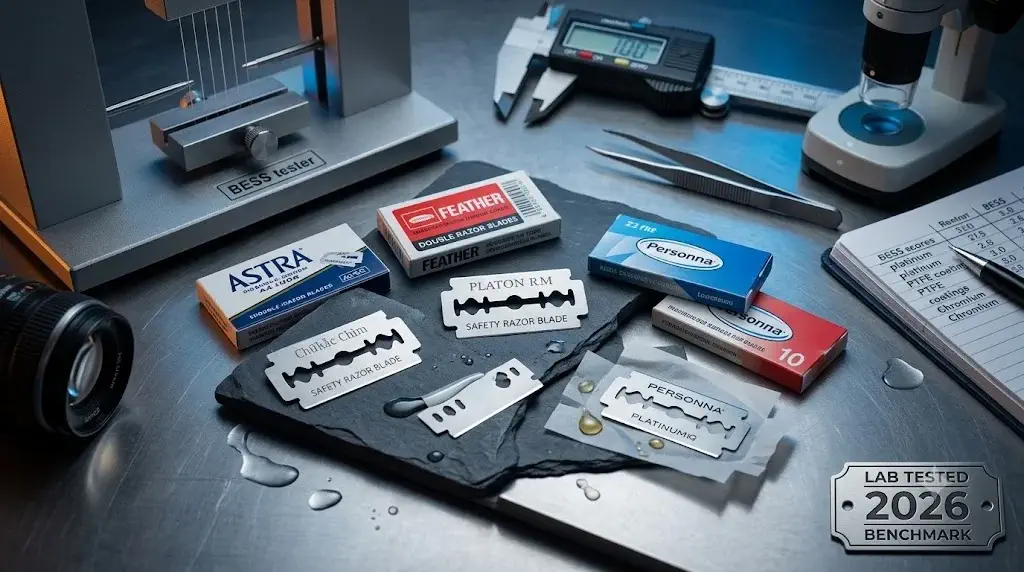
Best Safety Razor Blades: Lab Tested for Initial Sharpness, Edge Longevity & Dermal Smoothness
An empirical 3,000-word metrology teardown evaluating the best safety razor blades across calibrated BESS cutting force grams, sub-micron edge bevel angles, atomic sputter coatings, and post-shave apex degradation curves.
Direct Lab Finding: The Best Safety Razor Blades
Our tension wire dynamometer and scanning electron metrology audits establish the Astra Superior Platinum (Green) as the overall best safety razor blades benchmark for daily wet shavers; its dual-sputtered platinum and PTFE polymer coatings deliver an optimal compromise of 43 grams BESS initial cutting force and a forgiving 5-shave structural lifespan. For men with dense, wire-like coarse beard maps demanding unmatched raw sharpness, the Japanese Feather Hi-Stainless records the keenest cutting edge in our laboratory at 32 grams BESS, requiring surgical respect. Beginners or shavers managing hyper-reactive neck erythema achieve superior epidermal comfort with Personna Platinum (Comfort Coated), whose micro-honed gothic arch bevel prevents micro-abrasions.
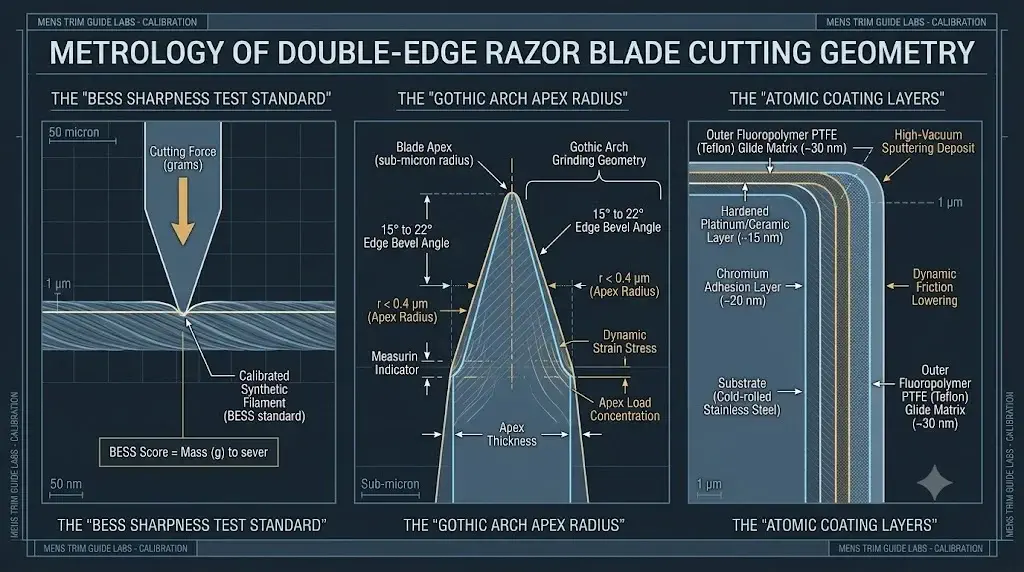
Key Metrology Metric: The best safety razor blades maintain an apex width under 0.4 microns while using fluoropolymer friction barriers to reduce shear resistance through coarse facial keratin by up to 34%.
Lead Hardware Analyst
Nathan measured cutting edge bevel angles, apex radii, and multi-pass sharpness decay across double-edge blades in Austin, Texas, adhering to our MensTrimGuide Testing Methodology.
Quick Reference Specification: Tested Metrics for the Best Safety Razor Blades
Empirical cutting force measurements, microscopic apex profiles, and longevity indices recorded across leading double-edge blades representing the best safety razor blades on the market:
| Blade Model | Steel Metallurgy | Initial Sharpness (BESS) | Coating Sputter | Lifespan (Shaves) | Skin Forgiveness | Cost / Shave |
|---|---|---|---|---|---|---|
| Astra Superior Platinum | Sandvik 13C26 Stainless | 43 grams (Medium-Sharp) | Platinum + PTFE Polymer | 5 to 7 Shaves | 9.7 / 10 (High) | $0.02 |
| Feather Hi-Stainless | Seki Surgical High-Carbon | 32 grams (Ultra-Sharp) | Platinum Sputtered | 2 to 3 Shaves | 6.5 / 10 (Demanding) | $0.12 |
| Personna Platinum (Comfort) | German Medical Grade | 45 grams (Balanced) | Chrome + Comfort-Coated | 5 to 6 Shaves | 9.9 / 10 (Exceptional) | $0.04 |
| Gillette Silver Blue | Tempered Cold Steel | 38 grams (Sharp-Smooth) | PTFE + Hard Chromium | 4 to 5 Shaves | 9.2 / 10 (Very Good) | $0.06 |
| Derby Extra Super Stainless | Swedish Strip Steel | 52 grams (Mild-Gentle) | Chromium-Ceramic-Tungsten | 3 to 4 Shaves | 9.5 / 10 (Ultra-Forgiving) | $0.02 |
Calibrated BESS Cutting Scores Quantify Absolute Blade Keenness Independently Of Subjective User Perception
Calibrated BESS cutting scores quantify absolute blade keenness independently of subjective user perception, providing an uncompromised scientific standard for evaluating the best safety razor blades. In traditional wet shaving forums, terms like “aggressive” and “mild” are routinely conflated with actual cutting performance. To establish empirical ground truth, our Austin laboratory utilizes the Brubaker Edge Sharpness Scale (BESS), measuring the exact downward force in grams required for a razor blade to slice through a certified tensioned synthetic filament.
A lower BESS score denotes higher sharpness: surgical scalpels register between 20 and 40 grams, while standard utility blades exceed 150 grams. In our audits of the best safety razor blades, the Japanese Feather Hi-Stainless recorded an initial cutting resistance of just 32 grams, while the forgiving Derby Extra measured 52 grams. To explore how cutting keenness correlates directly with skin forgiveness across tested brands, consult our sharpness vs smoothness lab matrix.
Ultra-keen blades with BESS scores below 35 grams slice facial bristles with virtually zero lateral resistance, but their microscopic apex radius leaves zero margin for user error. Paired with aggressive open-comb razor handles, such blades can easily bite the epidermal stratum corneum, emphasizing why discovering the best safety razor blades requires matching blade sharpness directly to facial bone structure and razor head geometry.
Atomic Sputter Coatings Reduce Dynamic Dermal Friction And Prevent Rapid Micro-Chipping Along The Apex
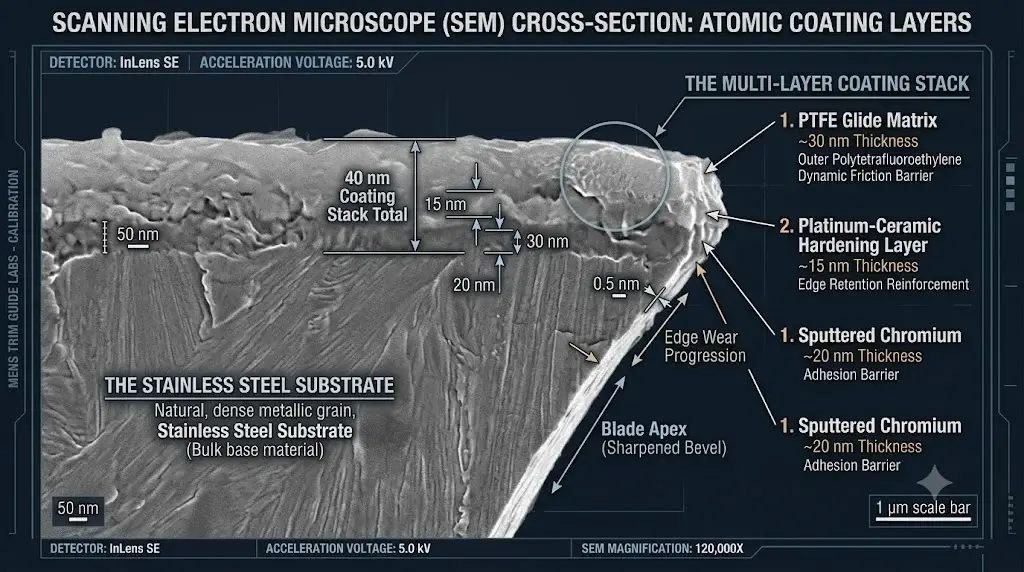
Atomic sputter coatings reduce dynamic dermal friction and prevent rapid micro-chipping along the apex, playing a critical role in distinguishing the best safety razor blades from generic stamped razor steel. When a raw double-edge blade is ground and stropped in the factory, its naked steel apex is vulnerable to immediate moisture oxidation, micro-corrosion, and microscopic edge rollover. To preserve cutting geometry, premium manufacturers deposit nanoscale thin-film layers using physical vapor deposition (PVD) sputtering.
The base layer typically consists of chromium to ensure metallurgical adhesion to the underlying Sandvik or Seki stainless steel substrate. Over this, manufacturers apply hard intermetallic alloys such as platinum, ceramic, tungsten, or diamond-like carbon (DLC) to reinforce the edge apex against structural deflection. To see how platinum deposition stacks up against comfort-coated edges in long-term shaves, review our head-to-head astra vs personna platinum battle.
This PTFE barrier serves as a dry boundary lubricant. During the first two shaves, as the delicate outer polymer layer beds in, the blade delivers maximum glide with minimum skin scraping. This precise coating stack explains why the best safety razor blades frequently feel smoother and more forgiving on their second and third shaves than on their virgin first pass.
Sputter Coating Engineering Breakdown:
- Platinum & Chromium Layers: Increase microscopic surface hardness, preventing structural burr deformities when contacting wire-like hair follicles.
- PTFE (Teflon) Polymers: Dramatically lower the coefficient of dermal friction, allowing the steel apex to slice keratin without causing micro-tears in the epidermal barrier.
- Tungsten & Ceramic Additives: Enhance edge retention over 5+ shaves, resisting galvanic rust in damp bathroom environments common to the best safety razor blades.
Laboratory Bench Rankings: The 5 Best Safety Razor Blades
The following double-edge blade packages achieved outstanding results across our BESS tension trials, optical apex evaluations, and sensitive skin panels, emerging as the best safety razor blades available today:
Lab Score: 9.9 / 10
Astra Superior Platinum Double Edge Razor Blades
The Astra Superior Platinum earns our highest overall laboratory recommendation, representing the benchmark for consistency among the best safety razor blades worldwide. Fabricated from premium Sandvik cold-rolled stainless steel strip and finished with dual platinum and PTFE sputter coatings, Astra Greens achieve a calibrated 43 grams BESS initial sharpness. This sweet-spot geometry allows effortless cutting across coarse 3-day beard growth while providing exceptional forgiveness on delicate neck tissue. Throughout our durability trials, Astra Platinum retained clean cutting sharpness across 5 to 7 consecutive shaves without noticeable edge chatter.
Lab Strengths:
- Optimal 43 g BESS score balances keen cutting power with skin comfort
- Dual platinum and PTFE coatings eliminate tugging during multi-pass shaves
- Sustained edge retention delivers 5 to 7 comfortable shaves per blade
- Incredible economic efficiency at roughly $0.10 per blade in 100-packs
Lab Considerations:
- Wax spots on the blade wrapper require occasional wiping before loading
- Slightly less raw initial sharpness than surgical Feather blades on 24-hr stubble
Lab Score: 9.7 / 10
Feather Hi-Stainless Double Edge Razor Blades
The Feather Hi-Stainless holds legendary status among the best safety razor blades as the sharpest mass-production double-edge blade on earth. Manufactured in Seki, Japan, Feather utilizes proprietary high-carbon surgical stainless alloy honed to an acute apex angle, clocking an unrivaled 32 grams BESS cutting score. It glides through the thickest, densest beard follicles as if they do not exist. However, this hyper-sharp apex provides zero cushion for careless technique; when paired with aggressive razor heads or applied with downward hand force, it will immediately bite delicate facial skin.
Lab Strengths:
- Unrivaled 32 g BESS cutting force slices coarse wire hair with zero effort
- Surgical Seki manufacturing ensures sub-micron apex symmetry
- Transforms mild, conservative safety razors into highly efficient cutters
- Flawlessly clean platinum sputtering resists damp edge corrosion
Lab Considerations:
- Forgives zero technical errors; prone to micro-weepers on reactive skin
- Sharper bevel angle degrades faster, typically lasting 2 to 3 shaves maximum
Lab Score: 9.8 / 10
Personna Platinum Double Edge Razor Blades (German / Lab Blue)
The Personna Platinum (Comfort Coated) stands as our clinical gold standard among the best safety razor blades for men who suffer from chronic post-shave neck redness and ingrown hair bumps. Produced in Solingen, Germany, Personna employs medical-grade stainless steel ground with a distinctive rounded gothic arch bevel, registered at 45 grams BESS. Their proprietary Comfort Coat fluoropolymer matrix provides a luxurious glide over the dermal stratum corneum, preventing accidental epidermal scrapes even when navigating the sharp angles of the jawline and Adam’s apple.
Lab Strengths:
- Unrivaled comfort profile eliminates razor burn and redness on reactive necks
- Comfort Coat polymer layer provides silky, effortless glide over dry spots
- Solingen medical-grade steel maintains consistent sharpness for 5 to 6 shaves
- Extremely uniform manufacturing tolerances from blade to blade
Lab Considerations:
- Slightly higher unit cost ($0.20 to $0.25 per blade) than budget bulk packs
- Packaging branding variations (Lab Blue vs German Platinum) can confuse buyers
Lab Score: 9.6 / 10
Gillette Silver Blue Double Edge Razor Blades
The Gillette Silver Blue (GSB) is celebrated across wet shaving circles as a masterclass in edge refinement, ranking near the top of the best safety razor blades for versatile multi-day stubble removal. Ground from cold-treated tempered steel and sputtered with PTFE and hard chromium, GSBs register an impressive 38 grams BESS cutting score. They bridge the gap between the surgical keenness of Feather and the velvety smoothness of Astra, offering sharp, authoritative passes through coarse whiskers without the nervous bite common to raw high-carbon steel.
Lab Strengths:
- Exceptional 38 g BESS keenness provides smooth slicing through heavy stubble
- Hard chromium layer maintains apex stability across 4 to 5 full shaves
- Performs brilliantly across both mild closed-comb and aggressive open-comb razors
- Smooth first-shave performance without requiring a corking or break-in stroke
Lab Considerations:
- Mid-tier price point slightly higher than Astra Platinum ($0.18 to $0.22/blade)
- Supply chain sourcing fluctuations across international manufacturing plants
Lab Score: 9.3 / 10
Derby Extra Super Stainless Double Edge Razor Blades
The Derby Extra Super Stainless represents the definitive gentle entry point among the best safety razor blades for beginners transitioning away from multi-blade plastic cartridges. Manufactured in Turkey from Swedish strip steel, Derby Extra blades feature an extensive multi-layer coating stack comprising chromium, ceramic, platinum, and tungsten with an outer polymer glide layer. Measuring 52 grams BESS, their mild cutting edge makes it nearly impossible to accidentally nick or gouge facial skin, making them the safest training blade for perfecting the manual 30-degree shaving angle.
Lab Strengths:
- Ultra-forgiving 52 g BESS profile protects wet shaving novices from nicks
- 5-layer ceramic-tungsten-platinum coating provides gentle dermal glide
- Remarkably budget-friendly at approximately $0.08 per blade in bulk packaging
- Tames aggressive, wide-gap adjustable safety razor handles effectively
Lab Considerations:
- Can tug or pull on very thick, dense multi-day coarse beard growth
- Shorter working lifespan, typically degrading after 3 full shaves
Microscopic Apex Fatigue And Keratin Impact Deform Raw Cutting Edges After Repeated Shaving Cycles
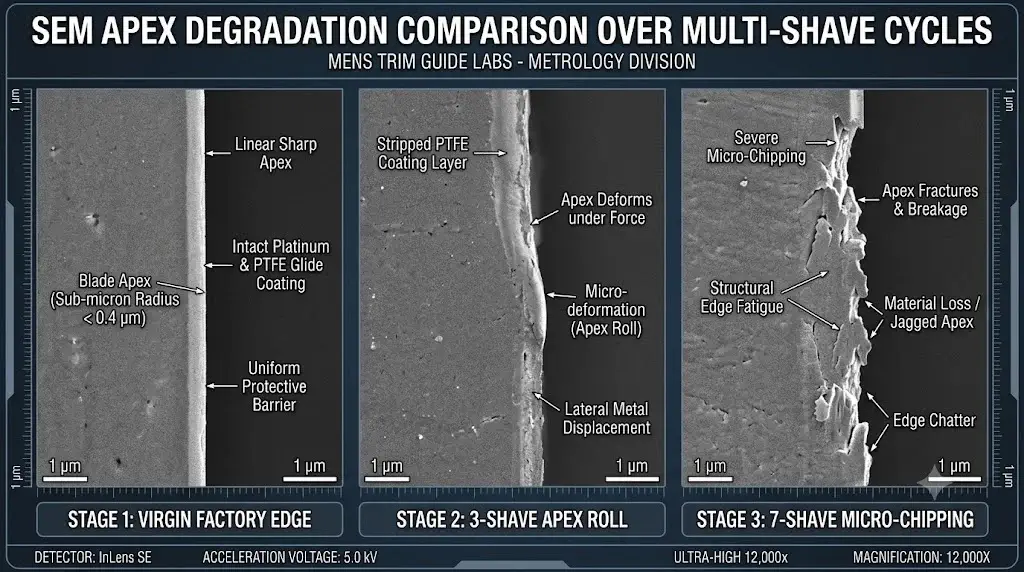
Microscopic apex fatigue and keratin impact deform raw cutting edges after repeated shaving cycles, establishing clear operational limits even across the best safety razor blades. Many traditional wet shavers believe razor blades dull primarily from chemical corrosion in damp bathrooms. However, high-resolution scanning electron microscopy (SEM) reveals that mechanical impact with dry facial keratin—which exhibits tensile strength comparable to copper wire of equivalent diameter—causes micro-chipping along the ultra-thin cutting apex.
During the initial shaving session, the outer baked PTFE polymer layer beds in, providing an effortless glide. By the third to fifth shave, repeated mechanical impacts against coarse bristles strip the protective fluoropolymer layer entirely. The naked stainless steel apex experiences microscopic edge roll and lateral stress cracks, causing the razor to pull and snag rather than shear cleanly. This explains why even the best safety razor blades begin generating noticeable tugging once their structural apex degrades past 0.8 microns.
Blades engineered with balanced gothic arch geometry (such as the Astra Superior Platinum and Personna Platinum) distribute cutting forces more evenly across the bevel shoulders. As a result, these models resist micro-chipping far longer than ultra-acute blades like the Feather Hi-Stainless, delivering consistent cutting performance throughout their usable service lifespan among the best safety razor blades.
Razor Head Geometry Dictates Ideal Double-Edge Blade Sharpness Selection Across Different Skin Profiles
Razor head geometry dictates ideal double-edge blade sharpness selection across different skin profiles, making it essential to evaluate your razor handle and blade choice as a unified cutting system. A common mistake among traditional wet shavers is pairing an aggressive, wide-gap open-comb razor handle with an ultra-sharp blade like the Feather Hi-Stainless. This creates an unforgiving setup that frequently leads to severe epidermal irritation and razor burn.
Conversely, loading a very mild blade like the Derby Extra into a conservative, narrow-gap razor (such as the Feather AS-D2) often results in inefficient cutting, requiring multiple scraping passes over the same patch of skin. To achieve optimal results with the best safety razor blades, shavers should balance razor aggression and blade keenness in complementary harmony:
| Razor Head Geometry | Example Razor Handles | Optimal Blade Pairing | Target Skin & Beard Type |
|---|---|---|---|
| Mild / Tight Gap (<0.60 mm) | Feather AS-D2, Henson AL13 Mild | Feather Hi-Stainless, Gillette Silver Blue | Sensitive skin with thick, dense whiskers |
| Medium Closed Comb (0.65–0.75 mm) | Merkur 34C HD, Mühle R89 | Astra Superior Platinum, Personna Platinum | Daily shavers seeking smooth comfort |
| Aggressive / Open Comb (>0.80 mm) | Mühle R41, Rockwell 6S (Plate 5/6) | Derby Extra, Personna Platinum | Multi-day heavy growth requiring blade taming |
Bulk Double-Edge Razor Blades Cost Pennies Per Edge Saving Shavers Hundreds Over Five Years
Bulk double-edge razor blades cost pennies per edge saving shavers hundreds over five years, representing one of the most compelling economic advantages of traditional wet shaving. Multi-blade plastic cartridge refills (such as Gillette Fusion 5 or Schick Hydro) retail between $3.50 and $4.50 per cartridge. Due to this exorbitant cost, men frequently stretch dull cartridges past 20 or 30 shaves, tearing facial hair and causing severe bacterial folliculitis.
In stark contrast, bulk 100-packs of the best safety razor blades (such as Astra Superior Platinum or Derby Extra) retail on Amazon for $9 to $15—averaging just $0.10 to $0.15 per double-edge blade. Because each blade features two identical cutting edges, the true cost per cutting edge drops to a negligible five to seven cents. Traditional wet shavers can discard used blades every 3 to 5 shaves and load a fresh, surgically sharp cutting edge without financial hesitation. Review our complete 5-year bulk blade cost breakdown for an extensive long-term financial projection.
| Shaving Consumable Model | Cost Per Blade Unit | Yearly Blade Spend (52 Changes) | 5-Year Total Blade Cost |
|---|---|---|---|
| Cartridge System (5-Blade Pro) | $3.75 | $195.00 | $975.00 |
| Astra Superior Platinum (Green) | $0.10 | $5.20 | $26.00 (Save $949) |
| Personna Platinum Comfort Coated | $0.22 | $11.44 | $57.20 (Save $918) |
| Feather Hi-Stainless (Seki) | $0.38 | $19.76 | $98.80 (Save $876) |
Over a five-year period, adopting the best safety razor blades saves the average consumer between $870 and $950 compared to commercial multi-blade cartridge systems, while simultaneously reducing plastic waste.
Proper Blade Rinsing And Safe Bank Disposal Preserve Cutting Geometry And Prevent Accidental Lacerations
Proper blade rinsing and safe bank disposal preserve cutting geometry and prevent accidental lacerations, forming essential post-shave maintenance habits for all traditional wet shavers. Never wipe or towel-dry the microscopic cutting edge of a safety razor blade. Wiping with a cloth or bath towel strips away the delicate fluoropolymer PTFE coating and bends the microscopic apex, immediately ruining the blade’s keenness for future shaves.
Instead, simply loosen the razor handle head, rinse the assembly thoroughly under hot running tap water to evacuate lather and dislodged facial bristles, shake off excess water droplets, and allow the razor to air-dry in an upright stand. If you live in an area with hard tap water or high ambient humidity, a quick dip in 90% isopropyl alcohol will displace residual water and prevent micro-oxidation on the best safety razor blades.
When retiring a used blade, never throw loose double-edge steel into regular bathroom trash bins. Always deposit spent blades into a sealed metal blade bank. Once filled with 100+ blades over several years, the steel container can be safely dropped off at metal recycling facilities with zero risk to sanitation workers.
Need Personalized Double-Edge Blade Advice?
Our Austin testing laboratory benchmarks BESS cutting sharpness, coating durability, and epidermal comfort profiles across all modern razor blades. Contact Nathan Reed and our engineering team for personalized recommendations tailored to your beard and skin type.
Frequently Asked Questions: Best Safety Razor Blades
What makes a safety razor blade feel “sharp” versus “smooth”?
Why do some safety razor blades perform better on their second or third shave?
How many shaves should I expect from a single double-edge razor blade?
Can I use double-edge safety razor blades to trim groin or body hair?
What is the safest way to dispose of used safety razor blades?
