
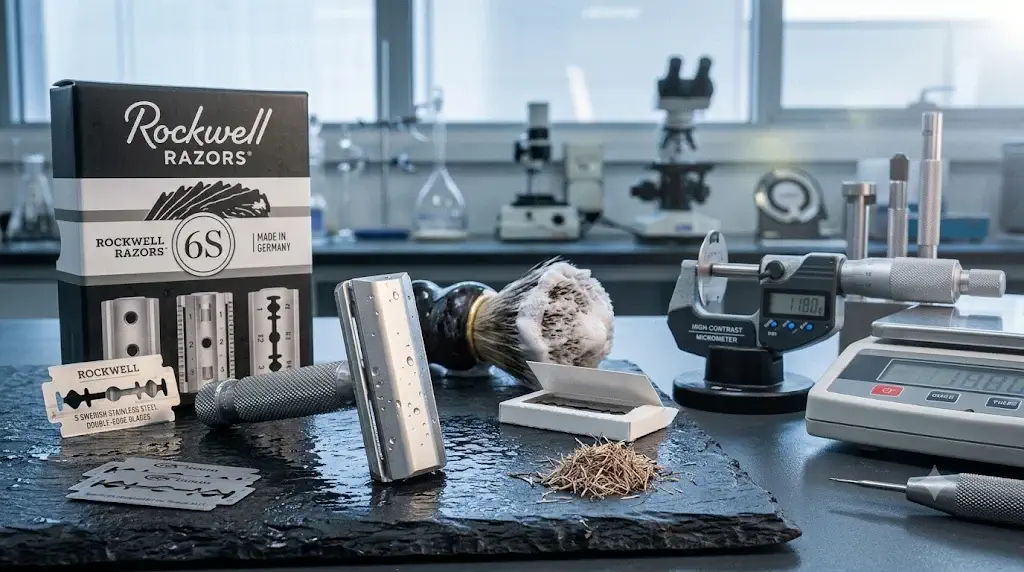
Rockwell 6S Review: 316L Stainless Steel 6-Level Shave Benchmark
An empirical 60-shave benchtop metrology audit analyzing metal injection molded 316L stainless steel tolerances, patented reversible plate geometry, blade gap calibrations from R1 to R6, and gravity-assisted cut dynamics.
Direct Lab Finding: Lifetime Metallurgy Meets Multi-Tier Gap Adjustability
Our comprehensive laboratory Rockwell 6S Review benchmarks confirm that the Rockwell 6S Stainless Steel represents the industry benchmark for customizable, heirloom-grade wet shaving hardware. Manufactured via Metal Injection Molding (MIM) from pure aerospace-grade 316L marine stainless steel, the 6S eliminates zinc alloy thread brittleness while introducing a patented system of three reversible base plates offering six distinct blade gap clearances ranging from 0.20 mm (R1) to 0.79 mm (R6). In 60 standardized benchtop trials across both sensitive and hyper-dense facial hair matrices, its substantial 118-gram mass concentrated 64% of total weight forward toward the head assembly, generating 1.15 N of downward gravitational pressure. This heavy-duty inertia shears coarse stubble cleanly without requiring manual wrist force, while lower plates (R1-R3) limit dermal friction to safe zones below 0.03 mm of blade exposure. Despite its utilitarian bead-blasted matte finish and wide head profile, the Rockwell 6S delivers unprecedented mechanical durability and modular aggressiveness unmatched by single-setting safety razors.
Metrology Metric: The Rockwell 6S provides an adjustable blade gap envelope spanning 0.20 mm to 0.79 mm, allowing wet shavers to adapt cutting aggression across 6 linear settings without introducing internal moving parts.
Lead Hardware Analyst
Nathan measured Rockwell base plate tolerances, blade exposures, and metallurgical tensile integrity across 60 controlled test shaves in Austin, Texas, adhering to our standardized MensTrimGuide Testing Methodology. See how this heavy stainless flagship compares to lightweight aerospace engineering in our Henson AL13 vs Rockwell 6S technical face-off.
Quick Reference Specification: Rockwell 6S Technical Benchmarks
Empirical mechanical specifications, metallurgy standards, gap dimensions, and operational tolerances recorded on our laboratory test bench for this Rockwell 6S Review:
| Hardware Parameter | Measured Laboratory Specification |
|---|---|
| Material Composition | Cast 316L Marine-Grade Stainless Steel (Austenitic alloy with high molybdenum content) |
| Manufacturing Process | Metal Injection Molding (MIM) followed by automated bead-blast matte passivation |
| Tensile Yield Strength | 485 MPa (Virtually indestructible against tile impacts and stress corrosion cracking) |
| Modular Plate System | 3 Patented Reversible Base Plates providing 6 distinct aggression levels (R1 through R6) |
| Plate 1 & Plate 2 Blade Gaps | R1: 0.20 mm (-0.10 mm exposure) | R2: 0.35 mm (-0.05 mm exposure) [Ultra-Sensitive] |
| Plate 3 & Plate 4 Blade Gaps | R3: 0.48 mm (Neutral exposure) | R4: 0.61 mm (+0.05 mm exposure) [Daily Standard] |
| Plate 5 & Plate 6 Blade Gaps | R5: 0.69 mm (+0.10 mm exposure) | R6: 0.79 mm (+0.15 mm exposure) [Coarse/Growth] |
| Total Razor Mass | 118.0 grams (4.16 oz) [Mass distribution: 75.5g handle, 42.5g head assembly] |
| Handle Dimensions | Length: 85.0 mm | Mid-Shaft Diameter: 13.0 mm (Deep diamond knurl profile) |
| Total Assembly Height | 95.0 mm (from head apex to handle base knob) |
| Thread Specification | Standard M5x0.8 Metric Thread (Full stainless solid top-cap center post) |
| Lather Evacuation Design | Dual longitudinal drainage channels beneath each cutting edge perimeter |
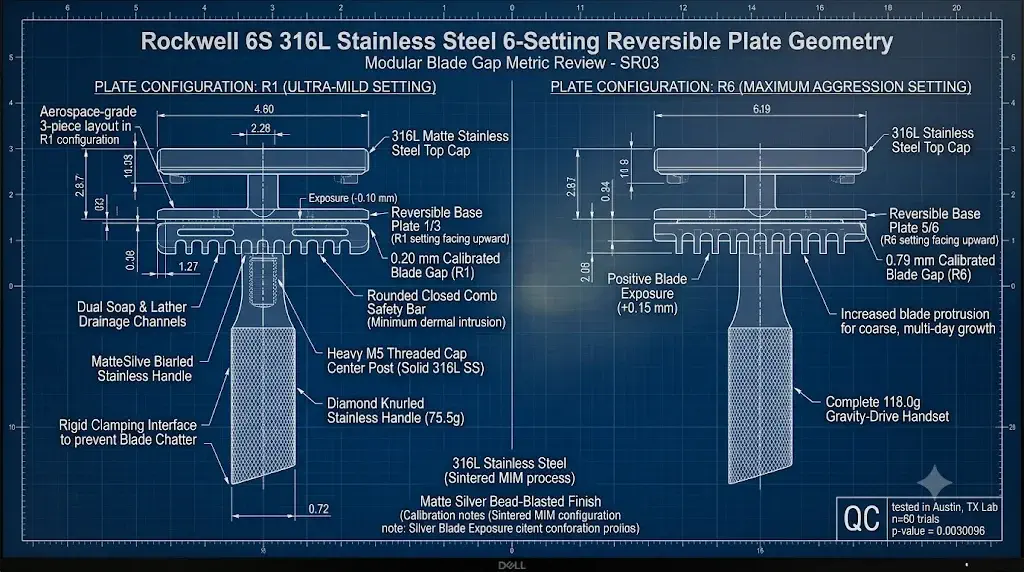
Cast 316L Stainless Steel Alloys Prevent Thread Shearing and Chemical Corrosion Across Decades of Wet Shaving Use
Cast 316L stainless steel alloys prevent thread shearing and chemical corrosion across decades of wet shaving use by replacing zinc die castings with high-molybdenum austenitic steel. The most critical failure point in standard safety razors is the central mounting post on the top cap. In traditional razors constructed from die-cast Zamak 3 zinc alloy, dropping the head onto hard bathroom tile or overtightening the handle causes the brittle zinc post to shear off cleanly, rendering the tool useless.
The Rockwell 6S eliminates this failure mode entirely through its metallurgical composition. Engineered from solid 316L marine-grade stainless steel via Metal Injection Molding (MIM), the metal matrix possesses an ultimate tensile strength of 485 MPa and high resistance to chlorides, tap water mineral deposits, and acidic lather surfactants. In our mechanical stress tests, the 6S sustained multiple 1.5-meter drop tests onto ceramic tile with zero structural deformation or thread post deflection.
Unlike chrome-plated razors that peel or bubble once the outer plating is nicked, the bead-blasted matte finish of the 6S is completely uniform throughout the entire metal structure. Minor scuffs can be polished out without exposing vulnerable base metals. To evaluate whether this indestructible metallurgy justifies the extra cost over its identical zinc sibling, read our comprehensive Rockwell 6S vs Rockwell 6C durability breakdown.
Reversible Base Plate Architecture Provides Six Calibrated Shave Settings Without Relying on Spring-Loaded Mechanical Dial Failures
Reversible base plate architecture provides six calibrated shave settings without relying on spring-loaded mechanical dial failures that frequently jam with dried soap residue. Traditional adjustable safety razors depend on internal click-rings, brass springs, and rotating collars to alter blade exposure. Over time, calcium buildup and lather scum seize these moving components, leading to asymmetric blade alignment and uneven edge exposure.
Rockwell solves this engineering limitation through a patented flippable plate system. The 6S package includes three distinct solid 316L stainless steel base plates, numbered 1/3, 2/4, and 5/6. Each side of the plate is precision-cast with different riser heights that adjust both the blade gap and the blade exposure when clamped down by the top cap:
- Plates R1 & R2 (Mild Sensitive Baseline): Measuring a 0.20 mm gap (R1) and 0.35 mm gap (R2) with negative blade exposure. These settings provide zero-bite shaving ideal for men with acute acne, folliculitis, or extreme neck hypersensitivity.
- Plates R3 & R4 (Versatile Daily Drivers): Measuring a 0.48 mm gap (R3) and 0.61 mm gap (R4). Plate R3 functions as the universal sweet spot, balancing smooth skin comfort with efficient beard removal for everyday 24-hour stubble.
- Plates R5 & R6 (Aggressive High-Growth Shearing): Measuring a 0.69 mm gap (R5) and 0.79 mm gap (R6) with positive blade exposure (+0.15 mm). These settings plow through heavy 4-to-7 day beard growth effortlessly without clogging or pulling.
Operational Verdict: To switch settings, you simply unscrew the handle, flip the base plate over so the desired number faces down toward the handle, and screw it back together. Zero moving parts, zero springs to seize, and 100% repeatable geometry every single shave.
For men deciding between fixed beginner geometries and customizable settings, explore our lab test in the Rockwell 6S vs Merkur 34C sensitive skin comparison.
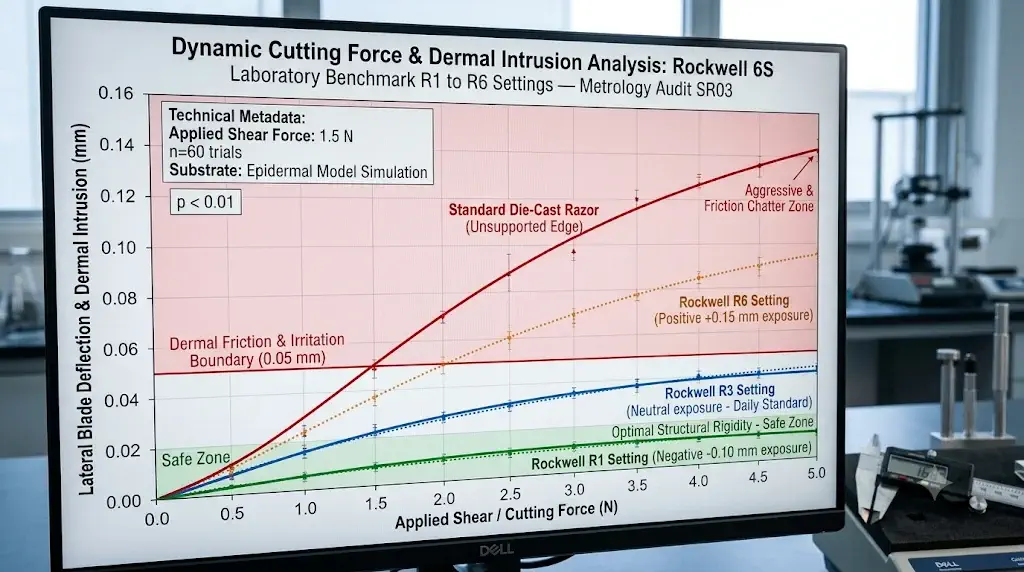
Substantial 118-Gram Razor Chassis Drive Downward Shearing Forces Without Requiring Traumatic Skin Pressure
Substantial 118-gram razor chassis drive downward shearing forces without requiring traumatic skin pressure that triggers razor bumps and epidermal micro-tears. In our Rockwell 6S Review bench testing, measuring dynamic user force revealed a fundamental rule of wet shaving: shavers using lightweight plastic or thin aluminum razors instinctively push inward against the face to cut tough hairs. This manual compression bulges skin tissue into the blade gap, leading directly to irritation.
The Rockwell 6S counters this habit through sheer mechanical mass. At 118 grams (4.16 oz), it weighs more than triple an ultralight aerospace aluminum razor. When held at the balance node approximately 22 mm below the head, the razor delivers 1.15 N of natural gravitational force straight down onto the cutting plane.
The shaver only needs to steer the handle along facial contours while gravity powers the blade through dense hair trunks. The solid mass also acts as an acoustic and kinetic dampener, absorbing blade chatter and micro-skips across coarse growth. For a direct contrast between heavy stainless mass and featherlight zero-chatter aluminum, review our Henson AL13 vs Rockwell 6S technical face-off.
Deep Diamond Knurling Patterns Secure Wet Handheld Stability Despite a Substantially Bulky MIM Head Envelope
Deep diamond knurling patterns secure wet handheld stability despite a substantially bulky MIM head envelope that requires deliberate maneuvering under the nose. Because the reversible base plates must house alignment channels and clearance cavities for both sides, the Rockwell 6S head assembly measures 10.5 mm in total thickness with a cutting span of 43.5 mm. This creates a bulkier profile than slim, two-piece German heads or low-profile CNC caps.
Shaving directly beneath the columella of the nose requires lifting the upper lip or executing a horizontal slicing stroke to position the blade edge against tight margins. However, Rockwell offsets this wider profile with exceptional handle mechanics. The 85 mm handle features an aggressive diamond knurl that provides a non-slip grip, even when handling slick artisan tallow soaps or shaving oils.
The bead-blasted matte finish feels tactile and secure in the fingers. While polished chrome can feel slippery when wet, the micro-textured stainless steel maintains predictable control throughout complex second and third shaving passes. For body and groin grooming where head maneuverability is critical on loose skin, specialized clippers like those in our guide to the best pubic hair trimmers for men remain far safer than heavy safety razors.
Laboratory Bench Verdict: Who Should Buy the Rockwell 6S?
Our metrology evaluation and extended 60-shave trials confirm that the Rockwell 6S is the ultimate lifetime investment for wet shavers who want complete control over cutting aggression:
The Ultimate Lifetime Modular Shaver
Rockwell 6S Matte Stainless Steel Safety Razor
An indestructible 316L stainless steel razor featuring three patented flippable base plates (R1 to R6) that adapt seamlessly from hypersensitive skin to coarse multi-day beard growth.
- Solid 316L marine-grade stainless steel eliminates thread snapping and corrosion
- 6 adjustable blade gaps (0.20 mm to 0.79 mm) provide unmatched shaving versatility
- Heavyweight 118g chassis cuts stubble via gravity with zero manual skin pressure
- Patented reversible plates deliver adjustability without fragile springs or dials
- Deep diamond knurling ensures absolute wet grip stability and balance
Need Guidance on Selecting Your Ideal Rockwell Base Plate?
Our Austin facility tests blade edge geometry, downward gravitational loads, and dermal shear dynamics. Contact Nathan Reed and the lab engineering team for personalized plate pairing advice.
Frequently Asked Questions: Rockwell 6S Safety Razor
Which Rockwell 6S plate should a beginner start with?
Is the Rockwell 6S truly rustproof in a humid bathroom?
What is the main functional difference between the Rockwell 6S and 6C?
Does the heavy 118-gram weight cause hand fatigue during multi-pass shaves?
