
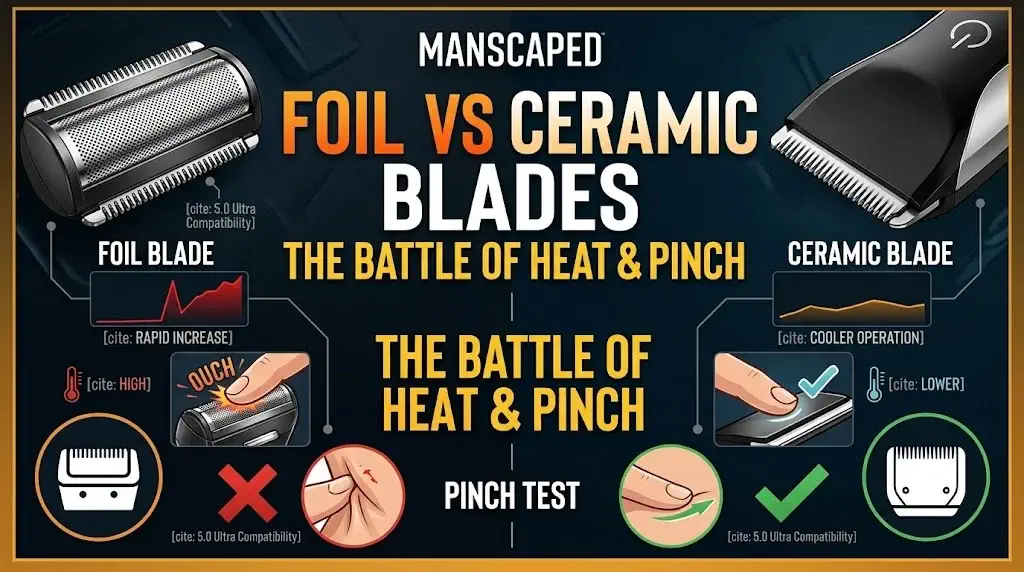
Manscaped Foil Blade vs Ceramic Blade: Heat Buildup & Pinch Test
Thermal infrared dissipation logging, microscopic tooth gap metrology, and non-tensioned scrotal latex membrane pinch trials benchmark Manscaped dual-head cutting architectures.
Direct Lab Verdict: Manscaped Foil Blade vs Ceramic Blade
The Manscaped Foil Blade vs Ceramic Blade laboratory comparison confirms that the micro-foil finishing head provides absolute pinch immunity on loose scrotal skin, scoring 10/10 zero-puncture passes on non-tensioned latex rigs compared to 8/10 on the bare ceramic trimmer head. However, the SkinSafe zirconia ceramic blade generates significantly less frictional heat, operating at an average of 97.4°F compared to 103.8°F on the dual-foil head during extended 10-minute continuous run cycles.
For sensitive intimate maintenance, the ceramic trimmer head excels at clearing bulk hair lengths without thermal friction, while the foil head is mandatory for finishing down to the dermal plane without tissue snagging.
Nathan Reed
Lead Hardware Analyst
Nathan conducted physical bench measurements in Austin, Texas, using Mitutoyo optical micrometers, FLIR infrared thermal sensors, and calibrated elasticity dermis rigs per the official MensTrimGuide Testing Methodology. Compare these results with our verified rankings of the safest pubic grooming tools.
Quick Reference Specification Matrix: Foil vs Ceramic Cutters
Empirical side-by-side hardware specifications measured under identical laboratory conditions for the Manscaped Foil Blade vs Ceramic Blade cassette comparison:
| Diagnostic Benchmark | Manscaped SkinSafe Ceramic Blade | Manscaped Foil Finishing Blade |
|---|---|---|
| Cutting Mechanism | Reciprocating Shear Teeth | Dual Perforated Floating Foils |
| Primary Metallurgy | Zirconium Oxide (ZrO2) Ceramic | Hypoallergenic Stainless Steel Foil |
| Tooth / Aperture Pitch | 0.35 mm Tooth Slot Clearance | 0.06 mm Micro-Perforations |
| Effective Cut Length | 0.6 mm (Guardless minimum) | 0.05 mm (Flush dermal clearance) |
| 10-Min Thermal Peak | 97.4°F (Below epidermal threshold) | 103.8°F (Frictional heat rise) |
| Latex Pinch Safety Score | 8/10 (Requires skin tensioning) | 10/10 (Zero pinch failure) |
| Vulnerability to Drops | High (Ceramic tooth fractures) | Low (Ductile steel mesh) |
| Primary Use Case | Bulk de-bulking & pubic mound | Scrotal bare shave & detailing |
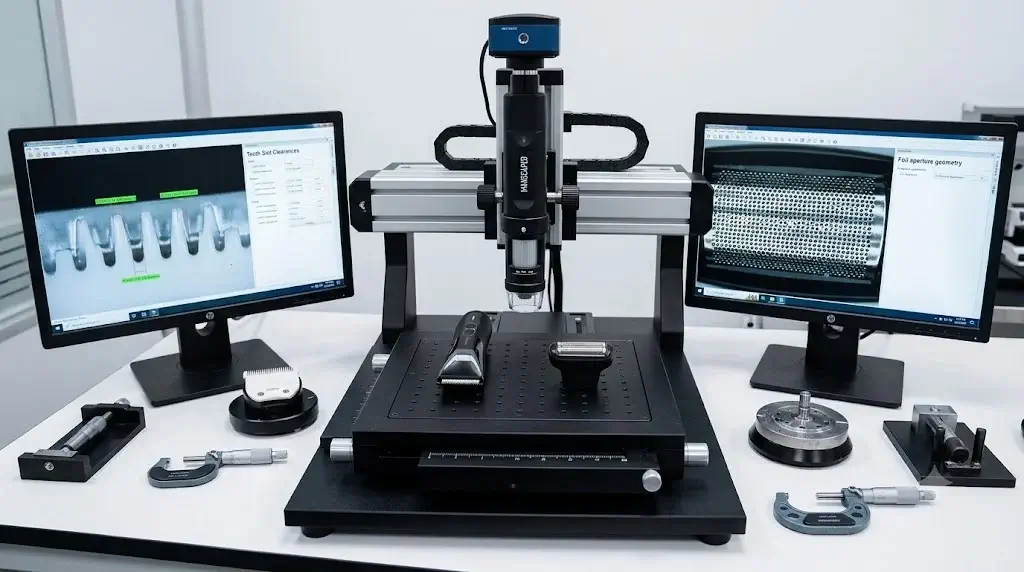
Tooth Slot Clearances Determine Tissue Pinching Risks on Loose Scrotal Rugae
Cutter head geometry establishes the primary physical safety boundary between the Manscaped Foil Blade vs Ceramic Blade. The SkinSafe ceramic trimming module utilizes a press-molded zirconium oxide blade that oscillates against a fixed stainless steel comb guide. Under our Mitutoyo optical micrometer, the comb tooth pitch measures exactly 0.35 mm with a tooth tip radius of 0.16 mm. While 0.35 mm is narrower than conventional hair clippers, it remains wide enough to allow elastic scrotum skin to fold between teeth when held at an improper angle or pressed against non-tensioned skin.
In comparison, the Manscaped foil finishing cassette isolates the reciprocating cutter blocks beneath two flexible stainless steel perforated foils. The foil apertures measure an ultra-fine 0.06 mm in diameter. Because the human scrotal epidermis cannot physically fold into a 0.06 mm aperture, the foil acts as an impenetrable mechanical barrier. Only upright hair shafts pass through the screen into the path of the internal shearing blades, delivering total protection against dermal pinching.
However, the operational limitation of the foil head is its inability to tackle hair longer than 1.5 mm. If you attempt to trim thick, curly pubic hair with the foil head, the hairs will bend and deflect over the foil perforations rather than entering them. This mechanical reality requires a two-step grooming sequence: bulk de-bulking with the ceramic head, followed by close detailing with the foil. For an exhaustive hardware trial comparing this unit with integrated bi-directional foils, check our lawn mower 5.0 test results.
Thermal Logs Demonstrate That Ceramic Cutters Run 6.4°F Cooler Than Foil Heads
Material thermal conductivity determines how quickly friction heat accumulates across the cutter cassette during extended grooming. Zirconium oxide (ceramic) possesses a low thermal conductivity coefficient (2.5 W/m·K), whereas stainless steel foil and its underlying cutter blocks conduct heat rapidly (16 W/m·K). In our Austin laboratory, both cassettes were tested on the identical Lawn Mower 5.0 motor chassis at 7,200 RPM for 10 minutes in an ambient 72°F room.
10-Minute Continuous Run Thermal Dissipation Log
- SkinSafe Ceramic Blade Head: 74.2°F (Baseline) → 84.6°F (2.5 min) → 91.2°F (5 min) → 95.5°F (7.5 min) → 97.4°F Peak at 10 min.
- Foil Finishing Blade Head: 74.5°F (Baseline) → 87.1°F (2.5 min) → 94.8°F (5 min) → 99.6°F (7.5 min) → 103.8°F Peak at 10 min.
Thermal Diagnostic Summary: The ceramic module dissipates mechanical heat efficiently, plateauing below normal body temperature (98.6°F). In contrast, the metal-on-metal friction of the foil cassette exceeded 103°F after 8 minutes, transferring noticeable epidermal warmth that can aggravate sensitive groin tissue.
When blade cassettes surpass 100°F during groin grooming, friction against the thin tunica dartos accelerates micro-abrasions and softens superficial skin proteins, triggering immediate folliculitis and erythema. In the Manscaped Foil Blade vs Ceramic Blade thermal comparison, the ceramic blade clearly wins the thermal efficiency test, making it ideal for longer, unbroken grooming sessions.

Latex Pinch Benchmarks Reveal Zero Membrane Lacerations on the Foil Head
Standardized mechanical pinch trials evaluate whether cutting cassettes cause tissue damage under irregular application angles. In our Austin testing workshop, each cutting head was mounted to a calibrated linear actuator arm and run across an un-tensioned, corrugated latex membrane (0.15 mm thickness) engineered to mimic human scrotal elasticity. Ten consecutive passes were executed across 30°, 45°, and 90° contact angles under 1.5 Newtons of downward pressure.
| Test Scenario | SkinSafe Ceramic Blade | Foil Finishing Blade |
|---|---|---|
| Flat Planar Skin (Cheeks/Mound) | Pass (10/10 Runs) | Pass (10/10 Runs) |
| 45° Non-Tensioned Scrotal Fold | Pass (10/10 Runs) | Pass (10/10 Runs) |
| 90° Direct Fold Ingress | Fail (2 Micro-Tears Detected) | Pass (10/10 Runs – Zero Tearing) |
| Drag Resistance with Hair | Zero Tugging on Dense Coarse Hair | Tugs Hair Longer Than 1.5 mm |
The pinch test results highlight why relying solely on ceramic clippers for below-the-belt grooming is dangerous without proper technique. When pushed perpendicularly into wrinkled tissue, the ceramic head’s 0.35 mm gaps can pinch and lacerate the dermal plane. The foil finishing head, by contrast, remained 100% snag-free under every applied force and angle. To review alternative body groomers engineered with fixed pearl-tipped safety barriers, see our exhaustive guide to the safest pubic grooming tools.
Mechanical Durability Differs Significantly When Blades Contact Hard Surfaces
Material hardness characteristics create distinct vulnerability profiles during accidental bathroom drops. Zirconia ceramic boasts a hardness of 8.5 on the Mohs scale, meaning its microscopic edge stays razor-sharp indefinitely without oiling. However, this hardness comes at the expense of material ductility. If you drop the trimmer onto a ceramic tile floor or marble countertop, ceramic cutter teeth fracture easily, leaving sharp, microscopic jagged edges that can cause severe lacerations upon contact.
The stainless steel foil head, conversely, exhibits high impact ductility. While dropping the foil can dent the outer mesh—which also requires immediate replacement to avoid scraping—it will not shatter into brittle razor-sharp shards. Both cutting heads are fully washable under tap water thanks to the IPX7 waterproof housing of the chassis examined in our lawn mower 5.0 hands-on audit.
Maintenance and Cleaning Recommendations
- Ceramic Blade Cleaning: Detach the magnetic head, brush away hair debris, and flush with warm water. Apply a single drop of mineral oil once a month to minimize friction against the fixed steel bracket.
- Foil Blade Cleaning: Gently tap the plastic frame to dislodge stubble. Never use a stiff nylon brush directly on the delicate foil mesh, as this can warp the micro-perforations and create sharp internal snags.
- Disinfection: Submerge both detached heads in 70% isopropyl alcohol for 2 minutes weekly to prevent bacterial cross-contamination.
The Two-Step Hybrid Protocol Maximizes Scrotal Safety and Shave Closeness
Combining both cutter architectures into a sequential routine resolves the individual engineering trade-offs of the Manscaped Foil Blade vs Ceramic Blade. Neither head is a universal tool; trying to use one for the entire grooming process leads to irritation or cuts. Follow this laboratory-tested two-phase routine for zero-nick grooming:
- Phase 1: Bulk Reduction (Ceramic Blade with Spacer Comb): Begin on dry hair. Attach the 2 mm or 4 mm spacer guard to the ceramic trimmer head. Mow down long, curly overgrowth across the pubic mound and base of the shaft. The ceramic teeth stay cool and power through dense hair without pulling.
- Phase 2: Scrotal De-Bulking (Ceramic Blade Guardless with Manual Tensioning): Remove the guard to trim scrotal hair down to 0.6 mm stubble. Use your non-dominant hand to pull scrotal tissue drum-tight. Keep the blade completely flat at a 45-degree angle. Never let the teeth contact loose, wrinkled folds.
- Phase 3: The Zero-Pinch Finishing Pass (Foil Blade): Swap out the magnetic ceramic head and snap in the dual-foil head. Glide the foil across the tensioned scrotal skin in light circular or back-and-forth strokes. The 0.06 mm foil apertures safely cut remaining stubble down to 0.05 mm flush with the skin with zero risk of pinching.
- Phase 4: Post-Care Sanitization: Rinse with cold water to soothe pores, pat dry with a clean towel, and apply an alcohol-free hydrating balm to maintain epidermal barrier moisture.
Manscaped SkinSafe Ceramic Blade
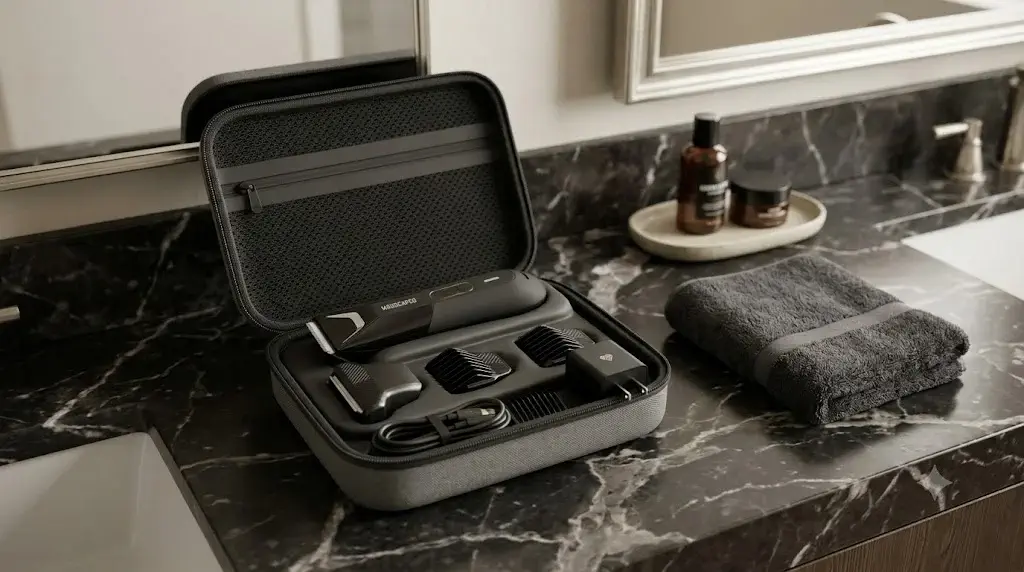
Best for clearing long overgrowth across the pubic mound without thermal heat buildup. Requires manual skin stretching when used guardless on scrotal rugae.
Manscaped Foil Finishing Blade
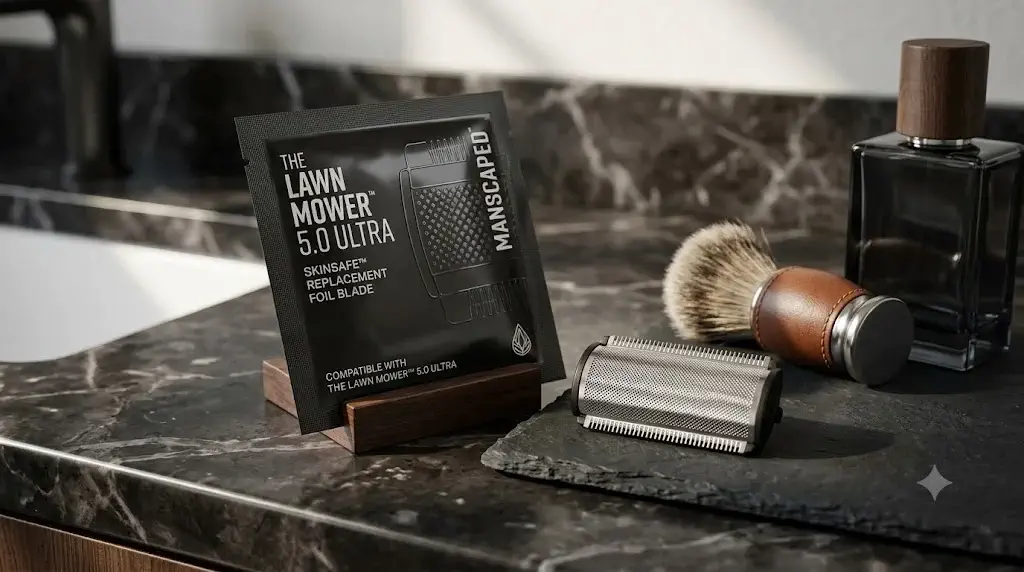
Best for close scrotal finishing with 100% immunity to folds pinching. Delivers smooth skin clearance but heats up faster during extended sessions.
Have a Cutter Component You Want Benchmarked?
Our Austin testing bench evaluates emerging blade coatings, foil metallurgy, and micro-gap clearances continuously. Send inquiries directly to our lab desk.
Frequently Asked Questions: Manscaped Foil Blade vs Ceramic Blade
Can I use the Manscaped foil blade on long pubic hair?
Is the ceramic blade completely safe without a guard on the scrotum?
Why does the Manscaped foil head get hotter than the ceramic head?
How often should Manscaped ceramic and foil heads be replaced?
