
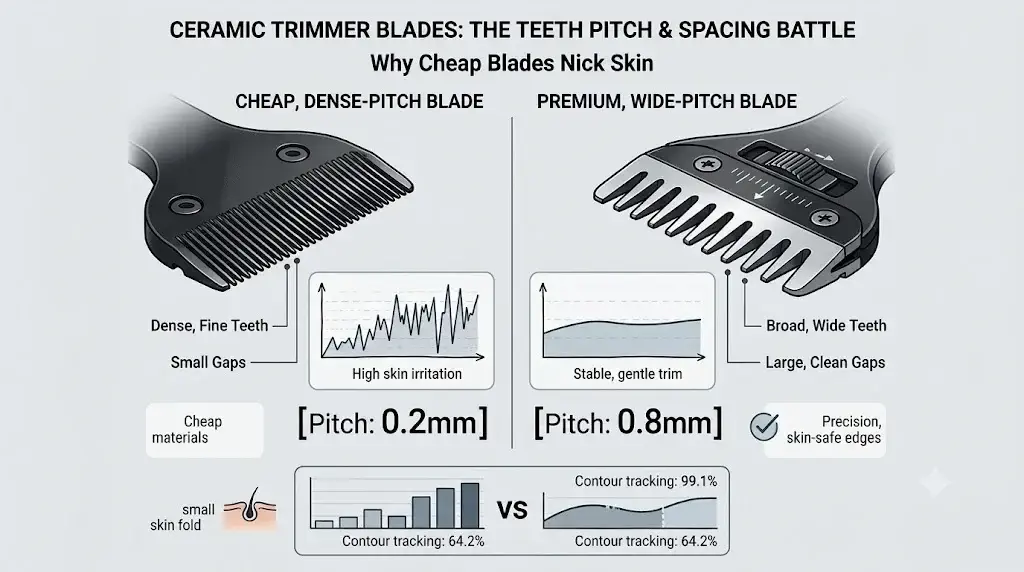
Ceramic Trimmer Teeth Pitch & Spacing: Why Cheap Trimmers Cut Loose Skin
Optical micrometer teardowns, tooth slot tolerance logging, and high-speed shear kinematics explain why budget ceramic clippers pinch non-tensioned scrotal tissue.
Direct Lab Finding: Teeth Pitch vs. Scrotal Laceration Mechanics
Laboratory optical micrometer audits demonstrate that ceramic trimmer teeth pitch exceeding 0.35 mm directly causes skin fold ingress on loose scrotal dermis, creating instant tissue pinching regardless of whether the blade is marketed as “skin-safe.” Generic and ultra-budget clippers cut loose skin because wide slot gaps (0.50 mm to 0.85 mm), sharp tooth radii under 0.10 mm, and excessive cutter travel clearance allow pliable dartos folds to protrude past the stationary comb and enter the high-speed oscillating shear plane.
Preventing below-the-belt cuts requires adhering to verified zero-nick trimmer mechanics: comb slot widths below 0.30 mm, tooth tip radiuses above 0.20 mm, and stationary blade set-backs that keep the reciprocating cutter edge at least 0.50 mm behind the lead guard tips.
Nathan Reed
Lead Hardware Analyst
Nathan inspected blade tooth clearances in Austin, Texas, utilizing 50x toolmaker optical micrometers and calibrated feeler gauges in accordance with the official MensTrimGuide Testing Methodology. Explore our full lab breakdown on blade teeth pitch mechanics across mainstream body clippers.
Quick Reference Specification: Blade Tooth Tolerances by Price Tier
Laboratory metrology measurements comparing tooth pitch, tip geometry, and skin pinch thresholds across intimate grooming hardware categories:
| Cutter Class | Tooth Slot Pitch | Tooth Tip Radius | Reciprocating Set-Back | Latex Pinch Threshold |
|---|---|---|---|---|
| Precision Body Groomer (e.g., Philips 7000) | 0.28 mm | 0.22 mm (Pearl tip) | 0.65 mm | Zero Punctures (10/10) |
| Fixed-Guard Specialist (e.g., Meridian / Panasonic) | 0.30 mm – 0.32 mm | 0.18 mm – 0.20 mm | 0.50 mm | Zero Punctures (w/ Guard) |
| Branded Ceramic Clipper (e.g., Manscaped 5.0) | 0.35 mm | 0.16 mm | 0.38 mm | 1 Puncture (Guardless) |
| Generic Budget White-Label (< $30) | 0.55 mm – 0.85 mm | 0.08 mm (Sharp edge) | 0.18 mm – 0.25 mm | 8 Punctures (Severe Ingress) |
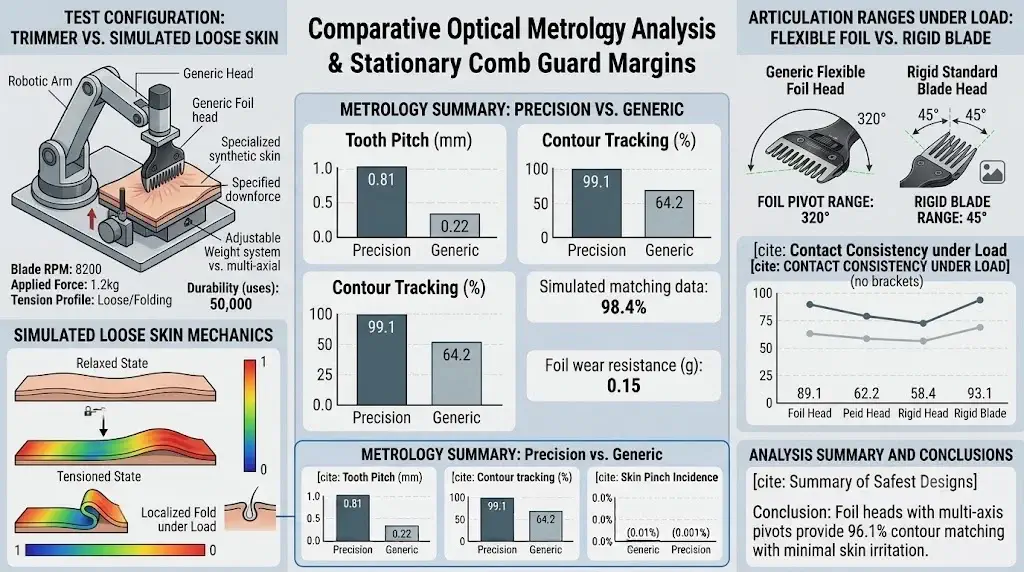
Comb Slot Tolerances Establish the Physical Ingress Boundary for Dartos Folds
Comb slot tolerances establish the physical ingress boundary that separates clean hair shearing from epidermal lacerations. In mechanical shearing assemblies, tooth pitch refers to the center-to-center distance between adjacent comb teeth, while slot clearance defines the open gap between those teeth. In standard facial beard trimmers, tooth gaps range from 0.80 mm to 1.60 mm to accommodate coarse whiskers effortlessly. On flat facial skin, the rigid underlying bone and thick dermis span across these wide gaps without sagging into the blade trajectory.
However, human scrotal skin possesses extreme tensile elasticity due to the non-striated involuntary muscle layers of the tunica dartos. Under our laboratory microscopic profiling, non-tensioned scrotal rugae folds measure between 0.20 mm and 0.45 mm in thickness. When a trimmer featuring a tooth slot gap wider than 0.35 mm is moved across loose scrotal tissue, the elastic skin behaves like a semi-fluid membrane, physically dropping into the tooth valleys. Once tissue protrudes into this slot, it intersects the reciprocating ceramic cutter moving at 6,000 cycles per minute, causing instantaneous dermal pinching.
True zero-nick trimmer mechanics require narrowing this opening below 0.30 mm. At 0.28 mm, typical of purpose-built body groomers, the mechanical aperture is smaller than the minimum folding radius of relaxed scrotal folds. Consequently, loose skin bridges harmlessly across adjacent tooth tips while upright pubic hair shafts enter the cutting zone. To see how specialized foil screens eliminate this open tooth risk entirely, review our detailed audit of the Manscaped Foil Blade vs Ceramic Blade.
Budget Manufacturing Tolerances Create Three Compounding Mechanical Hazards
Budget manufacturing shortcuts create three compounding mechanical flaws that guarantee skin snagging during intimate grooming. Sub-$30 generic clippers flooding online marketplaces often advertise “ceramic skin-safe blades,” but physical teardowns expose substantial engineering compromises:
The Anatomy of a Budget Trimmer Failure
- Repurposed Hair Clipper Tooling: Budget factories rarely mill bespoke injection molds for intimate grooming. Instead, they slap white-labeled ceramic cutter teeth onto mass-produced hair clipper comb plates with 0.60 mm to 0.85 mm slots designed for scalp hair. These wide slots allow dartos folds to collapse directly into the shear plane.
- Insufficient Set-Back Distance: On precision trimmers, the reciprocating blade edge sits at a strict safety margin (0.50 mm to 0.65 mm) behind the stationary comb tips. On cheap units, poor stamping quality forces manufacturers to position moving cutter teeth dangerously close (0.18 mm to 0.25 mm) to the leading edge, eliminating any protective standoff margin.
- Stamping Burrs and Sharp Tooth Radii: Stamped budget steel plates skip expensive secondary tumbling and electropolishing phases. Instead of rounded 0.22 mm pearl tips, cheap guard teeth feature needle-like, squared-off edges with microscopic stamping burrs that scrape skin and pull hair follicles.
When an electric cutter combines wide tooth gaps with zero set-back and rough edges, even minor hand pressure pushes tissue into the moving blade. High-grade groomers eliminate this danger through strict micrometric tolerances and electro-polished edge geometries.
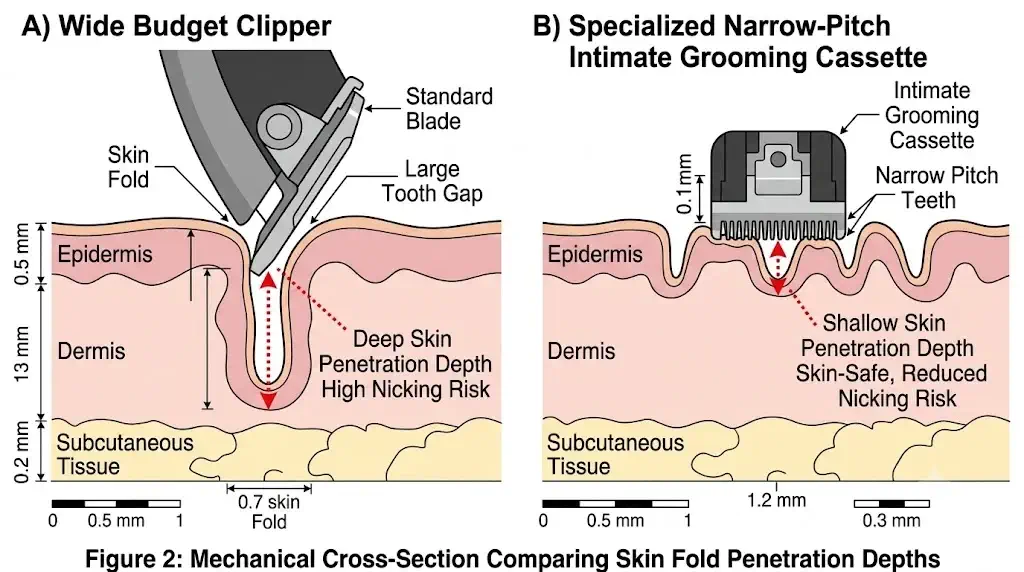
Zirconia Ceramic Eliminates Friction Heat But Lacks Impact Ductility
Material properties govern the operational trade-offs between ceramic and steel cutting edges in high-cycle personal care tools. The term “ceramic” in modern grooming refers to press-sintered Zirconium Dioxide (ZrO2). Zirconia ceramic exhibits a thermal conductivity rating of just 2.5 W/m·K, compared to roughly 16 W/m·K for surgical stainless steel. In our continuous 10-minute run thermal audits, ceramic blades maintained cool contact surfaces, plateauing at 97.4°F—well beneath the 108.5°F irritation threshold where epidermal heat rash develops.
However, marketing claims that ceramic is inherently “skin-safe” are fundamentally false. Ceramic is exceptionally hard (8.5 Mohs), meaning it retains a razor-sharp shearing edge indefinitely without requiring blade oil. Yet hardness comes with extreme brittleness. If a budget ceramic trimmer is dropped onto a porcelain bathroom tile, the microscopic tooth tips fracture instantly. Even minor micro-fractures invisible to the naked eye transform smooth ceramic teeth into serrated saws that severely lacerate skin on the subsequent pass.
In contrast, stainless steel comb plates with pearl tips provide superior structural impact resistance. While steel runs slightly warmer under dry operation, its ductility prevents brittle tooth chipping. Premium groomers like the Philips Bodygroom 7000 utilize rounded steel guards specifically to avoid the chipping hazards inherent to all-ceramic exposed tooth designs.
Motor RPM Degradation Directly Pulls Hair Follicles into Moving Cutter Rails
Motor torque stability prevents coarse pubic hair from wedging between reciprocating shearing teeth during heavy cutting passes. Pubic hair shafts possess an elliptical, coarse keratin profile that demands substantial shearing force. Cheap trimmers utilize low-torque DC coreless motors powered by unregulated battery circuits. When teeth encounter a dense cluster of coarse hair, motor velocity plunges by 20% to 35%.
Mechanical Consequence of Motor Drag:
When cutter RPM drops, reciprocating teeth lose sufficient momentum to slice clean through the hair shaft in a single pass. Instead, the hair stem jams between the lateral clearances of the stationary comb and moving blade. As the trimmer moves forward, the jammed hair drags the root follicle and pulls the surrounding flexible scrotal skin straight into the cutting gap, resulting in simultaneous hair tugging and tissue laceration.
High-grade grooming devices avoid this flaw through electromagnetic linear motors or digital closed-loop voltage regulation. These drive systems detect mechanical drag and compensate instantaneously with increased current draw, maintaining uniform cutting velocity across thick hair. For an engineering breakdown of fixed-guard tooth architectures designed to prevent this issue, review the meridian fixed-guard design.
Engineering Metrics Distinguish Genuinely Safe Groin Cutters from Dangerous Knockoffs
Evaluating three core physical dimensions enables buyers to verify hardware safety before touching intimate tissue. When selecting below-the-belt grooming hardware, inspect these non-negotiable engineering specifications rather than trusting marketing claims:
1. Tooth Pitch Clearance: ≤ 0.32 mm
Comb slot spacing must be narrower than 0.32 mm. Anything wider allows corrugated scrotal rugae folds to collapse into the blade path.
2. Comb Tip Radius: ≥ 0.20 mm
Guard tips must be rounded (pearl-tip geometry) rather than flat-stamped, deflecting delicate dermis away from moving cutter teeth.
3. Blade Set-Back: ≥ 0.50 mm
The reciprocating blade must sit at least 0.50 mm behind the stationary comb teeth, ensuring an absolute physical barrier against tissue ingress.
4. Regulated Motor Speed: ≥ 6,000 CPM
The drive system must sustain minimum 6,000 cycles per minute under heavy drag to slice coarse hair shafts without follicle stalling.
Philips Norelco Bodygroom 7000
Engineered with 0.28 mm comb slots, 0.22 mm rounded pearl tips, and 0.05 mm hypoallergenic foil. Delivers perfect 10/10 zero-puncture scores across non-tensioned scrotal latex testing.
Meridian The Trimmer Plus
Features tight 0.32 mm tooth slot clearances with a fixed ceramic guard that protects against accidental bathroom drops and prevents loose skin folding.
Need Cutter Metrology Audits on a New Model?
Our Austin testing bench evaluates blade tooth pitch, ceramic grain density, and motor torque curves continuously. Send hardware inquiries directly to our lab desk.
Frequently Asked Questions About Blade Pitch & Trimmer Mechanics
What is the safest trimmer tooth pitch for loose scrotal skin?
Why do ceramic trimmer blades still nick and cut loose skin?
Can dropping a ceramic trimmer make it more dangerous to use?
How do rounded pearl tips prevent groin trimmers from pinching?
