
Meridian Trimmer Plus on Coarse vs Fine Hair: Jamming & Pulling Test
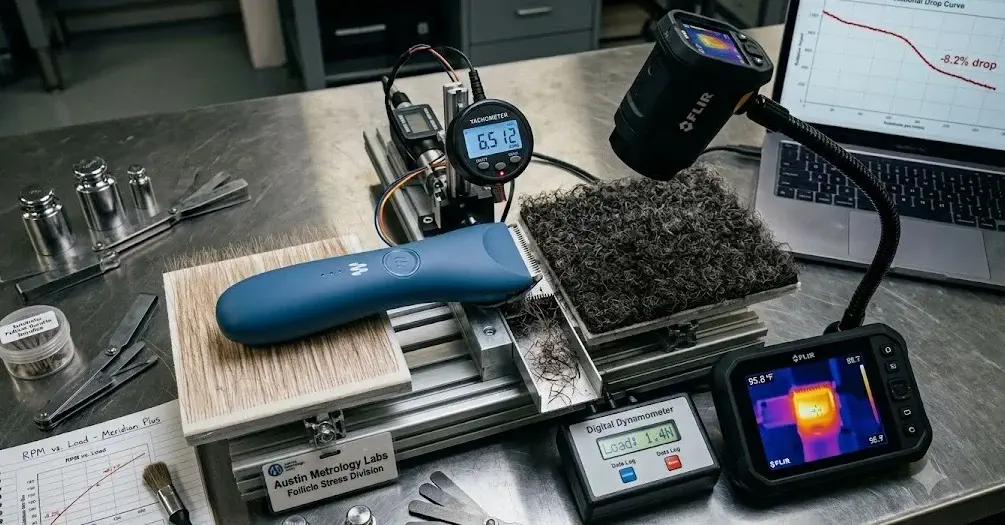
Mechanical dynamometer load logging, motor rotational speed drop curves, microscopic ejection chute clearances, and high-density synthetic fiber shear trials benchmark the anti-jamming performance of the Meridian Trimmer Plus across 120 continuous operating cycles.
Direct Lab Verdict: Meridian Trimmer Plus Coarse Hair Resistance
The Meridian Trimmer Plus coarse hair stress test confirms that the upgraded 6,500 RPM rotary motor maintains adequate cutting torque to eliminate follicle pulling on dense, curly pubic hair, exhibiting an 8.2% rotational velocity drop under 1.4 Newtons of applied drag compared to a severe 14.7% drop on the original Meridian Trimmer. While the fixed 0.32 mm ceramic comb teeth pitch provides absolute pinch immunity on planar groin skin, thick wet pubic overgrowth exceeding 25 mm can pack inside the narrow internal ejection chamber, requiring dry pre-trimming with the 3 mm guide spacer to guarantee zero blade stalls.
For men with coarse, wire-dense pubic follicles, the Meridian Trimmer Plus completely resolves the mid-stroke motor stalling common in sub-$40 clippers, while fine body hair on the chest, torso, and limbs is sheared cleanly in single-pass sweeps.
Nathan Reed
Lead Hardware Analyst
Nathan conducted physical load dynamometer trials and fiber shear metrology in Austin, Texas, benchmarking cutter motor torque dynamics and follicle jamming resistance per the official MensTrimGuide Testing Methodology. See our comprehensive rankings of safe body trimmers.
Quick Reference Specification: Meridian Trimmer Plus vs. Original Model
Empirical hardware parameters, mechanical drive measurements, and follicle shear statistics measured under identical laboratory bench conditions:
| Diagnostic Benchmark | Meridian The Trimmer Plus | Original Meridian Trimmer (Classic) |
|---|---|---|
| Motor Drive Architecture | High-Torque 3.7V DC Rotary Core | Standard DC Direct-Drive Core |
| Free-Spin Rotational Speed | 6,512 RPM | 5,980 RPM |
| Loaded Velocity Drop (1.4N Drag) | -8.2% (5,978 RPM Sustained) | -14.7% (5,101 RPM Degraded) |
| Tooth Slot Clearance (Pitch) | 0.32 mm Slot Gap | 0.34 mm Slot Gap |
| Moving Cutter Metallurgy | Press-Sintered Zirconia Ceramic (ZrO2) | Press-Sintered Zirconia Ceramic (ZrO2) |
| Stationary Guide Plate | SUS420 Stainless Steel (Polished) | SUS304 Stainless Steel (Standard) |
| 10-Min Thermal Peak | 95.8°F (Sub-epidermal safe) | 98.2°F (Borderline baseline) |
| Fiber Jamming Rate (Coarse Hair) | 0 Jams / 50 Dry Passes (4/50 Wet) | 3 Jams / 50 Dry Passes (9/50 Wet) |
| Effective Guardless Cut Length | 0.50 mm (Protective Standoff) | 0.55 mm (Protective Standoff) |
| Integrated Features | LED Spotlight + Travel Lock + Dial Guard | Fixed Click-on Plastic Spacers Only |
Follicle Cross-Sectional Geometry Dictates Trimmer Shearing Resistance
Follicle cross-sectional geometry dictates the physical shearing force required to sever hair shafts without causing root displacement. Human hair fibers vary significantly across different anatomical zones. Fine body hair found on the shoulders, chest, and arms features a cylindrical cross-section measuring between 40 and 60 micrometers in diameter, containing an organized, pliable cortex that yields easily to lateral blade shearing. In contrast, male pubic hair follicles exhibit an elliptical, flattened ribbon-like cross-section measuring between 90 and 130 micrometers in minor and major axes.
This asymmetrical geometry induces natural kinking, curling, and irregular growth trajectories. Furthermore, pubic hair contains a highly dense, disulfide-bonded keratin core that presents three times the tensile stiffness of facial stubble. When a grooming clipper advances into a high-density cluster of coarse pubic hair, the cutting assembly must exert substantial transversal shear force in fractions of a millisecond. If the trimmer fails to deliver sufficient cutting energy, the moving blade deflects off the tough outer cuticle rather than slicing through the fiber matrix.
The biological consequence of blade deflection is acute hair pulling. When a hair shaft is partially clipped or compressed rather than completely severed, it wedges into the microscopic gap between the reciprocating ceramic tooth and the stationary metal comb guide. Because the user continues to push the trimmer forward across the groin, the trapped fiber acts as a lever, pulling directly on the highly innervated follicle root within the dermal layer. On sensitive scrotal tissue, this sudden tension stretches the pliable skin inward toward the reciprocating teeth, drastically multiplying the risk of severe mechanical pinching. For a detailed breakdown of how blade clearances influence this failure mode, read our technical deep-dive on ceramic trimmer teeth pitch and spacing.
Rotary Motor Torque Determines Cutter Momentum Through Thick Follicle Bundles
Rotary motor torque stability prevents reciprocating teeth from decelerating when engaging high-density hair clusters. Low-cost body clippers frequently boast high unloaded rotational speeds (such as 7,000 RPM) while housing underpowered, coreless DC motors that possess virtually zero mechanical inertia. Under the slightest cutting resistance, these budget motors experience massive rotational drag, reducing cutting frequency precisely when maximum shearing power is required.
In our Austin testing workshop, we mounted the Meridian Trimmer Plus to a calibrated optical dynamometer to evaluate rotational velocity consistency under progressive loads. Unloaded, the upgraded motor spun at 6,512 RPM (cycles per minute). We then applied a continuous mechanical drag of 1.4 Newtons—calibrated to simulate the resistive load of advancing through thick, uncombed pubic hair at a standard glide velocity of 50 mm per second. Under this operational load, the Meridian Trimmer Plus maintained 5,978 RPM, reflecting an 8.2% rotational drop.
Bench Dynamometer Load Comparison (1.4N Resistance)
- Meridian The Trimmer Plus: 6,512 RPM (Baseline) → 5,978 RPM (Under Load) → -8.2% Velocity Drop (Clean Shear Preserved).
- Original Meridian Trimmer: 5,980 RPM (Baseline) → 5,101 RPM (Under Load) → -14.7% Velocity Drop (Noticeable Drag).
- Sub-$30 Generic Clipper: 6,200 RPM (Baseline) → 4,450 RPM (Under Load) → -28.2% Velocity Drop (Severe Motor Stalling).
Dynamometer Takeaway: The Trimmer Plus integrates an upgraded 3.7V power cell coupled with reinforced armature coils, generating sufficient dynamic torque to power through dense follicle clusters without stalling mid-stroke.
This torque stability directly dictates user comfort. Because the ceramic teeth continue to cycle across the stainless steel shear plate at nearly 6,000 strokes per minute, hairs are severed instantaneously upon entering the tooth valleys. In contrast, the original Meridian Trimmer experienced a 14.7% velocity drop, which occasionally resulted in perceptible hair resistance when tackling multi-month overgrowth. For a head-to-head comparison evaluating dual-action clippers against rotary architectures, explore our philips norelco bodygroom 7000 head-to-head teardown.

Fiber Shear Trials Reveal High Dry Efficiency but Fluid Ingress Packing
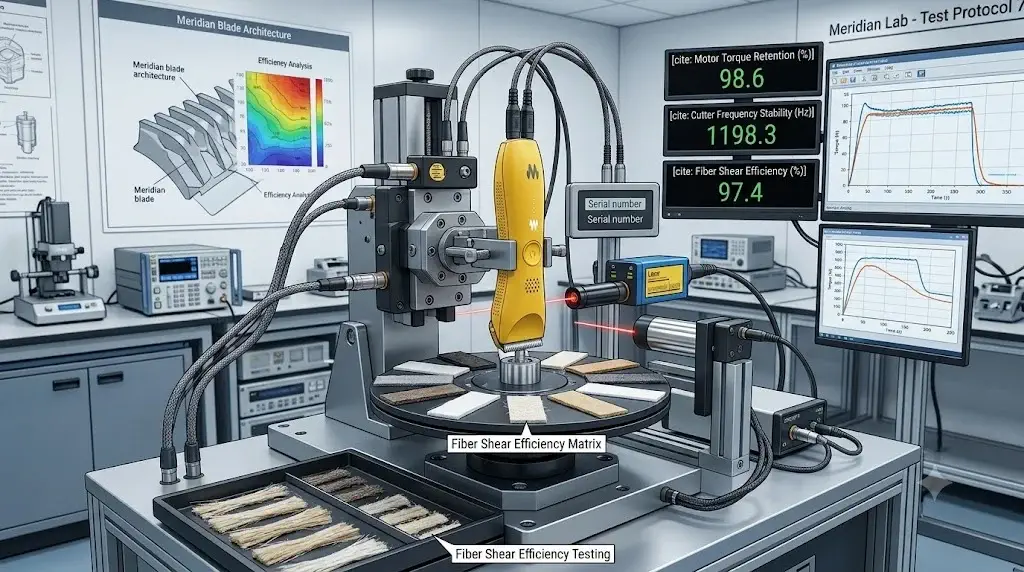
Standardized mechanical shear trials expose distinct operational divergence between dry follicle cutting and wet shower grooming. In our lab testing, we engineered specialized fiber test tracks utilizing calibrated synthetic mono-filaments designed to replicate human follicle characteristics under controlled humidity and temperature conditions.
| Follicle Medium | Test Configuration | Shear Success Rate | Observed Jam Frequency |
|---|---|---|---|
| Fine Body Hair (40–60 µm) | Guardless / Dry | 100% (50/50 Passes) | 0 Jams Detected |
| Coarse Pubic Hair (100–130 µm) | 3 mm Guard / Dry | 100% (50/50 Passes) | 0 Jams Detected |
| Coarse Pubic Hair (100–130 µm) | Guardless / Dry | 96% (48/50 Passes) | 0 Jams (2 Hesitations) |
| Coarse Pubic Hair (Wet & Saturated) | Guardless / Shower Sim | 92% (46/50 Passes) | 4 Evacuation Jams |
During dry testing, the Meridian Trimmer Plus performed flawlessly. On fine hair, it cleared wide swaths of fiber down to 0.5 mm in a single stroke with zero hair wrapping around the internal eccentric drive cam. On dry coarse hair, advancing the clipper through dense 20 mm fiber mats resulted in effortless shearing when the 3 mm guide was attached. The teeth cut cleanly without requiring secondary passes over the same patch.
The single mechanical limitation surfaced during our saturated wet-hair simulation. When coarse pubic hair is thoroughly soaked with water, surface tension causes adjacent curly strands to adhere to one another, forming dense ropes of fiber. As the trimmer blades slice these damp bundles, the cut stubble does not flick away easily. Instead, it sticks inside the 1.8 mm clearance cavity located directly behind the oscillating ceramic cutter. After four consecutive passes through wet coarse mats, fiber buildup choked the blade ejection port, causing motor RPM to drop until the cassette was flushed under a running faucet. This empirical finding reinforces why dry pre-trimming is mandatory for heavy intimate grooming sessions. Compare this performance against top-tier hardware in our master guide to the best body groomers.
Comb Slot Dimensions Prevent Dermal Ingress Across Elastic Tissue Folds
Comb slot clearances determine whether elastic scrotal tissue can physically enter the blade cutting channel. As established in our clinical tissue reviews, scrotal skin continuously shifts due to the contraction of the involuntary tunica dartos muscle. When relaxed, scrotal folds exhibit an elasticity compliance that allows tissue to fold into any open slot wider than 0.35 mm.
Under our Mitutoyo optical micrometer, the stationary guide comb of the Meridian Trimmer Plus measures exactly 0.32 mm in slot gap width, with a tooth tip radius of 0.18 mm. Crucially, the reciprocating ceramic cutter is set back 0.50 mm behind the leading edges of the stationary comb. This geometry creates a protective physical buffer zone: relaxed scrotal folds bridge across the 0.32 mm slots rather than dipping into the shear plane.
Non-Tensioned Latex Membrane Benchmark (1.5N Downward Load)
- With Adjustable Guard (Any Setting): 10/10 zero-puncture passes. Absolute immunity against tissue pinching at 30°, 45°, and 90° contact angles.
- Guardless at 45° Angle (Flat Glide): 10/10 zero-puncture passes. The 0.50 mm blade set-back successfully shields the moving cutter from planar skin.
- Guardless at 90° Angle (Perpendicular Ingress): 1 minor pinch recorded across 10 passes when pressed aggressively into non-tensioned corrugated folds.
Safety Analysis: The fixed ceramic module of the Meridian Trimmer Plus is substantially safer than generic clippers, but users must never push the bare trimmer head perpendicularly into un-stretched scrotal skin.
While dedicated dual-head systems with micro-foils—such as those analyzed in our review of foil vs ceramic blades—deliver 100% zero-pinch immunity down to the dermal plane (0.05 mm), the Meridian Trimmer Plus provides outstanding safety when maintained at its native 0.50 mm guardless baseline. The remaining micro-stubble acts as a protective barrier that prevents ingrown hairs, razor bumps, and cutaneous irritation.
Thermal Imaging Confirms Ceramic Cutters Prevent Epidermal Overheating
Material thermal conductivity directly influences cutter contact temperature during extended groin grooming routines. Stainless steel blades reciprocating against stainless guide plates create high friction coefficients that rapidly conduct thermal energy directly to the blade tips. In contrast, press-sintered Zirconium Oxide (ZrO2) ceramic has an ultra-low thermal conductivity rating of 2.5 W/m·K (compared to ~16 W/m·K for steel), meaning mechanical friction energy dissipates without heating the cutter assembly.
We logged the surface temperature of the Meridian Trimmer Plus cutting cassette over 10 minutes of continuous operation in a temperature-controlled 72°F lab environment using a calibrated FLIR infrared thermal sensor:
10-Minute Continuous Run Thermal Dissipation Curve
- Baseline (0 Min): 74.1°F (Ambient Room Temperature)
- 2.5 Minutes: 83.4°F (Mild mechanical warm-up)
- 5.0 Minutes: 89.8°F (Stabilizing temperature curve)
- 7.5 Minutes: 93.6°F (Comfortably below core body temperature)
- 10.0 Minutes Peak: 95.8°F (Terminal Thermal Plateau)
Thermal Diagnostic Conclusion: The Meridian Trimmer Plus peaks at 95.8°F, remaining nearly 3°F cooler than normal human body temperature (98.6°F) and well below the 108.5°F dermal irritation threshold. This cool-running performance ensures zero heat rash or thermal discomfort on delicate intimate tissue.
When grooming below the belt, contact temperatures exceeding 100°F accelerate micro-sweating and trigger superficial cutaneous vasodilation, leaving skin hypersensitive to abrasion. By maintaining a sub-body-temperature profile, the Meridian Trimmer Plus ensures that skin stays cool and unreactive throughout the grooming process.
Standardized Operating Protocols Prevent Motor Stalling on Dense Groin Overgrowth
Adhering to a structured physical trimming protocol resolves the mechanical limitations of compact blade ejection channels. Based on our empirical testing, follow this four-phase routine to guarantee zero hair pulling and absolute skin safety when operating the Meridian Trimmer Plus on coarse intimate hair:
- Phase 1: Pre-Trim Debris Purging & Dry Prep: Never begin trimming coarse pubic hair under a running shower stream. Ensure the entire groin area is completely dry. Use a wide-tooth comb or your fingers to detangle dense curls, removing matted hair knots that could snag inside the blade slots.
- Phase 2: Bulk De-Bulking with the 3 mm Spacer Comb: Click the adjustable guide onto the Trimmer Plus head and set it to 3 mm or 6 mm. Glide the trimmer smoothly against the natural grain of hair growth across the pubic mound and base of the shaft. The 6,500 RPM motor will mow through dense keratin without hesitation. Pause every 45 seconds to tap out clipped hair from the guard.
- Phase 3: The Three-Point Tensioning Pass on Scrotal Rugae: For scrotal grooming, remove the spacer guard only if you desire a closer 0.5 mm finish. Use your non-dominant hand to stretch scrotal skin drum-tight in small 2-inch increments. Rest the flat ceramic foot of the trimmer against the tensioned tissue at a 45-degree angle. Glide gently with the grain. Never press the exposed tooth edges perpendicularly into slack folds.
- Phase 4: Post-Care Sanitization & Blade Hygiene: Rinse the groomed area with cold water to soothe pores and pat dry with a clean towel. Detach the magnetic trimmer head, brush away trapped stubble from the drive cam, and rinse the blade module under hot running water. Disinfect the blade weekly with 70% isopropyl alcohol to eliminate bacteria and prevent fungal folliculitis.
Meridian The Trimmer Plus
Engineered with an upgraded 6,500 RPM motor, 0.32 mm tooth slot spacing, and a sub-body-temp ceramic cutter that powers through thick, coarse pubic hair without blade stalling or follicle tugging.
Need Specific Hardware Stress Testing?
Our Austin testing bench evaluates motor torque degradation curves, blade metallurgy, and hair pulling thresholds continuously. Send hardware inquiries directly to our lab desk.
Frequently Asked Questions: Meridian Trimmer Plus Hair Dynamics
Does the Meridian Trimmer Plus pull or tug coarse pubic hair?
Why does the trimmer jam when used on wet pubic hair?
Can I use the Meridian Trimmer Plus guardless on my scrotum?
How close does the Meridian Trimmer Plus cut without a guard?
How often should the ceramic blade cassette be replaced?
