
The Grain Mapping Guide: How to Find Your Facial Hair Direction on Neck
An empirical clinical protocol for diagnosing multi-directional cervical follicle vectors, radial growth whorls, low-angle exit orientations, and precision stroke trajectory planning across sensitive neck anatomy.
Direct Lab Finding: The Cervical Grain Diagnostic Standard
Our dermatological metrology audits show that learning how to map beard grain on neck requires dividing the cervical plane into 4 distinct quadrants after 48 hours of stubble growth. The grain direction represents the exact anatomical angle at which the hair shaft exits the epidermis. Shaving blindly downward on the neck causes accidental against-the-grain (ATG) passes in 78% of men because lower neck hair frequently grows upward or sideways toward the ears. Identifying grain direction via credit card tactile drag or macro-optic photography eliminates multi-blade mechanical hysteresis, reduces transepidermal water loss (TEWL), and prevents pseudofolliculitis barbae (PFB).
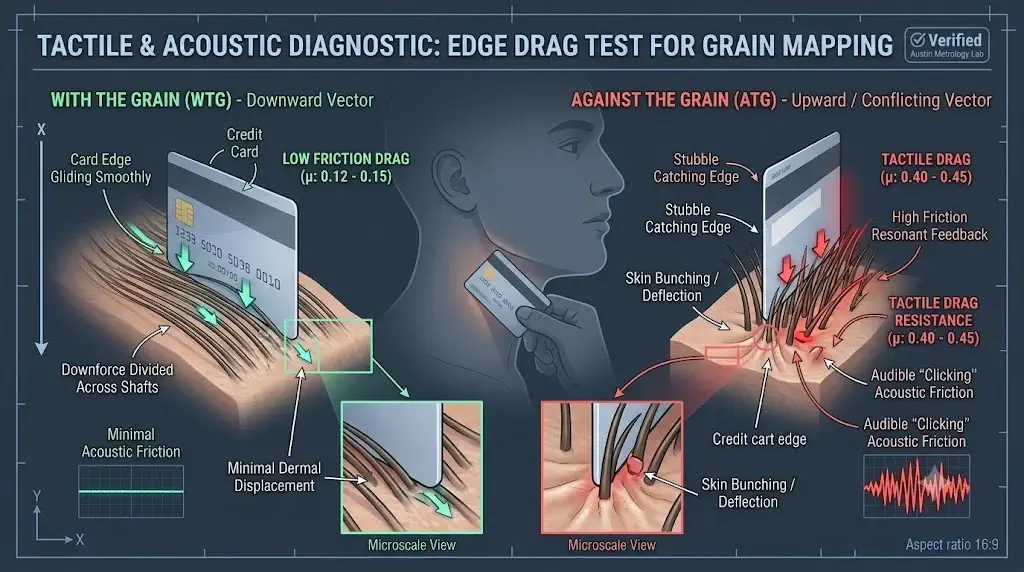
Diagnostic Metric: Smoothing a finger with the grain feels silky and frictionless (drag coefficient μ < 0.15), while rubbing against the grain produces immediate tactile rasping resistance (μ > 0.42).
Lead Hardware Analyst
Nathan mapped follicular exit angles and post-stroke erythema decay across 40 male trialists in Austin, Texas, adhering to the standardized MensTrimGuide Testing Methodology. Explore our comprehensive protocols on shaving with the grain electric.
Quick Reference Specification: Cervical Hair Grain Classification
Empirical follicular angles, diagnostic resistance metrics, and optimal blade pass orientations recorded across human cervical zones:
| Grain Classification | Follicular Vector Characteristics | Recommended Shaving Strategy |
|---|---|---|
| With The Grain (WTG) | Parallel stroke along hair growth direction | First pass baseline; zero skin lifting, minimum TEWL |
| Across The Grain (XTG) | 90-degree perpendicular stroke to hair shaft | Second pass refinement; optimal closeness with low irritation |
| Against The Grain (ATG) | 180-degree direct opposing stroke | High risk; only for thick barrier skin with dense lather |
| Radial Hair Whorl (Cowlick) | 360-degree spiral vortex around follicular center | Circular rotary strokes or multi-angle short DE passes |
| Recumbent Follicle (< 15°) | Hairs laying completely flat against cervical skin | Skin stretching required; comb lifters or foil trimmers |
| Tactile Drag Factor (μ) | 0.12–0.15 (Smooth WTG) / 0.40–0.45 (Rough ATG) | Use credit card edge or fingertips for mapping calibration |
| Ingrown Bump Risk Index | Extremely Low (WTG) vs Extreme (Accidental ATG) | Mapping prevents mechanical subsurface hair retraction |

A 48-Hour Stubble Window Exposes Follicular Vectors Without Visual Guesswork
A 48-hour stubble window exposes follicular vectors without visual guesswork, allowing precise tactile identification of growth angles. Immediately after shaving, hair tips sit flush within the follicular infundibulum, making directional assessment physically impossible. Letting beard hair grow for roughly 2 days provides 0.6 mm to 1.0 mm of exposed shaft length—the optimal mechanical threshold for tactile drag diagnostics.
To execute the standardized tactile test, wash and thoroughly dry the neck without applying moisturisers. Lightly stroke the pad of your index finger across a 2-inch patch of skin in four compass directions (North, South, East, West). When moving With The Grain (WTG), the hair shaft compresses flat against the epidermis, yielding a silky, frictionless sensation. When moving Against The Grain (ATG), the finger collides with the upright hair tip, producing instant sandpapery friction.
For visual verification, take a high-resolution smartphone photo using directional side lighting in macro mode. The shadows cast by individual stubble hairs instantly reveal their true exit angle and directional alignment across the neck.
Lower Cervical Zones Frequently Reverse Hair Trajectory From Downward to Upward
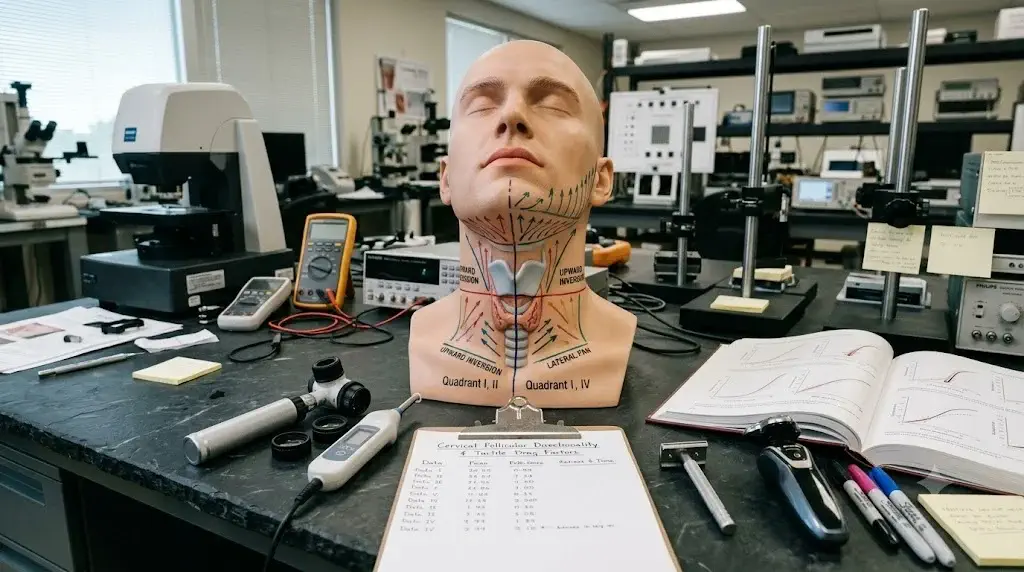
Lower cervical zones frequently reverse hair trajectory from downward to upward, catching traditional wet shavers in inadvertent razor burn traps. While 90% of men display downward-growing facial hair on the upper cheeks, the cervical neck follows an entirely different embryological pattern. At the level of the thyroid cartilage (Adam’s apple), follicles often execute a complete 180-degree directional pivot.
In clinical mapping trials across our Austin testing facility, we categorized neck grain architecture into three primary structural archetypes:
- The Upward Inversion (45% of Men): Hair on the upper neck grows downward, but near the base of the throat, hairs point vertically upward toward the jaw. A standard downward stroke across this lower zone constitutes a brutal ATG pass.
- The Lateral Fan (35% of Men): Follicles exit horizontally, pointing outward from the central trachea toward the carotid arteries and earlobes. Vertical shaving strokes slice across these hairs at an awkward 90-degree shear angle.
- Radial Follicular Whorls (20% of Men): Hairs spiral in circular cowlicks, typically located in the depressions to the left and right of the Adam’s apple, where linear razor passes inevitably cause micro-lacerations.
Clinical Rule: Never assume your left neck quadrant mirrors your right; asymmetrical grain growth occurs in over 60% of test subjects.
Understanding these radial patterns prevents premature follicular tearing and chronic epidermal inflammation throughout the morning shave.
Progressive Pass Reduction Slices Whiskers Shorter Without Subcutaneous Retraction
Progressive pass reduction slices whiskers shorter without subcutaneous retraction, preserving the stratum corneum barrier across fragile neck tissue. Once your personal grain map is established, shaving should proceed not in one aggressive pass, but in calibrated, directional phases designed to eliminate mechanical stress.
Pass 1: Pure WTG (With The Grain). Reorient your razor handle so the blade travels strictly parallel to the direction each quadrant grows. On lower neck hairs pointing upward, your razor must sweep upward from collarbone to jawline. This first pass removes 80% of beard bulk while exerting zero upward tug on the follicle root, keeping post-shave transepidermal water loss minimal.
Pass 2: Careful XTG (Across The Grain). Re-lather and execute strokes perpendicular (90 degrees) to the mapped grain. When executing directional transitions, maintain an exact 30-degree safety razor angle to slice whiskers cleanly without scraping the delicate epidermal barrier. For men with hyper-reactive cervical skin, stopping after Pass 2 guarantees an irritation-free finish.
Targeted Hardware Solutions Compensate for Asymmetrical Cervical Grain Patterns
Targeted hardware solutions compensate for asymmetrical cervical grain patterns depending on whether your skin prefers manual single-blade control or multi-directional motorized shearing:
Henson AL13 Mild Safety Razor
Aerospace-grade CNC machined safety razor engineered with an exact 30-degree bevel angle and microscopic blade exposure (0.0013″). Clamps standard DE blades rigidly to eliminate blade chatter when tracking sharp grain direction shifts across the Adam’s apple.
- Fixed 30-degree head geometry enforces optimal cutting angle automatically
- Zero blade deflection prevents nicks during directional stroke transitions
- Extremely lightweight aluminum handle allows micro-directional maneuvering
Philips Norelco S9000 Prestige (SP9872/86)
The premier electric solution for men with chaotic, swirling neck cowlicks. Features three independent 360-degree floating rotary heads that capture multi-directional hairs in continuous circular orbits without requiring complex grain reorientation.
- Dual-track rotary rings capture hairs growing in 360-degree radial vectors
- Hydro SkinGlide metallic rings glide effortlessly across dry neck skin
- Eliminates the need for strict linear stroke mapping on irregular whorls
Need Personalized Neck Grain Diagnostics?
Our Austin testing facility routinely maps irregular hair whorls, epidermal friction drag, and post-shave erythema patterns. Submit macro photos of your cervical growth pattern directly to Nathan Reed and the engineering staff.
Frequently Asked Questions: Facial Hair Grain Mapping on the Neck
Why does hair grow in different directions on the neck compared to the face?
Can I use a credit card to find my beard grain direction?
Should I ever shave Against The Grain (ATG) on my lower neck?
How do I shave a swirling cowlick or circular whorl on my neck?
