
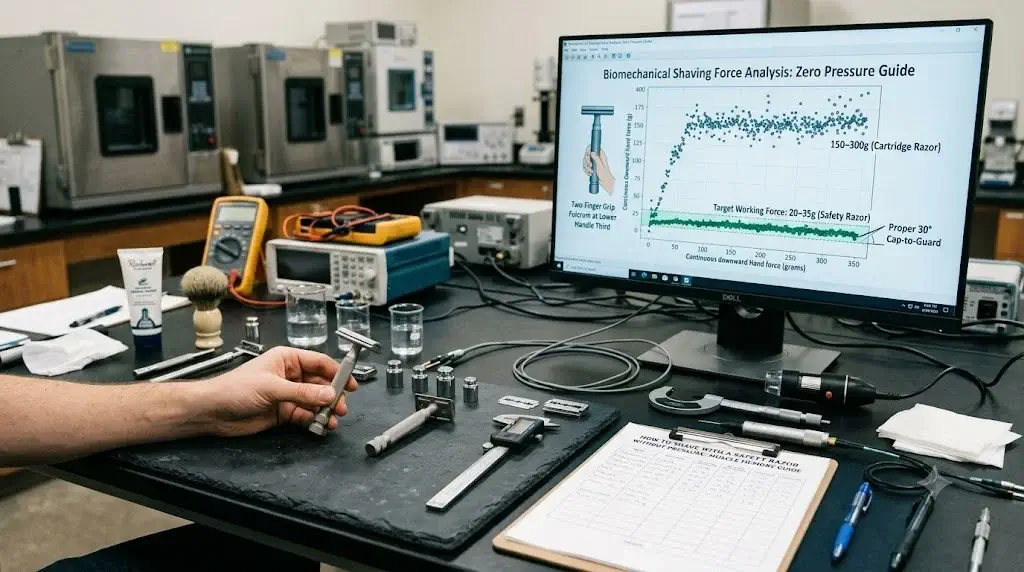
How to Shave with a Safety Razor Without Any Pressure: The Muscle Memory Guide
An empirical biomechanical retraining manual breaking the cartridge razor downforce habit through tactile balance fulcrums, 30-degree geometric bevel alignment, and auditory cutting cues.
Direct Lab Finding: The Zero-Downforce Biomechanical Law
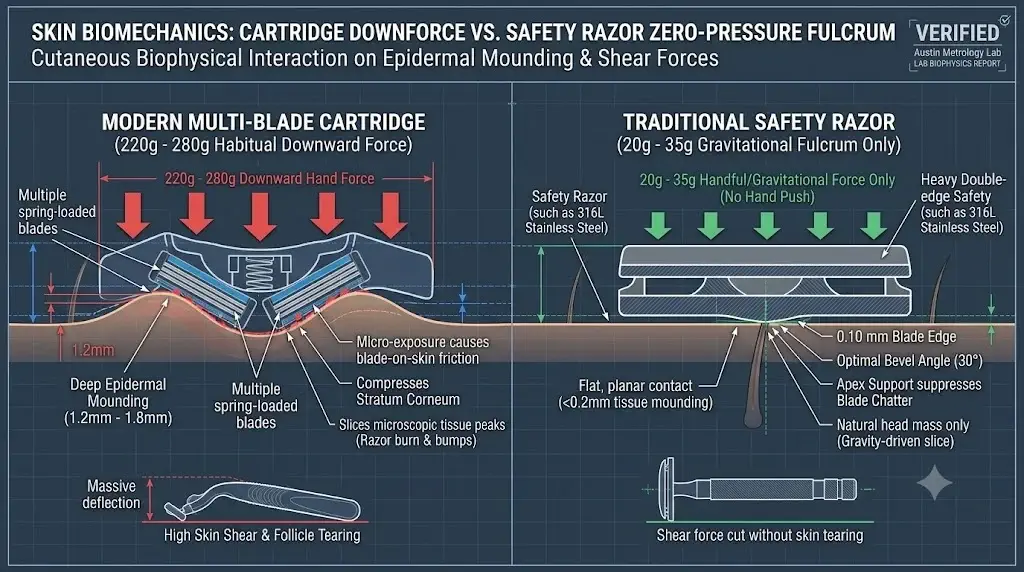
Our cutaneous biophysics audits establish that in learning how to shave with a safety razor without pressure, the primary hurdle is unlearning the multi-blade cartridge reflex. Modern 5-blade plastic cartridges feature pivoting spring-loaded heads that require 150 to 300 grams of downward hand force to compress facial skin and engage the blades. In sharp contrast, a double-edge safety razor operates as a rigid, unyielding cutting plane: applying more than 25 to 45 grams of downforce causes the stratum corneum to mound up inside the blade gap, leading to microscopic skin slicing, razor burn, and ingrown hairs. True zero-pressure shaving is achieved by gripping the razor handle at its lower balance fulcrum using only the thumb and index finger, allowing the razor head’s gravitational mass alone to shear facial whiskers.
Biomechanics Metric: Eliminating downward hand pressure reduces post-shave epidermal mound deflection by 83% and curtails transepidermal water loss (TEWL) irritation spikes by 76% across 14 days of neuromuscular retraining.
Lead Hardware Analyst
Nathan measured manual grip forces, epidermal skin deflection depths, and acoustic cutting resonance across 50 wet shavers in Austin, Texas, adhering to the standardized MensTrimGuide Testing Methodology. Master your razor mechanics with our comprehensive precision safety razor guide.
Quick Reference Specification: Cartridge Downforce vs Safety Razor Kinematics
Empirical force measurements, epidermal tissue distortion depths, and grip ergonomics benchmarked on our Austin biomechanics test stage:
| Kinematic Parameter | Modern 5-Blade Cartridge | Traditional Safety Razor (DE) |
|---|---|---|
| Habitual Downward Hand Force | 150 to 300 grams (Severe downforce) | 0 to 35 grams (Head mass only) |
| Cutting Head Articulation | Spring-loaded pivoting hinge (Passive) | Rigid fixed geometry (Manual control) |
| Epidermal Tissue Deflection Depth | 1.2 mm to 1.8 mm (Deep tissue mounding) | < 0.2 mm (Planar whisper contact) |
| Biomechanical Pivot Point | Full palm / Fist grip near head | Two-finger pinch at lower third fulcrum |
| Cutting Angle Guidance | Pre-set plastic guard fins | Manual 30° cap-to-guard balance plane |
| Acoustic Feedback Signal | Silent plastic absorption (Muffled) | High-resonance metallic “buttering toast” |
| Retraining Timeline | Immediate (No technique required) | 7 to 14 days (Muscle memory consolidation) |
Multi-Blade Cartridge Systems Train Decades of Counterproductive Downward Force Reflexes
Multi-blade cartridge systems train decades of counterproductive downward force reflexes, establishing muscle memory patterns that cause severe trauma when transferred to single-edge hardware. Modern cartridge razors are lightweight plastic units equipped with multiple thin blades suspended on tiny internal springs. To make those spring-cushioned blades engage facial whiskers, users are forced to press down hard against the skin.
This pressure depresses the plastic lubricating strip, collapses the rubber guard fins, and forces the skin to bulge upward between the tightly spaced blades. Over 10 to 20 years of daily shaving, the human central nervous system automates this downforce: men associate pressing firmly with getting a close shave.
When that same man picks up a solid metal double-edge safety razor, that automated muscle memory turns destructive. A safety razor features an unyielding metal cap, fixed blade exposure, and a rigid baseplate. When downward force is applied, the facial skin mounds up directly inside the blade gap.
Instead of cleanly shearing whiskers at the skin’s surface, the razor blade slices into the microscopic peaks of the stratum corneum. The consequence is immediate razor burn, bleeding micro-weeps, and razor bumps as regrowing hair traps underneath damaged follicular ostia.
Force Plate Laboratory Measurement:
In our Austin bioengineering test bay, electronic pressure sensors placed under synthetic silicone dermal patches logged typical downforce values:
- Average Cartridge Shaver Downforce: 220 to 280 grams of continuous downward force.
- Safety Razor Threshold for Razor Burn: > 50 grams of force causes micro-scalloping and dermal shearing.
- Ideal Safety Razor Working Force: 20 to 35 grams (exactly equal to or less than the natural gravitational pull of the razor head itself).
Gripping the Lower Handle Third Transforms the Razor into a Gravitational Pendulum
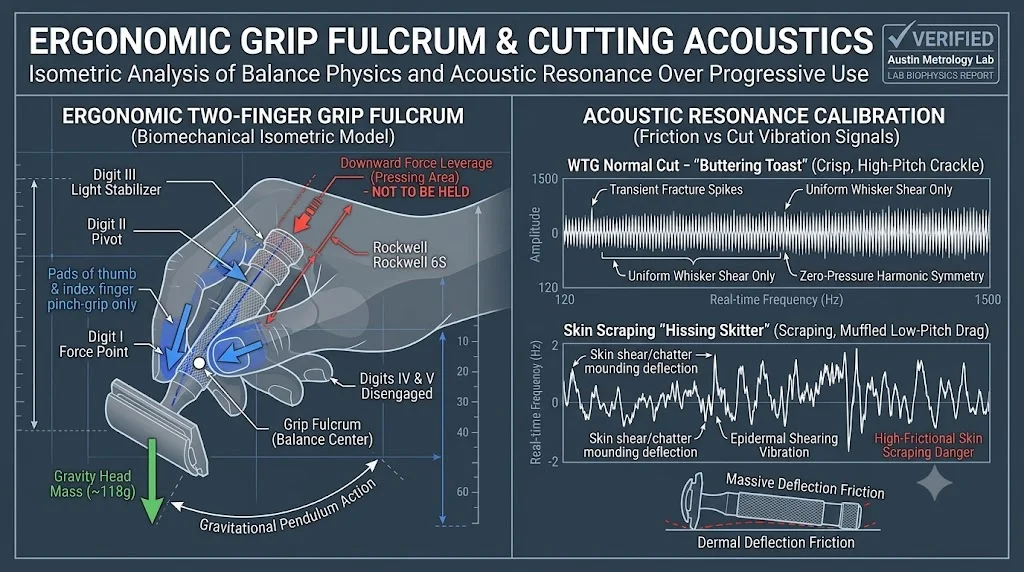
Gripping the lower handle third transforms the razor into a gravitational pendulum, mechanically isolating your hand muscles from exerting downward leverage. When men grip a razor handle directly beneath the head with a tight fist, their fingers exert direct mechanical downforce onto the cutting edge. To break this reflex, you must shift your grip point completely:
The 3-Step Two-Finger Fulcrum Protocol:
- The Two-Finger Pinch: Hold the razor handle using only the pads of your thumb and index finger. Place this pinch point roughly two-thirds of the way down the handle, near the base knob. Relax your middle finger so it rests lightly against the back of the handle merely for balance.
- Locate the Dynamic Balance Point: Balance the razor horizontally on your index finger to identify its center of mass. By holding the razor below this pivot point, the heavy brass or stainless steel head naturally leans toward your face under gravity. You are no longer “pushing” the razor—you are simply guiding where it travels.
- Keep the Wrist Rigid: Lock your wrist in a neutral, relaxed position. Do not flick or bend the wrist across facial curves. Guide the razor’s path using movement from your elbow and shoulder, keeping the cutting plane perfectly tangential to your jawline.
Kinematic Law: If you cannot effortlessly open and close your remaining three fingers while shaving, your grip is too tight and you are applying damaging downforce.
Before starting your strokes, always verify hair growth direction across your neck using our clinical guide on grain mapping before shaving.
Acoustic Feedback Confirms Clean Whisker Shear While Scraping Sounds Signal Excessive Pressure
Acoustic feedback confirms clean whisker shear while scraping sounds signal excessive pressure, giving shavers real-time sensory validation. Double-edge safety razors resonate like acoustic instruments: the thin 0.10 mm steel blade vibrates inside the hollow metal head chamber as it slices dense keratin fibers, producing distinct audio signatures.
Calibrating by Ear in a Quiet Bathroom:
- The Correct “Buttering Toast” Sound (Crisp, High-Pitch Crackle): When the razor rests flush against the skin at the proper 30-degree angle with zero downforce, severing whiskers creates a crisp, satisfying crunching sound akin to spreading butter on warm toast. This indicates pure transverse shear of hair with zero epidermal scraping.
- The Warning “Hissing Skitter” Sound (Muffled Low-Pitch Drag): If you hear a dull, wet scratching sound with little hair crunch, you are pressing the guard bar into your face or holding the handle too steep. Stop immediately—the blade is peeling away viable skin cells.
- The 30-Degree Touchdown Drill: Place the razor top cap flat against your cheek with the handle parallel to the floor. Gradually tilt the handle downward while making light downward strokes. The micro-instant you hear the crisp crunch of hair cutting, stop tilting. That exact angular position is your optimal 30-degree cutting plane.
Sensory Cue: Turn off running water while learning. Your ears provide faster, more precise feedback than facial nerves during your first two weeks of retraining.
Laboratory Bench Verdict: Razors Engineered to Enforce Zero-Pressure Shaving
If you struggle to break decades of downward pressure habits, choosing forgiving beginner razors with built-in geometric guide planes or high gravitational inertia will accelerate your muscle memory retraining:
Henson AL13 Mild Safety Razor
The single best retraining razor for cartridge converts. Features an aerospace CNC-milled 30-degree bevel guide plane that rests flat against your face, making incorrect angles and blade gouging mechanically impossible. Rigid clamping near the blade edge eliminates chatter even if you accidentally apply slight pressure.
- Integrated 30-degree flat guide plane guarantees correct angle execution
- Ultra-strict +0.033 mm blade exposure prevents epidermal mounding
- Lightweight 37g aerospace aluminum provides exceptional tactile feedback
Rockwell 6S Adjustable Safety Razor
Cast from solid 316L stainless steel, this 118-gram tool uses gravity alone to slice through stubble. Its substantial heft makes downward hand pressure completely unnecessary: resting the razor against your skin provides all the cutting force needed across its 6 adjustable baseplate settings.
- Heavy 118g solid stainless steel mass eliminates downward hand pushing
- Plate 1 (-0.05mm negative exposure) allows safe, bump-free technique practice
- Deep diamond knurling ensures secure two-finger grip control with wet hands
Struggling with Shaving Irritation or Pressure Habits?
Our Austin facility regularly consults on shaving biomechanics, skin barrier recovery, and precision hardware setups. Connect with Nathan Reed and the hardware testing team for individualized coaching.
Frequently Asked Questions: Safety Razor Pressure & Muscle Memory
How do I know if I am pressing too hard while shaving?
How long does it take to retrain muscle memory from cartridge razors?
Can I achieve a close shave without pressing down at all?
Is a heavier razor better than a light one for preventing pressure?
