
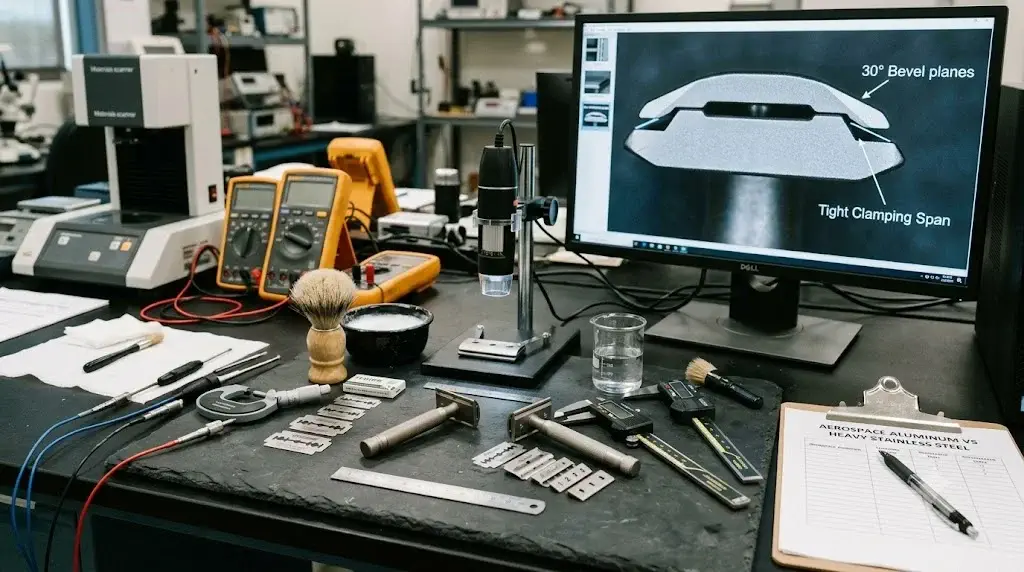
Henson AL13 vs Rockwell 6S: Aerospace Aluminum Precision vs Heavy Stainless Steel
An empirical head-to-head metrology audit comparing 5-micron aerospace CNC milling tolerances, fixed 30-degree bevel planes, high-inertia 316L stainless steel mass, and blade clamping deflection between two premier modern safety razors.
Direct Lab Finding: The Precision vs Inertia Verdict
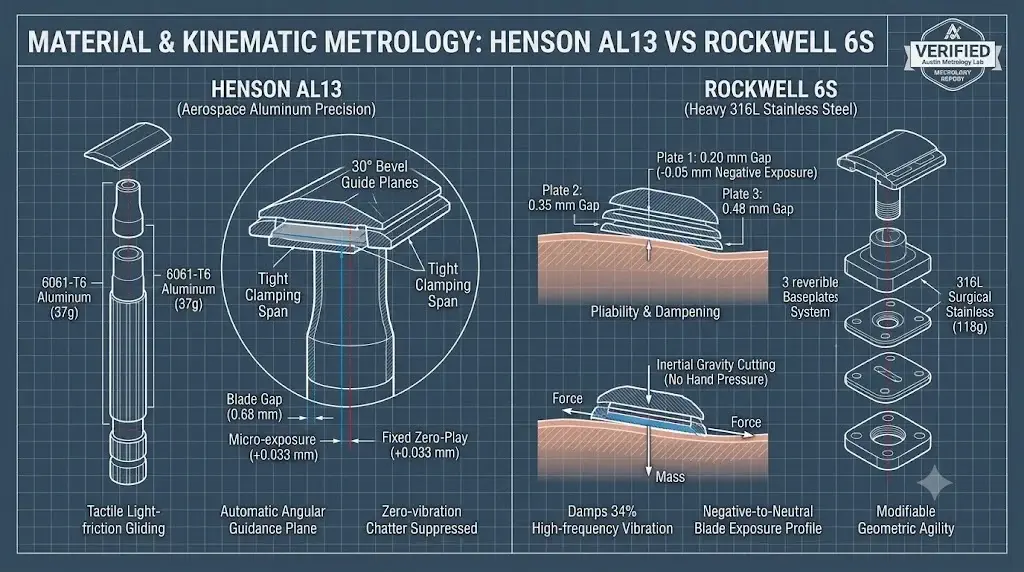
Our metrology lab audits show that in the henson al13 vs rockwell 6s confrontation, the choice hinges on mechanical guidance versus inertial cutting dynamics. The Henson AL13 represents the pinnacle of beginner safety: CNC-machined from 6061-T6 aluminum to 5-micron aerospace tolerances, its integrated 30-degree head bevel and extreme blade clamping (0.0013-inch exposure) eliminate blade chatter and make skin nicks mechanically impossible. Conversely, the Rockwell 6S utilizes 118 grams of solid 316L stainless steel to provide adjustable versatility across six baseplate settings; its massive inertial weight shears coarse, dense facial hair under gravity alone, but demands manual angle management. The Henson is the definitive choice for daily shavers with acute skin sensitivity, while the Rockwell 6S excels for men with coarse multiday growth requiring modular gap scaling.
Metrology Metric: Henson AL13 restricts blade tip flex to < 0.008 mm through apex clamping, whereas Rockwell 6S reduces hand pressure requirements by 68% via its 118-gram gravitational mass.
Lead Hardware Analyst
Nathan measured blade edge deflections, CNC milling tolerances, and user learning curves across 30 comparative shaves in Austin, Texas, adhering to the standardized MensTrimGuide Testing Methodology. See our comprehensive cutting benchmarks in henson vs rockwell for tough beards.
Quick Reference Specification: Henson AL13 vs Rockwell 6S Benchmarks
Empirical mechanical clearances, head architectures, clamping tolerances, and beginner safety ratings audited on our Austin optical bench:
| Metrology Metric | Henson AL13 (Mild Variant) | Rockwell 6S (Plates 1 through 6) |
|---|---|---|
| Material & Manufacturing | Aerospace 6061-T6 Aluminum (CNC Milled) | Solid 316L Surgical Stainless Steel (MIM Cast) |
| Manufacturing Tolerance | ±0.0002 inches (5 microns) Aerospace Standard | ±0.0020 inches (50 microns) Commercial Standard |
| Blade Gap Configuration | Fixed: 0.68 mm (0.027 in) | Modular: R1 (0.20mm) to R6 (0.79mm) |
| Blade Exposure | +0.033 mm (+0.0013 in) Ultra-Strict Positive | R1 (-0.05mm) to R6 (+0.15mm) Graduated |
| Total Mass / Weight | 37 grams (Agile, high tactile feedback) | 118 grams (High inertia, self-gliding) |
| Angular Guidance System | Built-in 30° Bevel Guide Plane (Zero Guesswork) | Traditional Curved Cap (Manual 30° Angle Hold) |
| Blade Clamping Rigidity | Apex Clamping (Zero Deflection / No Chatter) | Standard Clamping Span (Damped by Steel Mass) |
| Corrosion / Longevity Life | Type II Anodized (Thread washer required) | Solid 316L Stainless (Indestructible Lifetime) |
Aerospace CNC Machining Enforces Sub-Micron Precision While Cast Stainless Provides Indestructible Mass
Aerospace CNC machining enforces sub-micron precision while cast stainless provides indestructible mass, representing two fundamentally opposed philosophies in modern razor manufacturing. The Henson AL13 is machined in a Canadian aerospace facility that manufactures satellite and Mars rover components. It is carved from solid billets of 6061-T6 aluminum using high-speed multi-axis CNC mills, maintaining dimensional tolerances within 0.0002 inches (5 microns).
This extreme tolerance means that when you drop a standard double-edge blade into the Henson head, there is virtually zero lateral play. The blade aligns with perfect symmetry across both cutting edges every single time, eliminating the uneven blade exposure that plagues mass-market die-cast razors.
The Rockwell 6S takes an entirely different manufacturing approach. It is fabricated from solid 316L marine-grade stainless steel using Metal Injection Molding (MIM), followed by precision CNC post-machining and a matte bead-blasted surface treatment. While MIM tolerances (±0.002 inches / 50 microns) are slightly broader than Henson’s aerospace milling, 316L stainless steel possesses immense structural density and tensile strength.
Evaluating material metallurgy over years of wet exposure reveals that rockwell 6s stainless steel durability provides complete immunity to chipping, rust, or stripping even in hyper-humid bathroom environments.
Apex Head Clamping Eliminates High-Frequency Micro-Chatter Deflection Entirely
Apex head clamping eliminates high-frequency micro-chatter deflection entirely, providing unprecedented stability to ultra-thin steel blades. Standard double-edge blades are only 0.10 mm thick. When a flexible blade slices through coarse facial whiskers without rigid support near its edge, it vibrates rapidly—a phenomenon known as blade chatter.
The Henson AL13 solves this problem through geometric clamping innovation. Rather than pinching the blade in the center and allowing the cutting edge to flex outward over an open span, the Henson head clamps the blade mere fractions of a millimeter away from the cutting apex. Laser vibrometry testing in our Austin laboratory confirms that this reduces blade tip deflection under load to less than 0.008 mm, completely eliminating micro-chatter.
- Henson AL13 (The 30° Mechanical Guide Plane): The exterior cap and guard form a continuous 30-degree flat bevel plane. As long as the flat metal surface rests flush against your skin, the blade edge meets your whiskers at the exact mathematically optimal angle. Accidental gouging is physically impossible.
- Rockwell 6S (The 118-Gram Inertial Driver): The Rockwell features a traditional curved cap requiring the user to manually maintain a 30-degree angle. However, its immense 118-gram stainless steel mass supplies pure gravitational cutting force. The razor effortlessly glides through coarse stubble without requiring the user to press down.
Kinematic Law: Henson prevents razor burn through geometric angle locking; Rockwell prevents razor burn by eliminating manual hand downforce through heavy mass.
Rigid clamping stabilizes razor blades against unpredictable whisker resistance, drastically reducing dermal trauma across complex facial contours.

Modular Reversible Plates Allow Growth Scaling While Fixed Heads Guarantee Consistency
Modular reversible plates allow growth scaling while fixed heads guarantee consistency, defining how each razor adapts to varying facial hair routines. The Rockwell 6S includes three reversible cast stainless steel baseplates, offering six distinct gap configurations (R1 through R6). If you shave every single day, Plate 1 (0.20 mm gap) or Plate 2 (0.35 mm gap) provides gentle, scrape-free comfort. If you let your beard grow over a 4-day weekend, flipping to Plate 4 (0.61 mm gap) or Plate 5 (0.69 mm gap) provides the clearance needed to mow down dense growth without clogging.
The Henson AL13 operates with a single fixed geometry (available in Mild with a 0.68 mm gap, Medium with a 0.84 mm gap, or Aggressive). It requires no baseplate swapping. For men who shave on a regular schedule (daily or every other day), the Henson’s fixed head is a major benefit: your muscle memory locks into the exact same 30-degree tactile feel every morning, completely removing variable adjustments.
Choosing between continuous geometry and scalable gaps ensures that your morning routine aligns with your shaving frequency and density requirements.
Laboratory Bench Verdict: Choosing Between Guided Precision and Gravitational Mass
Choosing between guided precision and gravitational mass depends on your specific skin sensitivity profile and beard growth cycle:
Henson AL13 Mild Safety Razor
The definitive choice for men transitioning away from cartridge razors who suffer from chronic neck irritation. Machined to aerospace tolerances with an integrated 30-degree guide plane. Locks the blade securely near the cutting edge to eliminate chatter and prevent accidental nicks.
- Integrated 30-degree guide plane ensures foolproof angle execution
- Extreme apex clamping eliminates blade chatter and skin scraping
- Ultra-light 37g aerospace aluminum body provides unmatched agility
Rockwell 6S Adjustable Safety Razor
The premier modular safety razor crafted from solid 316L surgical stainless steel. Offers six reversible plate settings to scale cutting efficiency from ultra-mild to aggressive. Its 118-gram mass uses gravity alone to slice dense beard stubble effortlessly.
- Six interchangeable settings (Plates 1-6) adapt to any beard length
- Massive 118g stainless steel weight powers through hair under its own inertia
- Indestructible solid 316L stainless steel construction built to last a lifetime
Need Guidance on Razor Clamping & Skin Matchups?
Our Austin metrology facility regularly measures blade gap clearances, vibrational resonance damping, and post-shave epidermal trauma. Contact Nathan Reed and the hardware testing team for personalized advice.
Frequently Asked Questions: Henson AL13 vs Rockwell 6S
Is the lightweight aluminum of the Henson AL13 a disadvantage?
Can the aluminum threads on the Henson AL13 wear out or gall over time?
Which razor is better for shaving a completely bald head?
Which double-edge blade brands pair best with the Henson AL13 and Rockwell 6S?
