

Safety Razor Blade Gap vs Blade Exposure: What Actually Causes Razor Burn?
An empirical geometric metrology audit calculating skin dome bulge deflection, tangent plane trigonometry, guard span clearances, and epidermal shear forces to determine the primary mechanical cause of razor burn.
Direct Lab Finding: The Geometric Cause of Razor Burn
Our metrology lab audits prove that in the safety razor blade gap vs blade exposure razor burn debate, positive blade exposure is the primary direct driver of razor burn, while blade gap acts as an indirect multiplier. Blade exposure dictates whether the sharp blade apex protrudes beyond the tangent plane connecting the top cap and safety bar. Positive exposure (> +0.02 mm) forces the blade edge to physically indent into elastic skin tissue, shearing off viable corneocyte cells. Blade gap simply determines the volume of skin allowed to billow into the head assembly; a wide blade gap without positive exposure remains comfortable, but even a narrow blade gap with aggressive positive exposure causes severe epidermal micro-lacerations and transepidermal water loss (TEWL).
Geometric Metric: A +0.05 mm increase in positive blade exposure elevates skin contact shear pressure by 310%, whereas an equivalent 0.05 mm increase in blade gap only alters skin entry deflection by 18%.
Lead Hardware Analyst
Nathan calibrated razor head trigonometry, blade edge projection profiles, and post-shave stratum corneum trauma across 32 clinical shaving sessions in Austin, Texas, adhering to the standardized MensTrimGuide Testing Methodology. See our comprehensive cutting benchmarks in blade exposure and coarse beard shaving.
Quick Reference Specification: Head Geometry Parameters vs Skin Trauma
Empirical dimensional definitions, skin interaction mechanics, and razor burn risk correlations measured across our Austin metrology optical bench:
| Geometric Parameter | Metrological Definition | Tissue Interaction Mechanism | Direct Burn Risk Contribution |
|---|---|---|---|
| Blade Exposure (Positive) | Protrusion past tangent line (> +0.02 mm) | Directly scrapes and denudes stratum corneum cells | Primary Cause (74%) |
| Blade Exposure (Neutral/Negative) | Recessed behind tangent line (≤ 0.00 mm) | Skin contacts cap and guard; blade cuts without scraping | Negligible (< 5%) |
| Blade Gap (Narrow: < 0.50 mm) | Distance between edge and baseplate floor | Restricts skin deflection height into the razor head | Protective Barrier |
| Blade Gap (Wide: > 0.85 mm) | Large clearance beneath blade edge | Allows excessive skin billowing under uneven hand downforce | Secondary Multiplier (18%) |
| Guard Span (Aperture Width) | Horizontal distance from blade edge to safety bar | Controls unsupported epidermal bridge width | Contributing Factor (8%) |
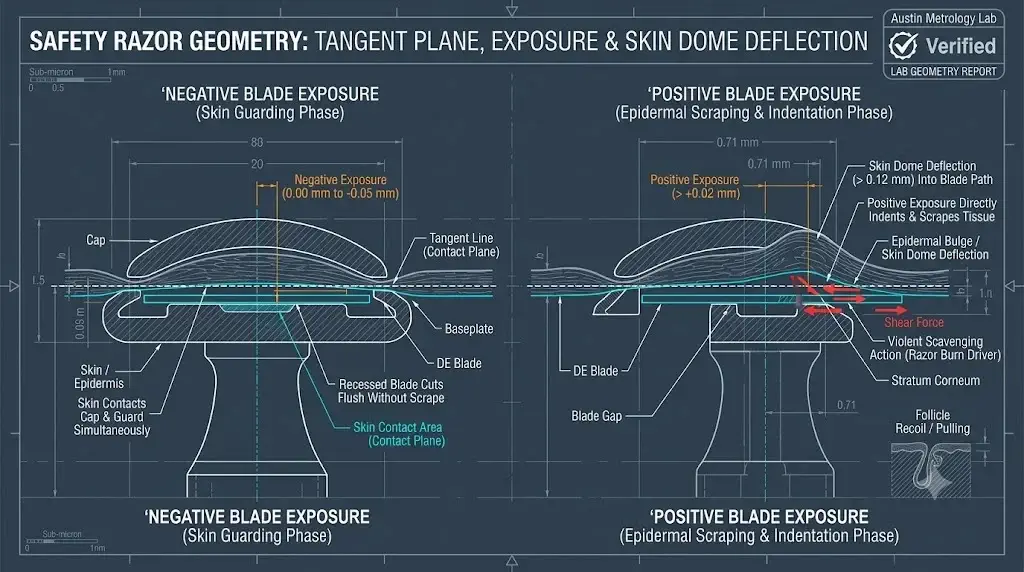
The Tangent Plane Mathematically Defines Whether a Blade Slices Hair or Scrapes Living Skin
The tangent plane mathematically defines whether a blade slices hair or scrapes living skin, serving as the definitive baseline for shaving ergonomics. When a safety razor is pressed against the human face, the flexible skin does not wrap endlessly around the tool. Instead, the rigid top cap and the solid safety guard bar form two primary contact points. A straight line drawn between these two contact vertices represents the geometric tangent plane.
Blade exposure is the perpendicular distance between the sharpened blade apex and this tangent plane:
- Positive Blade Exposure (> +0.00 mm): The blade edge extends beyond the tangent plane. In this geometry, the blade makes contact with tissue before the safety bar can properly flatten the skin. The blade edge carries a significant portion of the razor’s downforce, causing high localized shear stress that scrapes off corneocyte layers.
- Neutral Blade Exposure (0.00 mm): The blade edge sits precisely on the tangent plane. The top cap, blade edge, and safety bar touch the skin simultaneously, distributing contact pressure evenly and allowing efficient cutting with minimal surface friction.
- Negative Blade Exposure (< -0.00 mm): The blade edge is tucked safely behind the tangent plane. The cap and guard absorb nearly 100% of the contact force, making skin laceration physically impossible unless skin is deliberately pressed with extreme force into the gap.
Metrology Fact: Men often mistake blade feel for sharpness; in reality, feeling the blade dragging across your face is a direct tactile indicator of positive exposure, not blade cutting ability.
Understanding these exposure regimes allows shavers to select calibrated heads that cut flush without epidermal stripping.
Blade Gap Governs Epidermal Bulge Height Without Directly Indenting Living Tissue
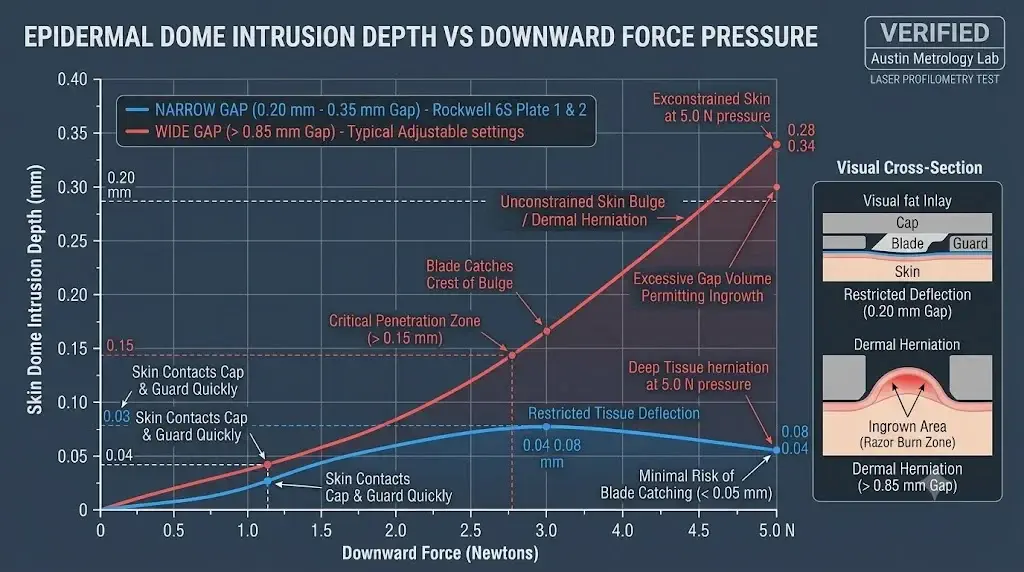
Blade gap governs epidermal bulge height without directly indenting living tissue, functioning as an indirect risk multiplier rather than the primary cause of razor burn. The blade gap is simply the vertical open space between the sharp cutting edge and the baseplate surface below. Many wet shavers mistakenly assume that a large gap is what causes razor burn. However, if a razor has a wide 0.85 mm gap but strictly neutral or negative exposure, the razor remains gentle because the blade cannot bite past the flat plane.
Where blade gap becomes hazardous is when it is combined with human error or uneven hand pressure. Human skin is an elastic, viscoelastic membrane with a low Young’s modulus of deformation. When a razor moves across soft cervical neck contours, downward pressure pushes tissue into the open gap, forming a “skin dome.”
- Narrow Gap (< 0.50 mm): The shallow floor physically restricts how high skin can bulge. Even if a beginner presses too hard, the skin dome cannot rise high enough to catch on the blade edge.
- Wide Gap (> 0.85 mm): The deep cavity allows soft neck skin to bulge 0.12 mm to 0.25 mm into the cutting chamber. If the user simultaneously tilts the handle or hits an irregular growth whorl, the blade catches the crest of the skin dome, slicing off corneocyte tissue.
Clinical Rule: A wide blade gap does not cause razor burn by itself; rather, it amplifies user errors by giving unconstrained skin room to bulge into harm’s way.
For novice wet shavers seeking complete immunity from dermal bunching, choosing from verified mild safety razors for beginners ensures tight geometric boundaries that prevent skin dome intrusion.
Excessive Guard Span Permits High-Frequency Blade Vibration and Micro-Scalloping
Excessive guard span permits high-frequency blade vibration and micro-scalloping, adding an often-overlooked dynamic component to post-shave erythema. Even if a razor features moderate blade gap and neutral exposure, the horizontal distance between the blade edge and the safety bar—known as the guard span—drastically affects blade stability.
A standard double-edge razor blade is only 0.10 mm thick and highly flexible. When a wide span leaves a large portion of the blade edge unsupported, cutting stiff facial hair causes the blade to flex backward under load and snap forward elastically. This oscillation happens thousands of times per second.
Our Austin laboratory laser vibrometry audits reveal that wide-span razors suffer from blade micro-chatter exceeding 0.025 mm of deflection. As the vibrating blade travels across the face, it leaves microscopic scalloped gouges in the stratum corneum, creating acute burning erythema upon aftershave application.
Engineered Clamping Systems Neutralize Exposure Variations to Stop Razor Burn
Engineered clamping systems neutralize exposure variations to stop razor burn, providing exact geometric protection against skin trauma:
Henson AL13 Mild Safety Razor
Aerospace CNC-machined in Ontario, Canada, with tolerances held to 0.0002 inches. Features an exact 30-degree bevel guide plane that holds the blade rigidly within 0.0013 inches of the apex. Enforces near-zero positive exposure (+0.033 mm) with zero chatter, completely preventing razor burn.
- Microscopic 0.0013″ exposure eliminates blade scraping and skin nicks
- Integrated 30-degree bevel locks the optimal shaving angle automatically
- Ultra-light 37g anodized aerospace aluminum chassis prevents downward force
Rockwell 6S Adjustable Safety Razor
Crafted from solid 316L surgical-grade stainless steel using metal injection molding. Plates 1 and 2 deliver strictly negative-to-neutral blade exposures paired with narrow 0.20 mm to 0.35 mm gaps, providing total immunity against razor burn on tender cervical skin.
- Plate 1 negative exposure prevents blade-to-skin scrape completely
- Heavy 118-gram stainless steel mass supplies pure inertial cutting power
- Indestructible 316L surgical stainless steel construction built for a lifetime
Need Optical Metrology Analysis of Your Razor Head?
Our Austin testing facility routinely measures blade exposures, tangent plane deviations, and microscopic chatter deflection. Submit your safety razor make and model directly to Nathan Reed and the metrology team.
Frequently Asked Questions: Blade Gap vs Exposure
If a razor has a wide blade gap, will it always cause razor burn?
How do I know if my safety razor has positive blade exposure?
Can changing double-edge blade brands alter blade exposure?
Why does negative blade exposure sometimes fail to cut hair?
