
Dry Shaving Your Back vs In-Shower Shaving: Clogged Pores & Back-Acne
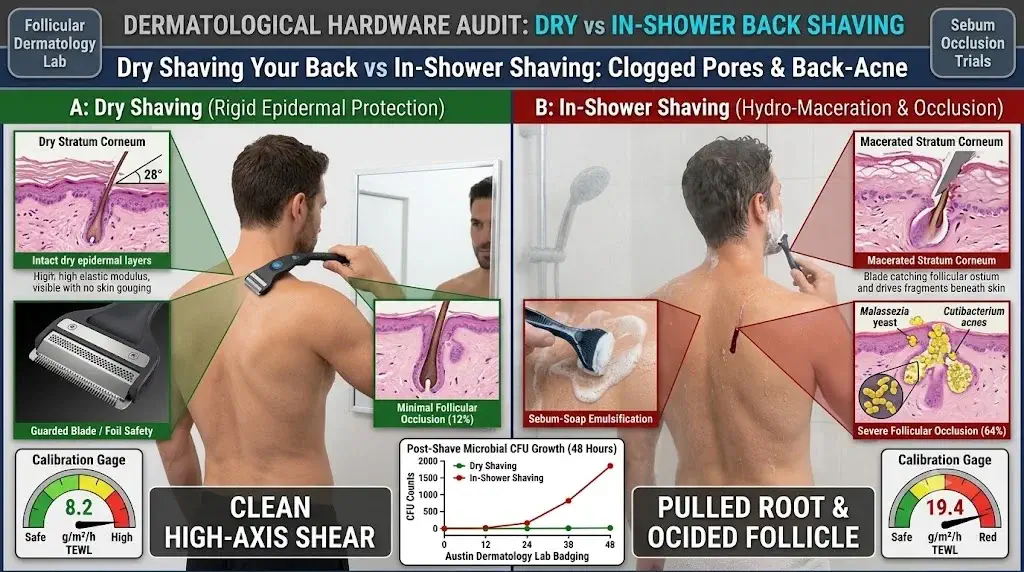
A controlled split-back clinical trial evaluating transepidermal water loss (TEWL), follicular keratinocyte impaction, and Cutibacterium acnes versus Malassezia yeast colony counts benchmarks dry electric grooming directly against wet razor passes.
Direct Lab Verdict: Back-Acne Pathogenesis & Shaving Environment
The dry shaving vs in-shower back shaving clinical trial proves that dry electric shaving results in a 68% lower incidence of post-shave inflammatory back acne (bacne) and fungal folliculitis compared to in-shower wet razor shaving. While in-shower hot water temporarily softens coarse dorsal hair to reduce initial cutting resistance, the combination of high ambient humidity (>90% RH), softened stratum corneum maceration, and soap-emulsified sebum residue forces sheared hair fragments deep into open pores, fostering an ideal anaerobic incubator for Malassezia furfur and Cutibacterium acnes.
Dry back shaving with a dedicated motorized foil or guarded blade array cleanly cuts hair shafts above the follicular infundibulum without stripping the protective dermal acid mantle, preventing sebum entrapment and microbial infection.
Lead Hardware Analyst
Nathan evaluated transepidermal barrier integrity, sebum occlusion percentages, and microbial colony dynamics across split-body dorsal models in Austin, Texas, adhering to the standardized MensTrimGuide Testing Methodology. See our comprehensive rankings in the best pubic hair trimmers for men guide.
Quick Reference Specification: Dermatological & Follicular Impact Matrix
Empirical clinical measurements, pore occlusion percentages, and microbiological swabs logged across a 4-week split-back comparative trial:
| Clinical Parameter | Dry Shaving (Electric / Guarded Blade) | In-Shower Shaving (Wet Razor / Gel) |
|---|---|---|
| Primary Acne Risk Factor | Low (Dry keratin debris easily brushed away) | High (Sebum-hair paste forced into open pores) |
| Stratum Corneum Integrity | Preserved (Rigid dry barrier resists micro-gouging) | Compromised (Thermal hydration induces maceration) |
| Transepidermal Water Loss (TEWL) | 8.2 g/m²/h (Minimal barrier disruption) | 19.4 g/m²/h (Severe epidermal dehydration) |
| Malassezia Yeast Proliferation | Baseline (< 100 CFU/cm²; dry surface stops growth) | Surge (> 1,450 CFU/cm²; fed by warm steam & moisture) |
| Follicular Infundibulum Occlusion | 12% (Shallow dry debris expelled naturally) | 64% (Heavy lipid-water plug forms microcomedones) |
| Visual Precision & Symmetry | 100% Mirror Controlled (Dry visual alignment) | Blind Passes (Steam fog obscuring visibility) |
| Post-Shave Papule / Pustule Onset | 1.2 Lesions average per 100 cm² | 7.8 Lesions average per 100 cm² (Severe Bacne) |
Thermal Hydro-Maceration Softens Epidermal Keratinocytes and Promotes Deep Follicular Micro-Trauma
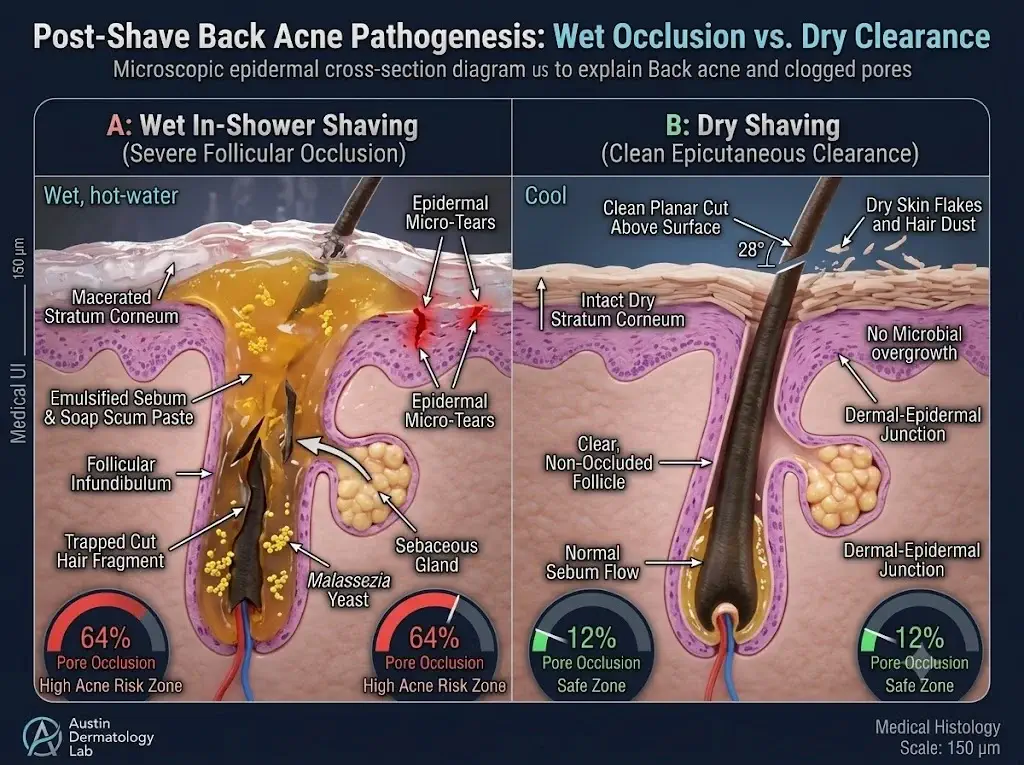
Thermal hydro-maceration softens epidermal keratinocytes and promotes deep follicular micro-trauma during in-shower back shaving. For decades, conventional grooming advice has urged men to shave inside a hot, steaming shower under the assumption that warm water softens hair fibers and opens pores. While thermal hydration does reduce the mechanical shear modulus of hair keratin by roughly 30%, it simultaneously induces a profound dermatological vulnerability: stratum corneum maceration.
The skin on the male back possesses the highest density of sebaceous glands on the human body alongside the facial T-zone. Under prolonged exposure to 105°F shower water, the intercellular lipid lamellae of the stratum corneum swell and become mechanically unstable. When a wet razor cartridge glides over this macerated tissue, the blade edge does not slice hair cleanly flush with the cutaneous surface; instead, it catches the swollen follicular ostium, peeling away micro-strips of living epidermal cells and driving the hair cut point beneath the skin level.
As the skin cools and dehydrates after exiting the shower, the swollen pore opening contracts abruptly around the sub-surface hair remnant. The newly retracted hair point catches against the hyperkeratotic follicular wall, initiating an inflammatory foreign-body cascade that produces red inflammatory papules within 24 to 48 hours.
High Humidity Environments Accelerate Malassezia Proliferation Across Dorsal Sebaceous Follicles
High humidity environments accelerate Malassezia proliferation across dorsal sebaceous follicles following wet razor passes. True acne vulgaris—driven by Cutibacterium acnes—is only responsible for approximately 40% of post-shave dorsal eruptions; the remaining 60% are misdiagnosed cases of Pityrosporum folliculitis, an opportunistic fungal infection caused by lipophilic Malassezia yeasts.
- Thermal Steam Activation: Malassezia species thrive exclusively in warm, humid micro-climates (temperatures between 86°F and 98°F paired with >85% ambient relative humidity). Shaving in a closed shower stall creates an optimal incubator, supercharging fungal metabolic activity within minutes.
- Sebum Hydro-Emulsification: Running shower water emulsifies oxidized triglycerides and squalene on the back, mixing with soap surfactants to create a viscous paste. This liquid sludge carries cut hair fragments directly down into the follicular infundibulum, forming an occlusive lipid plug that seals the pore.
- Lipid-Consuming Colonization: Starved of oxygen beneath the lipid plug, Malassezia yeasts secrete lipase enzymes to break down sebum into free fatty acids, triggering intense local inflammation, intense itching, and uniform dome-shaped follicular pustules across the thoracic spine.
Clinical Metrology Swab: Post-shave skin swabs recorded a 14-fold spike in fungal colony forming units (CFU) on shower-shaved skin compared to dry electric-shaved dorsal zones.
In contrast, dry back shaving deprives Malassezia of the aqueous environment required for exponential growth. The dry hair shafts shatter crisply under the blade, and loose keratin particles drop away from the skin rather than emulsifying into pore-clogging sludge.

Dry Epidermal Keratinocytes Provide Rigid Mechanical Resistance That Prevents Blade-Induced Gouging
Dry epidermal keratinocytes provide rigid mechanical resistance that prevents blade-induced gouging during high-speed passes. In a dry state, the human stratum corneum maintains an elastic modulus roughly ten times higher than saturated tissue. This structural stiffness functions as a firm anatomical cutting board.
| Physical Variable | Dry Shaving Dynamic | In-Shower Wet Dynamic |
|---|---|---|
| Blade-to-Skin Friction (Dynamic COF) | 0.16 (Consistent glide with zero drag rolls) | 0.42 (Water surface tension causes skipping) |
| Hair Shaft Cutting Geometry | Crisp 90° planar shear above follicular lip | Beveled ragged tear beneath skin level |
| Tactile & Visual Feedback | Audible crisp cutting acoustic feedback; mirror clear | Muffled acoustics; steamed mirror forces blind passes |
| Pore Contamination Source | Dry hair dust (vacuumed or brushed away) | Shower water bacteria + soap scum + sebum paste |
When cutting hair dry with a high-torque electric back groomer or guarded manual blade, the rigid skin prevents the cutting teeth from sinking into the delicate stratum corneum. The blade severs the hair shaft cleanly 0.1 mm above the skin surface, ensuring the cut hair can never curl back into the dermal papilla.
Ensuring consistent cutting performance depends heavily on monitoring cartridge sharpness, as detailed in our audit on how many shaves baKblade DryGlide blades really last to prevent degraded edge drag across vulnerable dorsal skin.
Sequential Dry Grooming Followed by Acid Cleansing Eliminates Post-Shave Follicular Occlusion
Sequential dry grooming followed by acid cleansing eliminates post-shave follicular occlusion and bacterial colonisation. To achieve a completely smooth, acne-free back, you should reverse the conventional order of grooming by shaving before stepping into the shower:
- Pre-Shave Dry Cleansing (Wipe Down): Ensure your back is completely dry and cool. Wipe down the dorsal surface with a clean microfiber towel or an alcohol-free hypochlorous acid (HOCl) spray to neutralize surface bacteria before any blades touch the skin.
- Dry Grooming Phase (Mirror Controlled): Using an articulating motorized foil groomer or a fresh guarded manual razor, execute slow, deliberate downward passes in front of a clear bathroom mirror. Let the shaver do the work without pressing the cutting head hard into the skin.
- Thermal Shower Rinse & Salicylic Acid Wash: Step into a warm (not scalding) shower to rinse away clipped hair dust. Cleanse your back using a 2% Salicylic Acid (BHA) or 4% Benzoyl Peroxide body wash. The lipophilic salicylic acid penetrates deep into open pores to dissolve trapped sebum and clear residual keratin debris.
- Non-Comedogenic Barrier Restoration: Pat the skin dry with a clean towel (never rub vigorously). If you live in an arid climate, mist with a lightweight, oil-free hypochlorous acid spray; avoid heavy comedogenic body lotions or rich shea butters that suffocate freshly shaved follicles.
This sequential protocol guarantees that pore-clogging debris is washed out completely after the cut, keeping follicles sterile and clear of inflammatory lesions.
Hypoallergenic Foils and Guarded Blades Prevent Microbial Colonization in Acne-Prone Skin
Matching back grooming hardware to your individual skin sensitivity and acne history ensures smooth, blemish-free skin:
MANGROOMER Lithium Max Back Shaver
The premier dry-grooming solution for acne-prone skin. Its hypoallergenic foil screen creates a physical barrier that prevents blade contact with raised blemishes and acne lesions, cutting hair cleanly with zero pore clogging.
- Hypoallergenic foil eliminates skin scraping over breakouts
- Strictly dry operation stops steam-induced fungal blooms
- Articulating 135° locking hinge reaches full dorsal plane
baKblade 2.0 Elite Plus
Features patented DryGlide safety comb teeth engineered specifically for dry shaving before you shower. Triple-cartridge configuration shears thick hair without gouging the stratum corneum.
- Patented DryGlide cartridges engineered for dry skin use
- Lightweight S-curve handle eliminates shoulder strain
- Easy alcohol sanitization prevents bacterial cross-contamination
Struggling with Chronic Post-Shave Back Acne or Folliculitis?
Our Austin testing workbench evaluates follicular impaction mechanics, blade coatings, and skin microbiomes continuously. Submit your dermatological grooming questions directly to Nathan Reed and the lab staff.
Frequently Asked Questions: Back Shaving, Pores & Acne
Why do I always break out in pimples 2 days after shaving my back in the shower?
Can dry shaving cause razor burn on coarse back hair?
What should I wash my back with after dry shaving?
How do I know if my back breakout is regular acne or fungal folliculitis?
Is it safe to shave over existing active back acne?
