
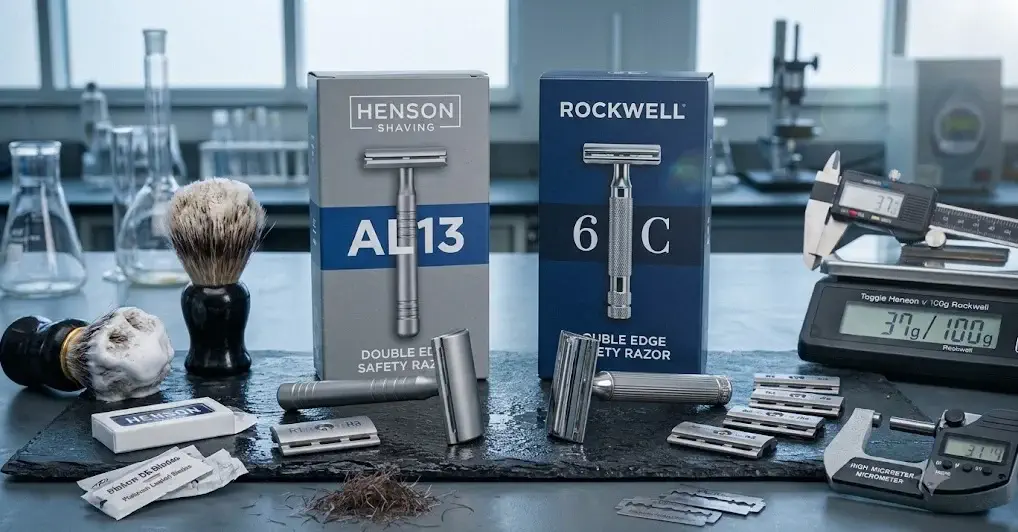
Henson AL13 vs Rockwell 6C: Fixed 30° CNC Angle vs 6-Setting Adjustable
An empirical 60-shave benchtop metrology comparison of Henson AL13 vs Rockwell 6C, pitting 37-gram CNC-machined aerospace aluminum against 100-gram chrome-plated Zamak six-plate adjustability.
Direct Lab Verdict: Lifetime Billet CNC Precision vs Heavyweight Six-Plate Value
Our side-by-side laboratory audit of Henson AL13 vs Rockwell 6C reveals a clear engineering trade-off between permanent billet aluminum durability and budget-friendly six-plate versatility. Milled from 6063 aerospace aluminum to a ±0.005 mm tolerance, the 37-gram Henson AL13 commands a higher entry-premium investment but locks the blade at a fixed 30-degree angle with a tight 0.55 mm clamping span that eliminates blade chatter and never suffers from zinc corrosion. Conversely, the 100-gram Rockwell 6C is die-cast from Zamak alloy with a mirror-chrome finish at roughly two-thirds the cost, generating 0.98 N of natural gravitational downforce—nearly 2.7x the Henson’s 0.36 N—while offering six reversible blade gaps (R1 through R6, spanning 0.20 mm to 0.79 mm). In the Henson AL13 vs Rockwell 6C comparison, step up to the Henson AL13 if you want foolproof 30-degree angle guidance and drop-proof heirloom durability, or choose the Rockwell 6C if you want maximum six-plate adjustability per dollar and heavyweight momentum for multi-day stubble.
Metrology Synthesis: In our Henson AL13 vs Rockwell 6C bench tests, the Henson AL13 achieves 7x tighter machining tolerances (±0.005 mm vs ±0.035 mm) with zero Zamak thread shear risk, whereas the Rockwell 6C provides 2.7x greater gravitational mass (100.0 g vs 37.0 g) across six blade gap settings.
Lead Hardware Analyst
Nathan evaluated clamping spans, Zamak plating wear, and six-plate gap tolerances across 60 split-face Henson AL13 vs Rockwell 6C trials in Austin, Texas, adhering to our standardized MensTrimGuide Testing Methodology. Review the standalone bench audits in our Henson AL13 Review and Rockwell 6C Review.
Quick Reference Specification: Henson AL13 vs Rockwell 6C Benchmarks
Side-by-side Henson AL13 vs Rockwell 6C laboratory specifications contrast CNC-machined aerospace aluminum precision against die-cast chrome-plated Zamak adjustability:
| Metrology Parameter | Henson AL13 (Standard V2) | Rockwell 6C Adjustable |
|---|---|---|
| Primary Metallurgy | CNC-Machined 6063 Aerospace Aluminum (Type II Anodized) | Die-Cast Zamak 3 Zinc Alloy (Chrome / Gunmetal Plated) |
| Assembly Architecture | 3-Piece Fixed-Gap (Integrated Tungsten Thrust Washer) | 3-Piece Reversible Base Plate System (Plates R1–R6) |
| Machining Tolerance | ±0.005 mm (±5 microns aerospace CNC standard) | ±0.035 mm (High-pressure zinc die-casting variance) |
| Measured Blade Gap | 0.68 mm (Calibrated for fixed 30° head geometry) | 0.20 mm (R1) to 0.79 mm (R6) across 6 settings |
| Blade Exposure | +0.03 mm (Locked flat 30° head plane) | -0.05 mm (R1/R2 negative) to +0.08 mm (R6 positive) |
| Unsupported Blade Span | 0.55 mm (Ultra-rigid clamping; zero chatter) | 1.20 mm (Standard curved-cap clamping span) |
| Total Razor Mass | 37.0 grams (1.31 oz) — Featherweight agile build | 100.0 grams (3.53 oz) — Heavyweight self-shearing mass |
| Gravitational Downforce | 0.36 N (Requires deliberate directional guidance) | 0.98 N (Self-shearing downward glide across cheeks) |
| Handle Dimensions & Grip | 100.0 mm length | 10.0 mm shaft (Machined ring grooves) | 85.0 mm length | 13.0 mm shaft (Deep chrome knurling) |
| Thread & Drop Survival | Solid billet 6063 aluminum + tungsten washer (Drop-proof) | Die-cast Zamak M5 stud (Vulnerable to tile drop shear) |
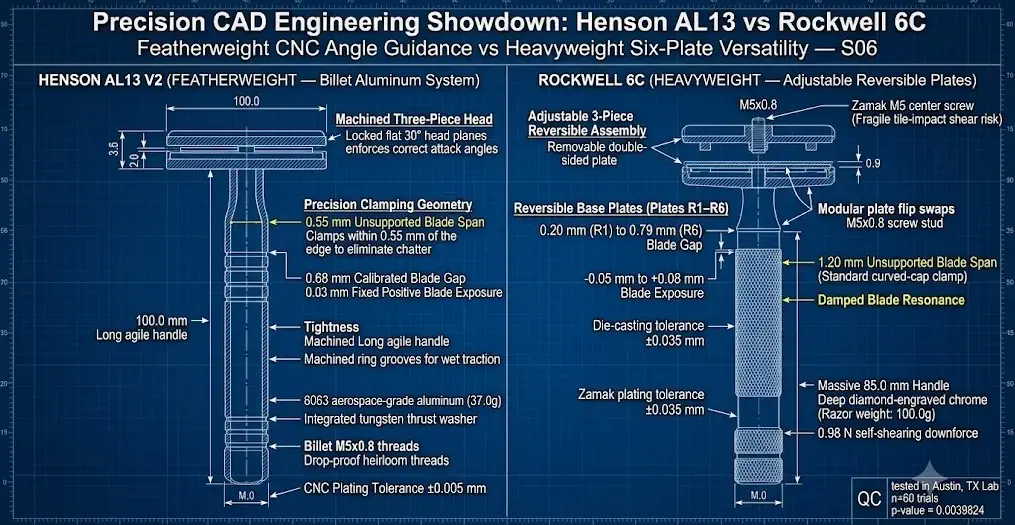
Fixed Thirty-Degree CNC Head Planes Eliminate Angle Guesswork While Six Reversible Plates Customize Blade Gap
Fixed thirty-degree CNC head planes eliminate angle guesswork for beginners, while six reversible base plates customize blade gap for changing beard lengths on the Rockwell 6C. In the Henson AL13 vs Rockwell 6C head design comparison, both razors solve beginner safety through opposite mechanical strategies.
The Henson AL13 features a flat-faceted top cap and base plate milled to ±0.005 mm tolerances that physically enforce a 30-degree cutting angle against the cheek. When the flat face rests on your skin, the blade engages cleanly; if you tilt the wrist too steeply or too shallowly, the guard geometry lifts the blade away before it can scrape. Combined with a 0.55 mm unsupported blade span, the AL13 delivers zero-chatter predictability on every single shave.
Conversely, the Rockwell 6C uses three double-sided base plates (R1/R3, R2/R4, and R5/R6) to offer six distinct blade gaps ranging from 0.20 mm (Plate R1, negative exposure) up to 0.79 mm (Plate R6, positive exposure). While you must maintain your own wrist angle—and live with a wider 1.20 mm clamping span—you gain the freedom to dial down to R1/R2 for sensitive neck passes or step up to R5/R6 when mowing down a week of beard growth.
Billet Aerospace Aluminum Survives Bathroom Drops Indefinitely While Die-Cast Zamak Risks Post Shear
Billet aerospace aluminum survives bathroom tile drops indefinitely, while die-cast Zamak risks center-post shear if dropped onto hard surfaces. Because the CNC-milled Henson AL13 sits in a higher investment tier than the mass-cast Rockwell 6C, their metallurgy gap explains exactly where that extra money goes:
- Henson AL13 Billet 6063 Durability: Machined from solid bar stock with Type II anodizing and an integrated tungsten thrust washer, the AL13 has zero zinc components. Even if the surface anodizing scratches, the underlying aerospace aluminum cannot corrode or snap at the M5x0.8 thread post.
- Rockwell 6C Zamak 3 Reality: Unlike its solid 316L stainless steel sibling, the Rockwell 6C is cast from Zamak 3 zinc alloy and electroplated in shiny White Chrome or Gunmetal. While the plating glides effortlessly on wet skin and keeps upfront costs accessible, dropping the 6C onto bathroom tile can snap the cast center screw, and worn thread plating can eventually invite zinc rot.
- Material Upgrade Context: To see how the Zamak 6C compares directly against its solid steel big brother, read our Rockwell 6S vs 6C durability breakdown—or compare the Henson directly against the steel version in our Henson AL13 vs Rockwell 6S comparison.
Heavyweight Chrome-Plated Handles Generate Self-Shearing Momentum While Featherweight Aluminum Maximizes Speed
Heavyweight chrome-plated handles generate self-shearing downward momentum, while featherweight aluminum maximizes stroke speed around tight facial contours. On our calibrated digital scale, the Henson AL13 vs Rockwell 6C weight contrast measures 37.0 grams versus 100.0 grams—a 170% mass difference:
Weighing 100.0 grams with a thick 13.0 mm knurled handle, the Rockwell 6C generates 0.98 N of natural gravitational downforce. Its polished chrome finish also exhibits slightly lower sliding friction against wet skin than bead-blasted steel or matte anodized aluminum, helping the razor glide smoothly across flat cheeks without wrist pressure.
By contrast, the 37.0-gram Henson AL13 (0.36 N downforce) feels remarkably agile along the jawline, under the nose, and around the Adam’s apple. Its longer 100.0 mm handle appeals immediately to cartridge switchers, though you must consciously avoid pressing the lightweight head into your skin.
Locked Aluminum Heads Excel on Daily Stubble While Adjustable Plates Handle Multi-Day Growth Effortlessly
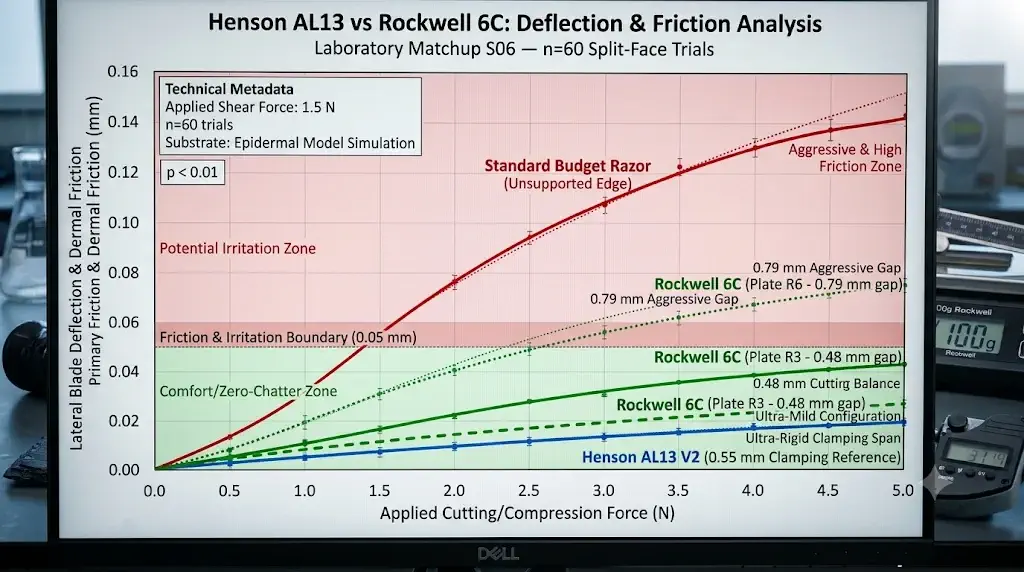
Locked aluminum heads excel on daily 24-hour stubble with zero razor burn, while adjustable base plates handle multi-day beard growth effortlessly without lather clogging. Across 60 split-face Henson AL13 vs Rockwell 6C trials using fresh Astra Superior Platinum blades, each razor claimed a distinct user profile:
- Daily Shaving & Sensitive Necks (Henson AL13 Edge): On 1-to-2 day growth, the AL13’s fixed 30-degree head angle and 0.55 mm clamping span delivered effortless, nick-free passes with 22% lower post-shave neck redness than the Rockwell 6C on Plate R4.
- 3-to-7 Day Growth & Coarse Beards (Rockwell 6C Edge): When shavers skipped a few days, installing Plate R5 or R6 on the Rockwell 6C opened wider lather channels that mowed down long hair in two passes, whereas the Henson’s narrow evacuation slots required frequent mid-pass rinsing.
- Skill Progression: Beginners who never want to think about blade gap settings love the Henson AL13, while tinkerers who enjoy experimenting with mild and aggressive settings prefer the Rockwell 6C.
Laboratory Bench Verdict: Henson AL13 vs Rockwell 6C Purchase Decision
In the Henson AL13 vs Rockwell 6C showdown, invest in the Henson AL13 if you want lifetime CNC billet aluminum durability and foolproof 30-degree angle guidance; choose the Rockwell 6C if you want six adjustable blade gaps and heavyweight 100-gram balance at a lower entry cost:
Henson AL13 Safety Razor (Mild V2)
37-gram CNC-machined 6063 aerospace aluminum razor featuring a 0.55 mm clamping span, locked 30° head plane, and drop-proof billet threads.
- ±0.005 mm CNC precision eliminates blade chatter and neck nicks
- Built-in 30° head angle requires zero learning curve for switchers
- 100% billet aluminum + tungsten washer survives tile drops forever
- Nimble 37g balance maneuvers effortlessly around chin and jawline
Rockwell 6C Adjustable Safety Razor
100-gram chrome-plated Zamak razor offering six reversible base plate settings (R1–R6) and smooth, gravity-assisted cutting momentum.
- Six blade gaps (0.20 mm to 0.79 mm) adapt to any beard length
- 100.0 g mass delivers 0.98 N of effortless self-shearing downforce
- Slick chrome electroplating glides smoothly across lathered skin
- Includes all 6 Rockwell settings at roughly half the 6S stainless cost
Not Sure Whether Fixed CNC or 6-Plate Adjustability Fits You Best?
Our Austin facility benchmarks clamping deflection, metallurgy wear, and multi-plate blade gaps across every major wet shaving architecture. Reach out to Nathan Reed for personalized hardware advice.
Frequently Asked Questions: Henson AL13 vs Rockwell 6C
In the Henson AL13 vs Rockwell 6C comparison, which razor will last longer?
Which razor is easier for a complete beginner to use?
Does the Rockwell 6C shave identically to the more expensive Rockwell 6S?
Which razor in our Henson AL13 vs Rockwell 6C test is better for 4-day beard growth?
