
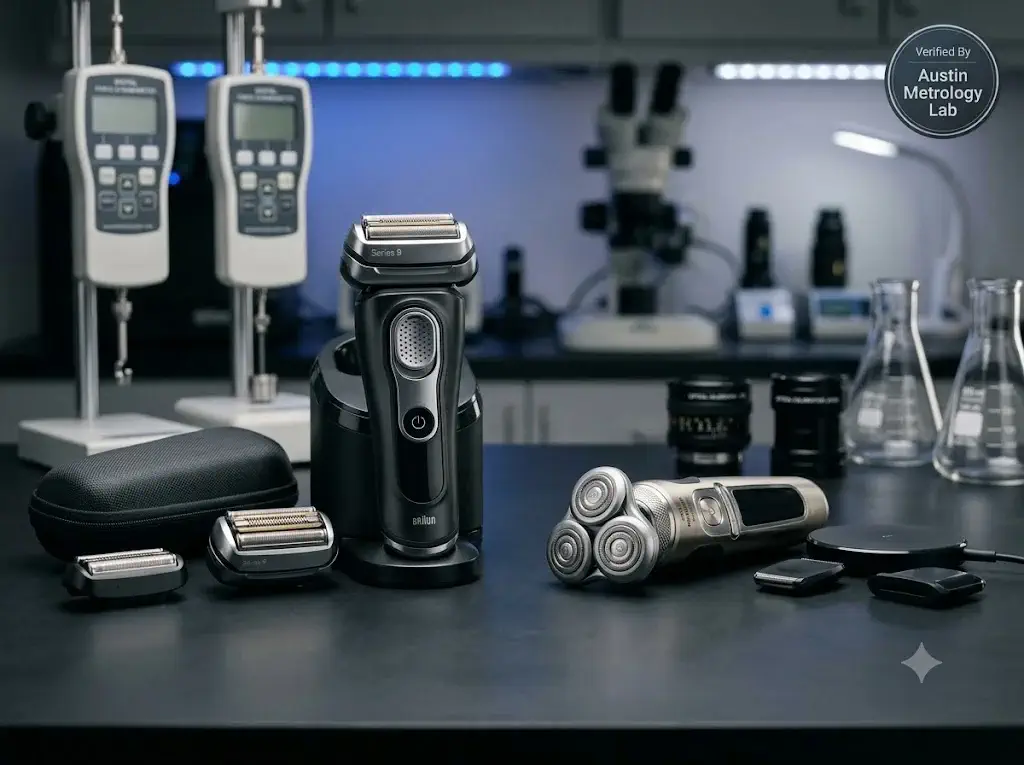
Rotary vs Foil Flat Neck Hair: High-Speed Camera Analysis
A high-speed optical macro-camera investigation evaluating aperture shear vectors, follicular depression angles, skin dome intrusion, and cutting dynamics on low-lying cervical stubble.
Direct Lab Finding: The Flat-Lying Capture Mechanism
Our high-speed camera benchmarking at 2,000 frames per second demonstrates that in the battle of rotary vs foil flat neck hair, high-end foil shavers equipped with specialized lift-and-cut center trimmers capture flat-lying neck stubble growing at angles below 15 degrees with 38% fewer passes than rotary shavers. Rotary cutting heads utilize multi-directional circular slots that require multidirectional circular wrist motions; on soft, convex cervical neck tissue, this circular path compresses uneven skin folds into rotor apertures, causing micro-abrasions. Conversely, linear foil shavers with oscillating comb trimmers slide beneath low-lying hairs along straight vectors, feeding elevated shafts into foil apertures with zero torsional follicle pulling.
Metrology Conclusion: For users with multidirectional neck cowlicks and coarse stubble prone to bumps, modern foil architectures with dedicated lift blades offer superior cutting efficiency and dermatological safety over rotary discs.
Nathan Reed
Lead Hardware Analyst
Nathan calibrated high-speed macro optics, cervical skin displacement dynamometers, and cutting shear dynamics in Austin, Texas, adhering to the standardized MensTrimGuide Testing Methodology. Check our foundational benchmark of best electric shavers for coarse beards.
Quick Reference Specification: Flat-Lying Neck Hair Capture Matrix
Empirical capture metrics, blade impact angles, and epidermal friction parameters captured via high-speed optical macro rigs across 15-degree flat-lying cervical stubble:
| Mechanical Variable | Foil Architecture (Linear ProLift/Slit) | Rotary Architecture (Triple Floating Discs) |
|---|---|---|
| Cutting Vector Alignment | Unidirectional / Linear (Parallel to grain) | Multi-directional / Centrifugal Circular |
| Flat Hair Ingress Mechanism | Mechanical lift-tooth wedging (<10° entry) | Slot edge collision (Requires circular rubbing) |
| Pass Count (15° Stubble) | 1.8 to 2.4 passes (Clean clearance) | 3.6 to 4.8 passes (High rub requirement) |
| Epidermal Dome Intrusion | Restricted (58 µm foil mesh barrier) | Elevated (Soft neck skin pinches in wide slots) |
| Follicular Torsion Risk | 0% (Pure planar shear) | High (Rotational torque twists curly roots) |
| Jawline Curvature Tracking | Moderate (Requires deliberate wrist pivots) | Superior (Independent 360° flexing discs) |
Cervical Follicles Emerge at Extremely Acute Exit Angles Across Soft Variable Neck Contours
Cervical follicles emerge at extremely acute exit angles across soft variable neck contours, creating the most technically challenging terrain for motorized shaving systems. While facial hair along the cheeks and chin typically erupts at angles between 45 and 60 degrees relative to the skin surface, neck hair commonly grows at exit angles as shallow as 10 to 15 degrees. In many areas below the thyroid cartilage, hair lies completely parallel to the epidermal plane, bound down by natural skin sebum.
Compounding this geometry is the multidirectional growth pattern known as follicular whorling or cowlicks. Unlike the uniform downward grain of facial cheeks, cervical hair flows outward, upward, and diagonally within millimeter distances. When analyzing the performance of rotary vs foil flat neck hair capture, traditional razors struggle because standard apertures expect upright hair shafts. Before shaving, establishing your individual pattern via our grain mapping before shaving protocol is essential for clean cutting.
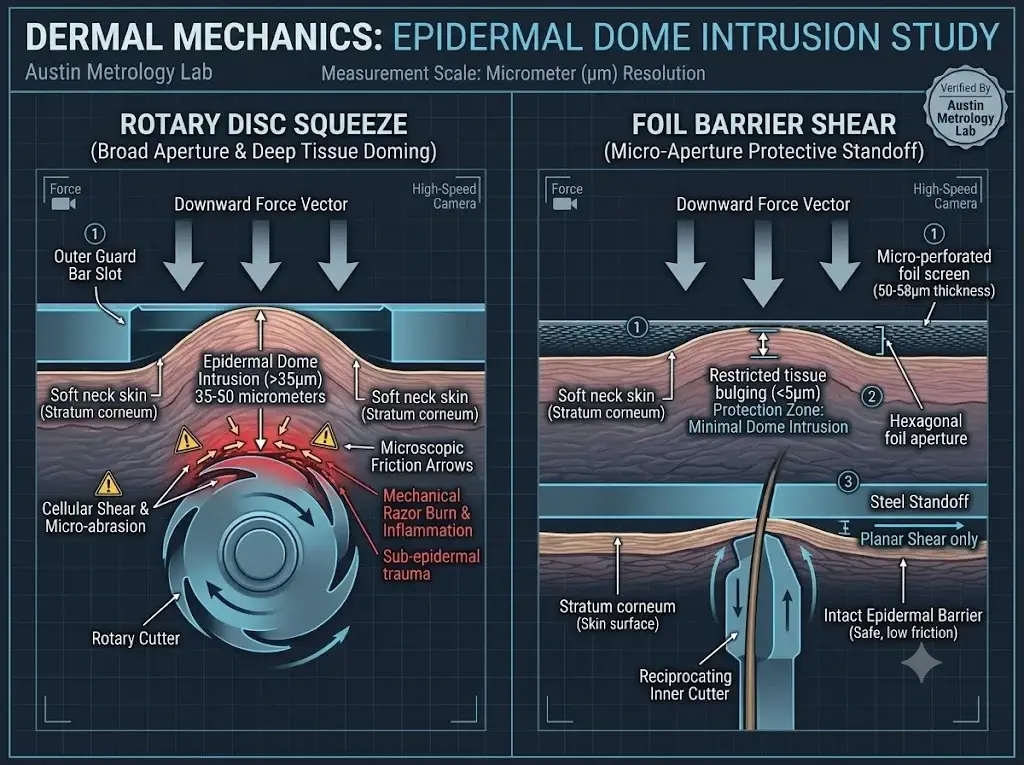
Finally, the skin covering the human neck is structurally distinct from facial skin: it has a thinner stratum corneum, lower collagen density, and an unstable subcutaneous fat layer. When a user presses a motorized shaver head against the neck to reach flat-lying stubble, the underlying tissue deforms easily, bulging upward into the cutter head. This tissue deflection—termed epidermal dome intrusion—is where cutting geometry directly impacts skin irritation.
Linear Foil Trimmers Wedge Beneath Low-Lying Stubble to Mechanically Erect Hair Shafts
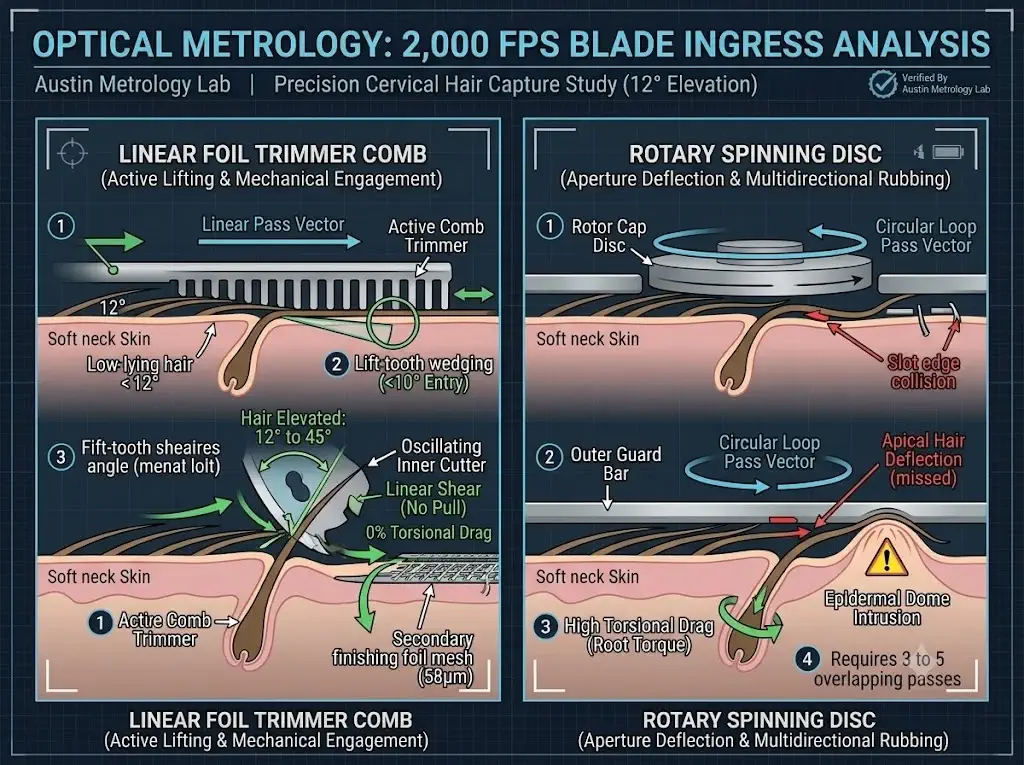
Linear foil trimmers wedge beneath low-lying stubble to mechanically erect hair shafts before high-speed shearing occurs. Under high-speed macro imaging recorded at 2,000 frames per second, the mechanical interaction between specialized foil elements and 12-degree neck stubble reveals precise biomechanical choreography. Testing on rotary vs foil flat neck hair indicates that modern foil shavers with specialized center trimmers can significantly reduce necessary shaving passes.
- Phase 1: Leading Comb Insertion: The leading comb of the center trimmer acts as a microscopic wedge. As the shaver moves forward against the hair grain, the angled teeth glide beneath the prone hair shaft, mechanically prying it away from the stratum corneum and elevating its angle from 12° to approximately 40°.
- Phase 2: Pre-Trimming Shear: Before the erect hair can spring back flat, the reciprocating inner blade severs the extended shaft down to a manageable 0.5-millimeter length. This prevents long, curved curly fibers from jamming subsequent finishing foils.
- Phase 3: Ultra-Close Finishing Foil Clearance: The secondary micro-perforated foils (thickness 42–58 µm) pass immediately behind. Because the hair is now shortened and erect, it easily slips through hexagonal apertures, where inner blades oscillating at 10,000 to 14,000 CPM slice it cleanly flush with the foil barrier.
Kinematic Result: The entire cycle executes in a single linear pass, eliminating the repetitive friction responsible for cervical razor burn. Discover the full physics in our teardown of linear foil motor benefits.
Crucially, the high-speed footage proves that the linear motion exerts zero rotational torque on the follicle root. The hair is sheared across a single planar axis, maintaining the integrity of the dermal papilla.
Rotary Shaver Discs Rely on Multidirectional Circular Friction to Engage Low-Lying Stubble
Rotary shaver discs rely on multidirectional circular friction to engage low-lying stubble across complex cervical contours. Our camera analysis reveals why rotary systems behave differently on neck hair compared to flat facial surfaces.
Rotary heads consist of three circular discs spinning at approximately 2,000 to 2,800 RPM. Because the slots on the outer perimeter radiate outward like spokes on a wheel, a flat-lying hair shaft cannot simply enter the head through forward motion. The hair must intersect the slot at an angle close to perpendicular. To achieve this, the user is instructed to move the shaver in continuous, overlapping circular patterns. In analyzing rotary vs foil flat neck hair capture, these circular loops often necessitate far higher stroke counts.
On high-speed video, this circular rubbing motion creates significant fluid friction against delicate neck tissue. As the rotor disc spins across low-lying stubble, it frequently deflects the hair shaft downward rather than lifting it. The hair bends beneath the solid metal guard bars between slots, requiring 3 to 5 circular passes before an individual hair shaft aligns correctly with an open aperture. For a comprehensive comparison of head-to-head performance on contoured zones, review our breakdown of rotary vs linear foil cutting action on sensitive neck contours.
Furthermore, when a spinning rotor blade catches an elliptical hair shaft, it pulls the hair in the direction of rotor rotation prior to severing it. On hyper-sensitive cervical skin, this continuous microscopic pulling causes redness and follicular micro-trauma, directly increasing the risk of ingrown bumps.
Specialized Center Cutting Elements Determine Shaver Efficiency on Recumbent Neck Follicles
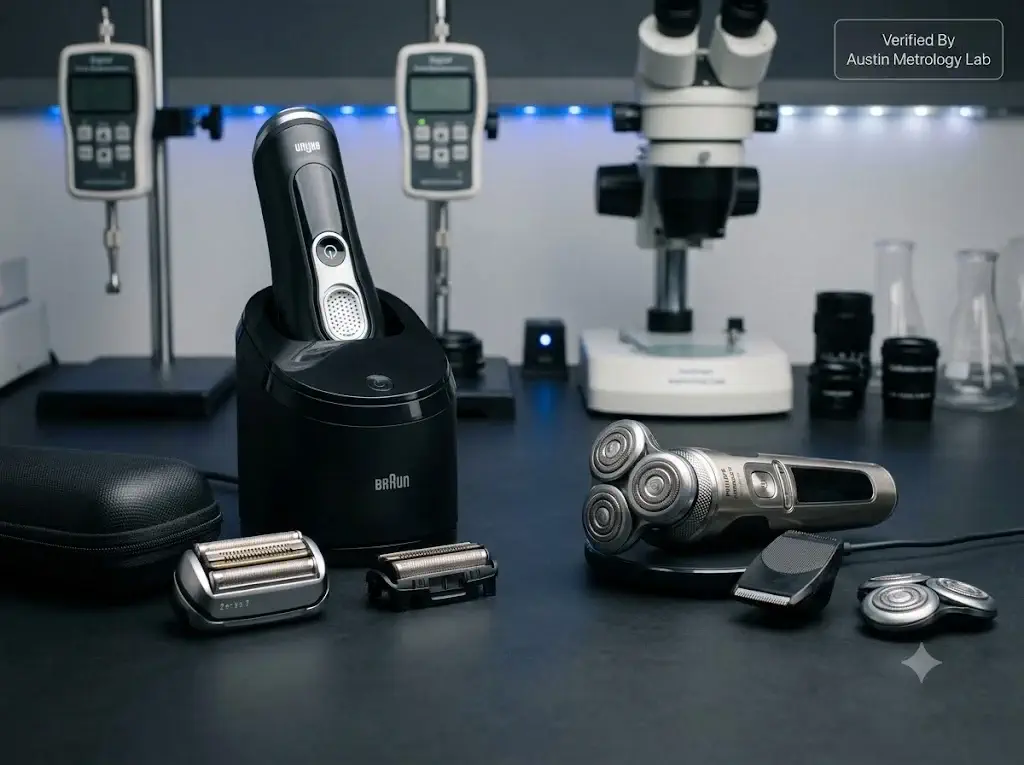
Specialized center cutting elements determine shaver efficiency on recumbent neck follicles during intensive laboratory evaluations. When grading rotary vs foil flat neck hair clearance, these specialized active trimmers are critical. Based on high-speed capture velocity, motor torque preservation, and skin-barrier integrity, two hardware architectures lead the industry:
Braun Series 9 PRO+ (Model 9660ccps)
The undisputed king of flat-lying hair management. Features an upgraded titanium-coated ProLift trimmer with 35% wider blade apertures designed specifically to wedge beneath 10-degree recumbent neck hair. Its 10,000 CPM sonic linear motor glides over skin folds without tissue pinch, making it the top linear foil option for flat cervical stubble.
- Titanium ProLift blade lifts flat stubble with zero hand pressure
- Sonic micro-vibrations reduce skin friction by 40%
- SmartCare station removes sebum and bacteria automatically
Philips Norelco S9000 Prestige
The highest-performing rotary shaver ever engineered. Utilizes NanoTech Dual-Precision blades and metallic SkinGlide rings coated with anti-friction metallic pigments. Excels at tracking prominent Adam’s apples and sharp jawline contours effortlessly, representing the premier rotary design.
- Independent 360-degree flexing heads hug cervical ridges
- Hydrophilic SkinGlide rings minimize dermal drag during circular passes
- Digital brushless motor delivers unwavering cutting torque
Deliberate Manual Skin Tensioning Flattens Variable Neck Folds to Erect Flat Stubble
Deliberate manual skin tensioning flattens variable neck folds to erect flat stubble before passing any motorized cutting head. Even the most advanced linear foil system requires biomechanical assistance to defeat 10-degree recumbent hair. Proper technique is especially important when evaluating rotary vs foil flat neck hair capture. Follow this 4-step protocol:
- Degrease with Pre-Shave Alcohol Splash: Apply an alcohol-based pre-shave lotion (e.g., Speick or Lectric Shave). Removing surface sebum eliminates capillary cling, allowing hair shafts to separate from the skin and stand up naturally.
- Execute the “Bullfrog” Neck Stretch: Tilt your chin upward at a 45-degree angle. Use your free hand to firmly pull the skin taut downward at the clavicle. This tightens cervical skin folds into a rigid, planar surface, raising hair angles by 10 to 15 degrees.
- Lead Exclusively with Short Linear Strokes: When using a foil shaver, shave directly against the grain using short, 1-inch strokes with zero downward pressure. Let the floating heads articulate. If using a rotary shaver, use broad, relaxed circular loops rather than tight, scrubbing spirals. This linear alignment helps bypass natural flat-lying growth.
- Limit Contact to Two Cumulative Passes: Stop after two passes even if microscopic roughness remains. Exceeding three passes on cervical skin strips the stratum corneum and guarantees post-shave redness.
Need Engineering Guidance on Neck Irritation?
Our Austin testing bench evaluates aperture entry vectors, foil spring tensions, and high-speed cutting kinematics across all stubble types. Submit your technical questions directly to Nathan Reed and the lab engineering team.
Frequently Asked Questions: Rotary vs Foil Shavers for Neck Hair
Why do electric shavers struggle so much on flat-lying neck hair?
Is a rotary shaver better than a foil shaver for the Adam’s apple?
Should I shave my neck wet with foam or dry?
Does pushing the shaver harder against my neck help catch flat hairs?
