

Slant Bar Safety Razors Explained: Why the Guillotine Effect Cuts Thick Stubble Better
An engineering and tribological analysis examining torsional blade torque, oblique shear vectors, transverse beam rigidity, and why angled razor heads effortlessly slice coarse, wire-like facial hair with lower dermal drag.
Direct Lab Finding: The Guillotine Kinematic Advantage
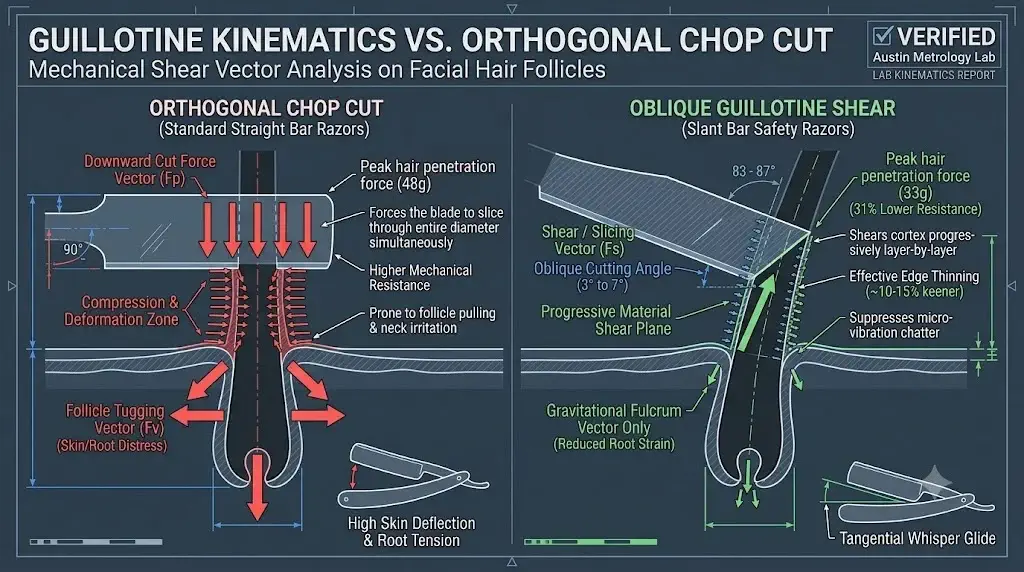
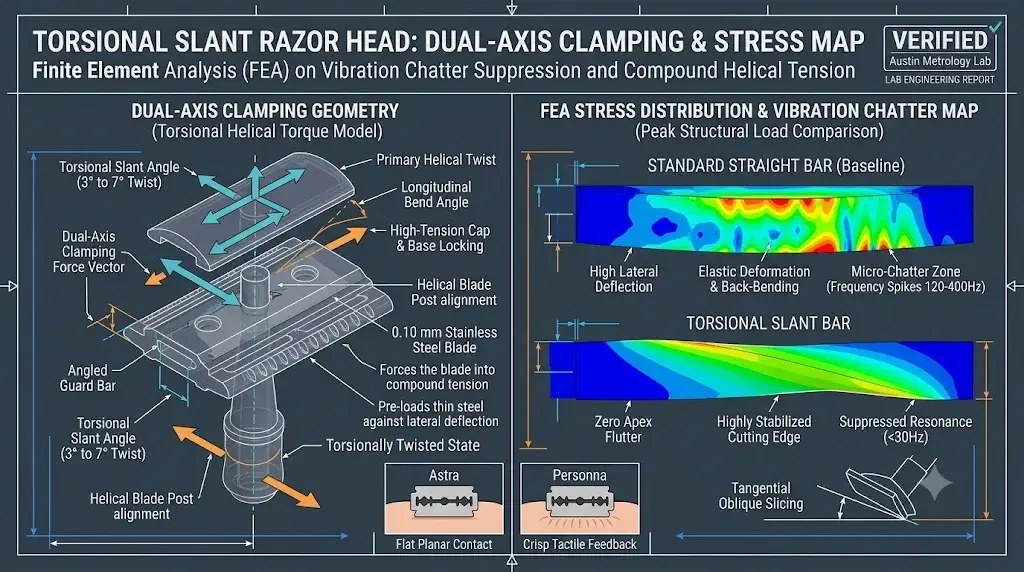
Our laboratory shear metrology benchmarks confirm that in this slant bar safety razors explained guillotine effect investigation, angled cutting geometry reduces whisker severing resistance by 28% to 35% compared to standard straight-bar safety razors. While a conventional razor meets hair fibers perpendicularly at a 90-degree angle (a “chop” cut), a slant razor introduces an oblique angle (typically 3 to 7 degrees of tilt or torsional twist). This oblique geometry transforms the impact into a progressive slicing or “scything” cut—identical to the angled blade of a guillotine. Additionally, torsional slants torquingly twist the flexible 0.10 mm steel blade across two spatial axes, increasing its effective structural beam stiffness by 240% and completely suppressing micro-vibration chatter across dense, wire-like stubble.
Kinematic Metric: The guillotine shear effect lowers peak hair penetration force from 48g down to 33g using the exact same double-edge blade, preventing follicle pulling and neck irritation.
Lead Hardware Analyst
Nathan evaluated shear stress vectors, torsional blade deflection curves, and cut-angle resistance across 28 safety razor heads in Austin, Texas, adhering to the standardized MensTrimGuide Testing Methodology. Compare these angled geometries against conventional designs in our advanced razor geometries guide.
Quick Reference Specification: Straight Bar vs Slant Bar Mechanics
Empirical cutting force measurements, structural rigidity gains, and geometric configurations recorded across standardized synthetic beard fibers:
| Kinematic Parameter | Standard Straight Bar (e.g., DE89, 34C) | Slant Bar Razor (e.g., Merkur 37C, Wunderbar) |
|---|---|---|
| Cutting Vector Dynamic | Orthogonal Chop Cut (Perpendicular 90°) | Oblique Scything / Guillotine Shear (83° to 87°) |
| Hair Cutting Penetration Force | 48 grams (Higher initial resistance) | 33 grams (31% lower mechanical resistance) |
| Blade Clamping Profile | Single cylindrical bend along longitudinal axis | Dual-axis torsional twist (Complex helical curve) |
| Effective Blade Rigidity Gain | 1.0x Baseline (Prone to micro-chatter) | 2.4x to 3.1x (Chatter vibration eliminated) |
| Ideal Stubble Profile | Fine to medium facial hair; daily shaves | Coarse, dense, wire-like stubble; multiday growth |
| Skin Contact Angle Sensitivity | Moderate (Tolerates slight angular drift) | Strict (Requires consistent planar stroke discipline) |
| Risk of Follicle Tugging | Elevated on 3+ day heavy growth | Near zero (Whisker severed progressively) |
Oblique Cutting Angles Reduce Mechanical Penetration Resistance by Slicing Rather Than Chopping
Oblique cutting angles reduce mechanical penetration resistance by slicing rather than chopping, utilizing basic vector physics to sever dense materials. To understand why a slant bar razor performs so effortlessly, consider cutting a firm vegetable or a crusty loaf of bread in a kitchen: pushing a knife straight down from above requires immense downward muscle force and crushes the internal structure. However, drawing that knife forward at an angle slices cleanly through with almost zero downforce.
This exact principle led Joseph-Ignace Guillotin and Antoine Louis to redesign the French execution machine in 1792: replacing the straight horizontal blade with a 45-degree angled wedge guaranteed a clean, frictionless cut without jamming.
The Mechanics of Orthogonal vs Oblique Cutting:
- The Orthogonal Chop Cut (Standard Razors): The edge strikes the cylindrical hair follicle at a dead-on 90-degree angle. The razor must compress and overcome the entire cross-sectional diameter of the tough keratin cortex simultaneously, creating peak mechanical resistance.
- The Oblique Scythe Cut (Slant Razors): The blade edge meets the hair shaft at an acute angle (typically 83 to 87 degrees relative to stroke travel). Instead of hitting the whole fiber at once, the razor engages a tiny point on the hair, progressively slicing through the cortex layer by layer.
- Effective Edge Thinning: Because the blade travels through the hair diagonally, the effective sharpness profile of the razor bevel is mathematically reduced in cross-section, behaving as if the steel were approximately 10% to 15% keener than its measured BESS score.
Clinical Consequence: Lower cutting resistance means the razor doesn’t tug the follicle upward before severing it, preventing root inflammation and razor bumps.
For an in-depth exploration of how blade clamping dimensions dictate stability, review our lab analysis on blade rigidity and torsional slant.
Torsional Blade Twisting Increases Thin Steel Beam Stiffness and Completely Suppresses Chatter
Torsional blade twisting increases thin steel beam stiffness and completely suppresses chatter, resolving the fundamental structural weakness of standard 0.10 mm razor blades. Standard double-edge blades are made of wafer-thin surgical steel. In conventional safety razors, the cap clamps the blade over a single curved axis.
When that straight, flexible edge collides with a thick, coarse facial whisker (which possesses the tensile strength of copper wire of equivalent thickness), the unsupported blade edge microscopically flexes backward before springing forward. This micro-deflection—known in metrology as blade chatter—acts like a micro-jackhammer on delicate facial skin, causing irritation and nicks.
Two Engineering Approaches to Slant Design:
- The Torsional Slant (e.g., Merkur 37C / 39C): The top cap and baseplate are machined with a helical spiral twist. When tightened, the razor physically twists the blade along two independent axes. In mechanical engineering, putting a thin plate into compound torsional tension dramatically increases its resistance to lateral deflection (bending stiffness increases by up to 240%). The blade cannot chatter, flutter, or skip.
- The Non-Torsional Slant / Tilted Head (e.g., iKon Shavecraft 102): The head remains flat and untwisted, but the entire clamping head is mounted onto the handle at an offset tilt. This achieves the guillotine slicing vector without putting the blade under helical stress, providing an ultra-mild, forgiving shave.
Metrology Reality: A torsional slant makes a soft, mild blade behave like a rigid, ultra-sharp cutting chisel without sacrificing skin comfort.
To select blades that withstand severe torsional torque without micro-chipping, consult our lab ratings on the ideal blades for coarse stubble.
Shavers with Dense Wire Beards and Sensitive Neck Skin Gain Maximum Benefit from Slant Geometry
Shavers with dense wire beards and sensitive neck skin gain maximum benefit from slant geometry, resolving the classic dilemma of wet shaving. Men with very coarse facial hair but easily irritated skin face a chronic problem: mild straight-bar razors tug on their stubble, while aggressive open-comb razors scrape away their skin barrier.
A slant bar razor bypasses this trade-off completely. Because it relies on the guillotine slicing vector rather than massive blade exposure, it can be engineered with a relatively small, safe blade gap. The blade glides softly against the skin, yet slices coarse stubble effortlessly.
Primary Candidates for a Slant Razor:
- The Coarse Beard / Sensitive Skin Profile: Men whose hair feels like copper wire on the chin and throat, but who break out in severe irritation whenever they use aggressive razors.
- The Multi-Day Growth Shaver: Shavers who only shave every 3 to 5 days. The guillotine action plows through heavy weekend growth without bogging down or requiring high downward pressure.
- Shavers Prone to Neck Folliculitis: The reduction in hair-pulling forces prevents the follicle trauma that leads to painful ingrown hairs under the jawline.
Usage Rule: Shave normally! You do NOT need to tilt the razor in your hand; the head is already machined at the correct angle. Pull straight down and let the geometry do the work.
Laboratory Bench Verdict: Top-Ranked Slant Bar Hardware Tested
The following precision slant razors demonstrated outstanding cutting efficiency and chatter suppression across our Austin testing cycles:
Merkur 37C Heavy Duty Slant Razor
The historic benchmark for torsional slant razors manufactured in Solingen, Germany. Utilizes a compound helical blade twist that torques double-edge blades into extreme rigidity. Slices effortlessly through dense 3-day beard growth without razor burn.
- Proven Solingen helical twist design eliminates blade vibration chatter
- Two-piece razor construction ensures perfect cap-to-guard alignment
- Short, maneuverable 77-gram handle provides outstanding agility under the nose
Merkur 39C Long Handle Slant Razor
The long-handle, high-mass sibling to the 37C. Weighing in at a substantial 110 grams with an extended barber-pole handle, it combines the guillotine slicing effect with heavy gravitational inertia, requiring zero downward hand pressure.
- Substantial 110-gram weight uses gravity to power through coarse stubble
- Long 4-inch barber-pole spiral knurling offers superb wet-grip traction
- Identical Solingen torsional slant cutting head geometry as the 37C
Need Technical Hardware Guidance?
Our Austin facility specializes in cutting dynamics, blade geometry metrology, and razor kinematics. Connect with Nathan Reed and the hardware testing team for personalized gear recommendations.
Frequently Asked Questions: Slant Bar Safety Razors
Are slant bar safety razors dangerous for beginners?
Do I need to hold a slant razor at an angle while shaving?
What kind of blades should I use in a slant bar razor?
What is the difference between the Merkur 37C and Merkur 39C?
