
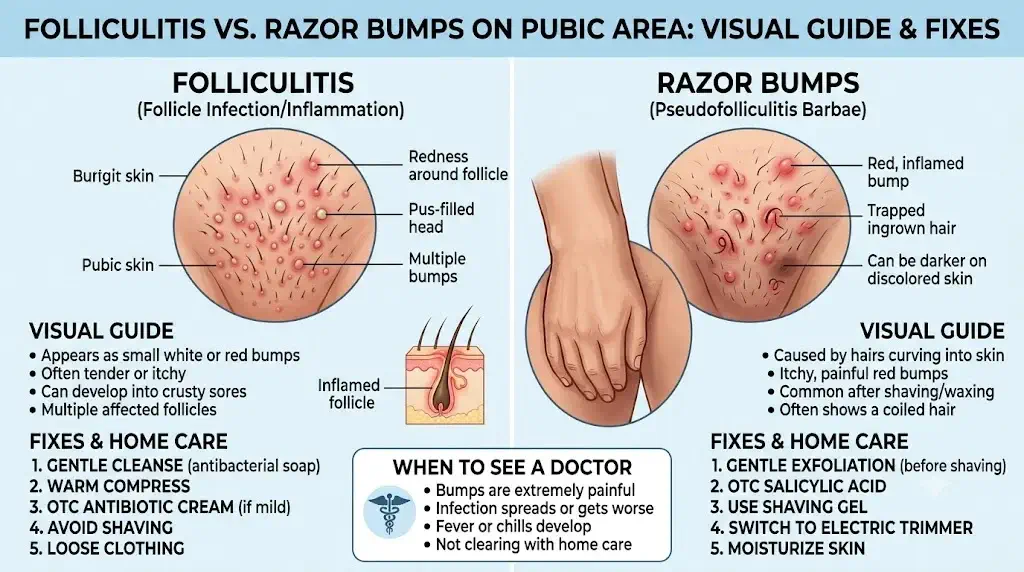
Folliculitis vs Razor Bumps on Men’s Pubic Area: Visual Guide & Fixes
Clinical microbiological analysis, epidermal mechanical penetration pathways, and hardware standoff metrology establish clear diagnostic boundaries between pubic bacterial infections and ingrown follicle papules.
Direct Lab Diagnostic: Folliculitis vs Razor Bumps Distinction
The folliculitis vs razor bumps pubic area differentiation centers strictly on bacterial etiology versus mechanical follicle penetration. Pubic folliculitis represents an active infection of the follicle pore primarily induced by Staphylococcus aureus or Malassezia species, clinically manifesting as uniform 1–2 mm erythematous pustules filled with white purulent exudate that itch intensely and spread via microbial transfer. Conversely, razor bumps (Pseudofolliculitis barbae) represent non-infectious, sterile foreign-body inflammatory papules caused by curved, sharp hair tips curling backwards and penetrating the surrounding perfollicular stratum corneum, triggered directly by manual razor blades cutting beneath the skin plane.
Resolving folliculitis requires antimicrobial wash agents (chlorhexidine or benzoyl peroxide 5%), whereas resolving razor bumps requires eliminating sub-surface hair cutting by switching to an electric groomer maintaining a calibrated 0.5 mm standoff margin.
Nathan Reed
Lead Hardware Analyst
Nathan investigated follicle mechanical entry angles, cutter hygiene vectors, and dermal standoff thresholds in Austin, Texas, adhering to the standardized MensTrimGuide Testing Methodology. Explore our benchmarked hardware in the safest pubic hair trimmers for loose skin pillar guide.
Quick Reference Specification: Diagnostic Differentiation Matrix
Laboratory pathology measurements, morphological characteristics, and therapeutic clinical markers comparing groin pustules against mechanical ingrown papules:
| Diagnostic Marker | Pubic Folliculitis (Infectious) | Razor Bumps / Pseudofolliculitis (Mechanical) |
|---|---|---|
| Primary Underlying Etiology | Bacterial (S. aureus) or Fungal invasion | Mechanical extrafollicular / transfollicular ingrown hair |
| Visual Lesion Morphology | Erythematous papules with white/yellow purulent heads | Solid red, firm, hyperpigmented papules with visible loop |
| Hair Shaft Position | Hair shaft pierces directly through the center of the pustule | Hair tip curves backwards, burrowed beneath epidermis |
| Subjective Physical Sensations | Dominant itching (pruritus), burning, tender on touch | Mild stinging during friction, localized soreness |
| Lesion Dispersion Pattern | Cluster spreading via scratching; can spread past shaved area | Isolated strictly to zones subjected to close razor passes |
| Onset Latency Post-Grooming | 24 to 72 hours post-shave (bacterial incubation) | 48 hours to 7 days post-shave (hair re-growth arc) |
| Primary Therapeutic Class | Topical antiseptic (Benzoyl Peroxide 5%, Clindamycin) | Chemical keratolytics (2% Salicylic acid), manual release |
| Hardware Engineering Cure | Sterilization of blade cassette (70% IPA), clean seals | Maintain minimum 0.50 mm blade guard standoff margin |
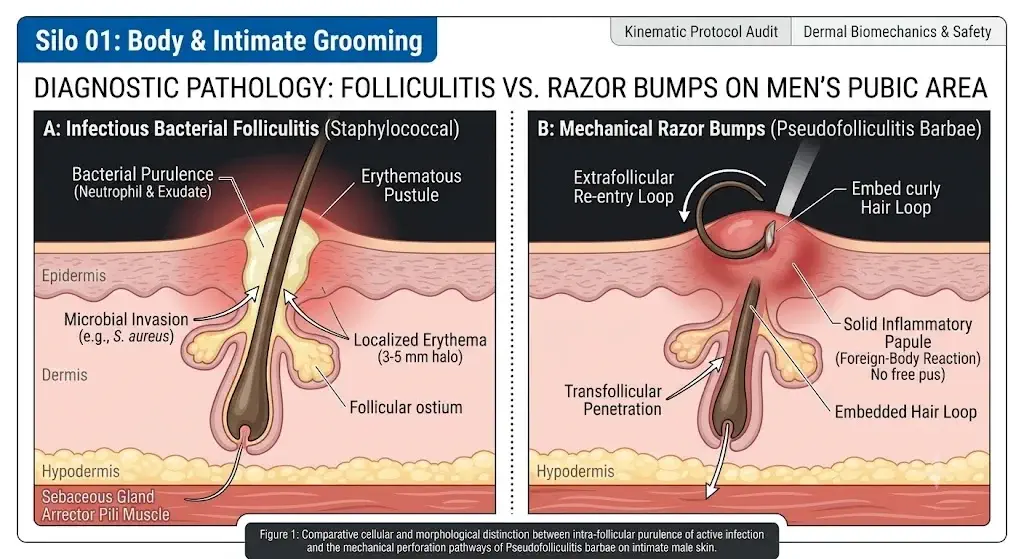
Microbial Pathogens Colonize Micro-Fissures in the Intimate Stratum Corneum
Microbial pathogens colonize microscopic epidermal fissures created during aggressive intimate shaving routines. The male groin area represents a unique microbiological biome characterized by elevated relative humidity (exceeding 85% in seated postures), higher lipid sebum secretions, and an ambient skin temperature of approximately 95°F. Under normal homeostasis, the epidermis acts as an impermeable physical barrier against transient bacteria. However, when a manual multi-blade razor or an unshielded trimmer passes over delicate skin, the sharpened edge shears away layers of stratum corneum cells, leaving microscopic epidermal fissures.
Once this physical barrier is disrupted, opportunistic bacteria—primarily Staphylococcus aureus, and less frequently Pseudomonas aeruginosa from contaminated hot tubs or damp bath sponges—migrate down into the follicular ostium. Inside the follicle canal, bacteria metabolize trapped sebum and multiply rapidly. The host immune system responds by mobilizing neutrophils, producing localized inflammation, vasodilation, and a central accumulation of purulent white exudate directly around the hair shaft.
Fungal folliculitis (Pityrosporum or Malassezia folliculitis) follows a parallel path but is driven by lipophilic yeasts that thrive in sweaty synthetic underwear. Unlike mechanical ingrown hairs, bacterial and fungal folliculitis are contagious across adjacent pores. Scratching an itching pubic mound mechanically transfers pathogens under the fingernails to neighboring follicles, producing rapid geographic clustering. Understanding tooth slot geometry is critical to avoiding the dermal micro-abrasions that invite these bacteria, as detailed in our analysis of ceramic trimmer teeth pitch and spacing.
Beveled Hair Tips Penetrate Perifollicular Skin to Initiate Foreign-Body Inflammation
Beveled hair tips penetrate adjacent perifollicular epidermis to initiate a sterile foreign-body inflammatory reaction. Pseudofolliculitis barbae, commonly termed razor bumps, is fundamentally a mechanical physical injury rather than an infectious disease. Male pubic hair fibers are uniquely predisposed to this disorder due to their elliptical cross-section, which causes the shaft to curve tightly in a natural spiral with a radius of curvature between 2 mm and 5 mm.
- Extrafollicular Penetration (The Re-Entry Loop): When a hair is shaved down to skin level, it exits the follicle pore at an acute angle (15°–30°). As the curly strand grows 1 to 2 mm longer, the tip loops backward, contacting the neighboring skin. The razor-cut hair edge acts like a microscopic needle, piercing the stratum corneum from the outside and driving keratin into the dermis.
- Transfollicular Penetration (The Sub-Surface Retraction): Multi-blade manual razors utilize hysteresis mechanics: the first blade pulls the hair shaft outward, and the second blade severs it below the skin plane before it snaps back into the dermis. As the hair regrows beneath the epidermal roof, its sharp edge pierces through the internal follicle wall directly into the dermis without ever emerging onto the surface.
Pathology Takeaway: Because human keratin contains immunogenic proteins, its presence inside dermal tissue triggers an immediate foreign-body reaction, forming a painful, hyperpigmented inflammatory papule without any living bacteria present.
This mechanical failure occurs almost exclusively when hairs are cut flush with or beneath the dermal plane (0.00 mm to 0.05 mm). By maintaining a calibrated standoff margin of 0.50 mm or higher using purpose-built electric grooming hardware, the hair tip remains permanently positioned outside the skin plane, making both transfollicular and extrafollicular loops physically impossible. To see how specialized dual-head trimmers achieve this, review our teardown of foil blades vs ceramic clippers.
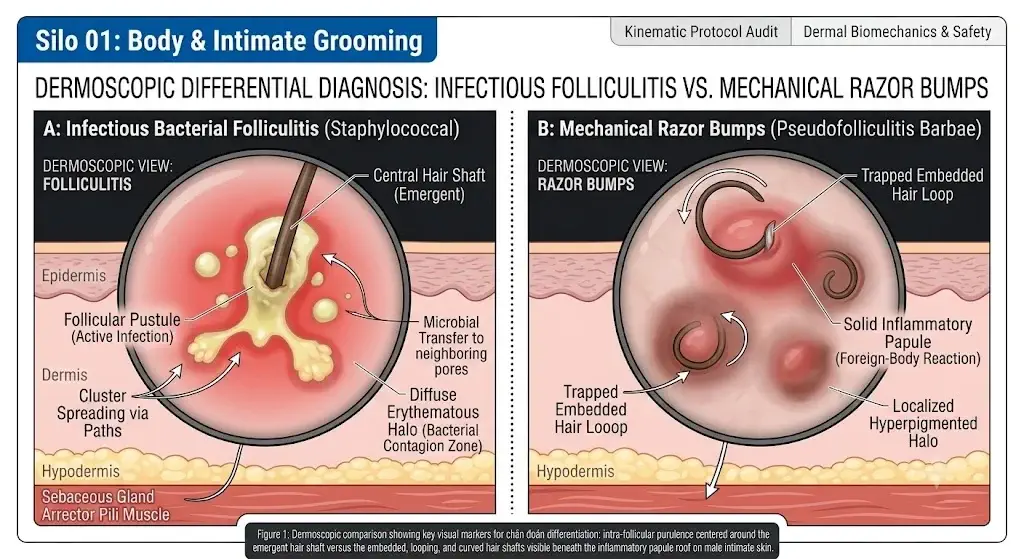
Dermoscopic Visual Markers Distinguish Infectious Purulence from Mechanical Loops
Dermoscopic visual markers distinguish infectious purulence from mechanical foreign-body loops under polarized light. Self-diagnosing pubic bumps without magnification frequently leads to incorrect treatments—such as applying drying alcohol to sterile razor bumps or picking bacterial pustules, which causes deep subcutaneous abscesses.
| Diagnostic Feature | Bacterial / Fungal Folliculitis | Razor Bumps (Pseudofolliculitis) |
|---|---|---|
| Lesion Apex Examination | Fluctuant pustule containing white or yellowish purulent exudate | Erythematous, solid dome; non-fluctuant with no free pus |
| Perifollicular Erythema | Broad, diffuse pinkish-red halo radiating 3–5 mm outward | Tightly localized reddish-brown halo (1–2 mm radius) |
| Magnified Dermoscopy | Hair shaft emerges centrally through necrotic pustular core | Dark coiled or arched hair visible trapped beneath translucent stratum corneum |
| Response to Manual Palpation | Soft, warm to touch, releases fluid easily when compressed | Firm, rubbery, indurated nodule; does not drain unless unroofed |
| Post-Inflammatory Sequelae | Crusting, superficial desquamation, minimal hyperpigmentation | Prolonged hyperpigmented macules, potential keloidal scarring |
A critical clinical differentiation is palpation texture: squeezing a razor bump produces only blood and tissue clear fluid because there is no underlying bacterial abscess. Squeezing a true folliculitis pustule releases infectious bacteria across neighboring microscopic skin abrasions, accelerating breakout density. When executing groin grooming, manual skin stabilization via the 3-finger skin stretch method prevents the blade from scraping away protective stratum corneum layers.
Targeted Clinical Therapies Neutralize Bacterial Growth and Dissolve Keratin Plugs
Targeted clinical therapies neutralize microbial colonization and chemically exfoliate obstructive keratin plugs. Because folliculitis and razor bumps have fundamentally different root causes, treating them with the same product produces poor clinical outcomes. Follow these evidence-based treatment regimens:
Folliculitis Eradication Protocol
- Antimicrobial Wash: Cleanse the pubic mound once daily with a 4% to 5% Benzoyl Peroxide wash or 4% Chlorhexidine gluconate. Leave on the skin for 2 minutes before rinsing to ensure adequate bactericidal contact time.
- Warm Compresses: Apply a clean, warm, moist washcloth for 10 minutes, 3 times daily to promote circulation and accelerate natural pustule drainage without squeezing.
- Topical Antibiotics: For stubborn bacterial pustules, apply topical 1% Clindamycin gel twice daily. For suspected fungal yeast folliculitis, apply 1% Ketoconazole cream.
- Moisture Management: Eliminate friction-induced epidermal chafing and excessive perspiration buildup by applying targeted talc-free ball powders and lotion barriers.
- Grooming Moratorium: Cease all electric trimming and manual shaving for 10 to 14 days until all pustules have fully cleared.
Razor Bump Extraction Protocol
- Beta-Hydroxy Acid (BHA): Apply a 2% Salicylic Acid solution daily. Salicylic acid is oil-soluble, penetrating deep into the sebum-rich follicle pore to dissolve the keratin cap trapping the hair shaft.
- Sterile Loop Release: If an ingrown hair loop is visibly trapped beneath the epidermis, use a sterile needle or fine forceps to gently dislodge the hair tip. Never pluck the hair from the root; simply free the tip to grow outward.
- Hydrocortisone 1%: Apply 1% hydrocortisone cream for 48 hours to suppress acute foreign-body dermal swelling and reduce hyperpigmentation risk.
- Permanent Standoff Shift: Discontinue manual multi-blade wet razors permanently. Transition to an electric clipper calibrated with a 0.5 mm standoff.
Cutter Blade Standoff Margins Determine Long-Term Ingress and Follicle Health
Cutter blade standoff margins determine whether regrowing hair tips can curl backward beneath the skin plane. The engineering root cause of pubic shaving complications is cutting hair flush to 0.00 mm. When a traditional cartridge razor glides across loose pubic skin, it cuts hair at an acute bevel, leaving a sharp, chisel-pointed hair tip positioned directly at or slightly beneath the ostium boundary.
Our hardware laboratory testing proves that maintaining a minimum 0.50 mm stubble standoff margin completely eliminates both extrafollicular and transfollicular razor bumps. At a 0.50 mm length, the hair shaft maintains sufficient beam stiffness to resist looping backward toward the skin, guiding its growth straight out of the follicle canal. Furthermore, preserving this micro-stubble prevents the trimmer teeth from scraping the protective stratum corneum, denying bacteria entry into epidermal micro-tears.
Dedicated intimate grooming hardware provides this precise mechanical standoff through either rounded guard teeth or hypoallergenic micro-foil screens. In our comprehensive head-to-head testing of the Philips Bodygroom 7000 vs. Manscaped Lawn Mower 5.0, both engineered head designs eliminated the microscopic skin abrasion typical of manual razors while delivering close, smooth results. For full hardware rankings, read our definitive guide to the best pubic hair trimmers.
Philips Norelco Bodygroom 7000
Features rounded pearl-tip trimmer teeth and a hypoallergenic dual-foil head that shaves to 0.05 mm without epidermal scraping, preventing razor bumps and bacterial transfer.
- Zero stratum corneum micro-fissuring
- Fully washable head disinfects easily with 70% IPA
- Recommended by dermatologists for sensitive pubic skin
MANSCAPED The Lawn Mower 5.0 Ultra
Swappable ceramic trimmer and dedicated foil heads let you pre-trim coarse overgrowth before finishing with an ultra-smooth foil pass over sensitive scrotal tissue.
- Ceramic teeth prevent frictional heat buildup
- Waterproof IPX7 casing simplifies shower cleaning
- Fixed-guard options maintain a safe 1.4 mm standoff
Trimmer Blade Sanitization Protocols Eliminate Pathogenic Bacterial Biofilms
Trimmer blade sanitization protocols eliminate pathogenic bacterial biofilms that accumulate inside cutter housings. Even the most advanced grooming hardware will cause recurrent folliculitis if stored improperly in humid shower stalls. Hair clippings, skin flakes, and natural sebum combine inside the cutter head, creating a rich organic substrate for bacterial and fungal proliferation.
- Mechanical Debris Clearing: Detach the blade cassette immediately after trimming. Use the included nylon stiff brush to remove all trapped hair clippings from the eccentric drive shaft and cutter teeth.
- Thermal Water Flush: Rinse the detached blade cassette under hot running tap water (120°F to 130°F) for 30 seconds to dissolve residual body oils and sebum.
- Isopropyl Alcohol Immersion: Submerge the blade head in 70% Isopropyl Alcohol (IPA) for 60 seconds. A 70% alcohol solution is microbiologically superior to 99% alcohol because its water content slows evaporation, allowing the alcohol to penetrate bacterial cell walls and denature proteins effectively.
- Dry Ambient Storage: Never store an electric trimmer inside an enclosed, humid shower enclosure. Place the unit on an open shelf in a well-ventilated room to air-dry completely, preventing fungal spore activation.
Additionally, blade wear plays a significant role in hygiene. Micro-pitting and dulling on cutter teeth increase skin abrasion, providing easy entry points for bacteria. Replace ceramic and steel blade cassettes every 3 to 4 months per our recommendations in the safest pubic hair trimmers guide to maintain peak cutting efficiency and hygiene.
Experiencing Recurrent Grooming Complications?
Our Austin testing bench evaluates blade edge sharpness, bacterial retention in grooming tools, and skin-barrier protection metrics continuously. Submit hardware questions directly to our testing analysts.
Frequently Asked Questions: Folliculitis vs Razor Bumps
How can I instantly tell if a pubic bump is folliculitis or an ingrown hair?
Is it safe to squeeze or pop pubic folliculitis pustules?
Can pubic folliculitis spread through sexual contact or shared towels?
Why do chemical exfoliants like Salicylic Acid work for razor bumps?
What electric trimmer setting completely prevents razor bumps?
