
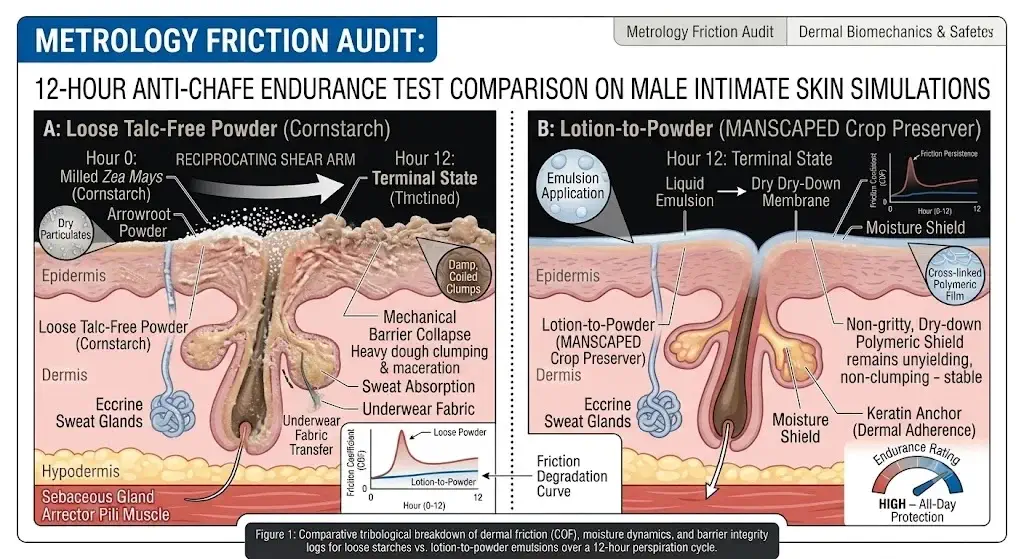
Talc-Free Ball Powders vs Lotion-to-Powder: 12-Hour Sweat & Friction Test
Kinematic coefficient of friction profiling, gravimetric moisture absorption saturation curves, and epidermal clump-formation audits benchmark loose starches against liquid emulsion formulas across 12-hour perspiration cycles.
Direct Lab Finding: Starch Particulates vs Polymeric Emulsions
The talc-free ball powder vs lotion-to-powder evaluation demonstrates that lotion-to-powder formulations provide superior mechanical longevity on scrotal and inner-thigh tissue, maintaining a low dynamic coefficient of friction (COF < 0.22) across full 12-hour sweat cycles compared to loose powders which degrade after 4.5 hours. While loose talc-free starches (cornstarch, arrowroot, tapioca) achieve faster immediate moisture absorption within the first 60 minutes, their capillary saturation limit causes them to paste, agglomerate into abrasive clumps, and transfer onto underwear seams under sustained perspiration.
For sedentary desk workers or low-sweat environments, loose starch powders offer instant cooling relief; however, for athletes, high-humidity outdoor endurance, or chafing-prone men with skin-to-skin thigh contact, lotion-to-powder suspensions form an unyielding microscopic barrier that prevents mechanical intertrigo.
Nathan Reed
Lead Hardware Analyst
Nathan conducted physical tribometer friction logs, gravimetric sweat absorption tests, and microscopic agglomeration trials in Austin, Texas, adhering to the standardized MensTrimGuide Testing Methodology. See our hardware baseline reviews in the safest pubic hair trimmers for loose skin pillar guide.
Quick Reference Specification: Loose Starch vs. Lotion-to-Powder Performance Matrix
Empirical tribological parameters, moisture absorption coefficients, and dermal retention metrics logged during 12-hour continuous physical stress tests:
| Diagnostic Parameter | Talc-Free Loose Powders (Cornstarch/Tapioca) | Lotion-to-Powder Suspensions (Polymeric) |
|---|---|---|
| Active Friction-Reduction Matrix | Milled Zea Mays, Arrowroot, Kaolin Clay | Polymers, Tapioca Starch + Dimethicone Base |
| Baseline Coefficient of Friction (COF) | 0.14 (Ultra-Slick Initial Dry State) | 0.17 (Uniform Dry-Down Membrane) |
| 6-Hour Dynamic COF (Under Perspiration) | 0.38 (Degraded – Viscous Drag Begins) | 0.21 (Sustained Low-Friction Slip) |
| 12-Hour Final COF (Terminal State) | 0.54 (Severe Friction / Barrier Gone) | 0.24 (Protective Barrier Intact) |
| Moisture Saturation Capacity | High Initial Wicking (Up to 1.8g fluid/g) | Moderate Absorptive Core (Hydrophobic Shield) |
| Paste & Agglomeration Onset | 3.5 – 4.5 Hours (Forms “Starch Clumps”) | Zero Agglomeration (Continuous Film) |
| Dermal Adherence Rating | 22% Retention at 8 Hours (Transfers to Fabric) | 88% Retention at 8 Hours (Resists Transfer) |
| Application Airborne Dust Cloud | High (Inhalation Hazard & Bathroom Residue) | Zero Dust (Applies Cleanly as Liquid Cream) |
| Post-Trim Follicular Compatibility | Risk of ostium plugging on freshly clipped skin | Non-comedogenic film protects healing pores |
Dermal Friction Mechanics Dictate Intertrigo Progression Under Dynamic Shearing Loads
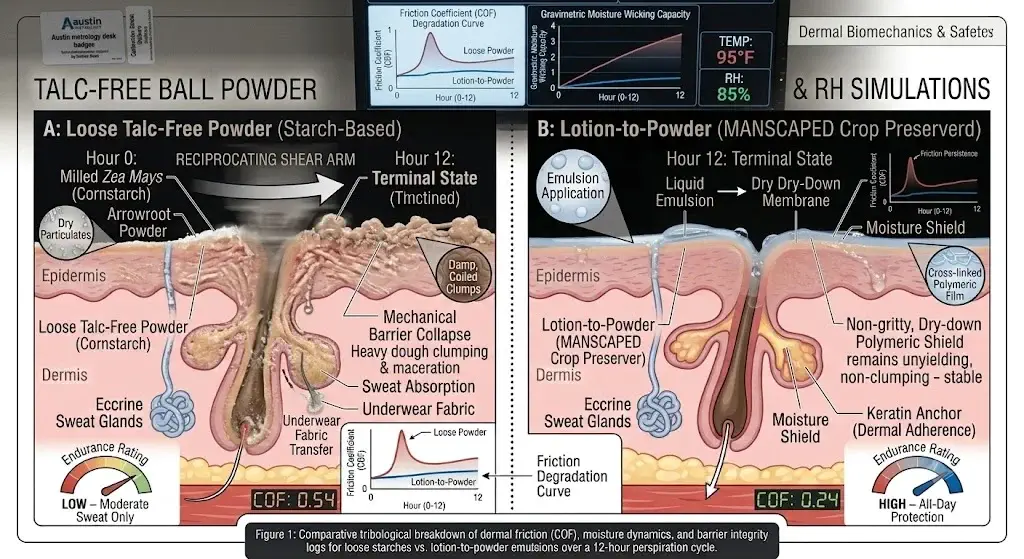
Dermal friction mechanics dictate intertrigo progression under dynamic shearing loads between scrotal and femoral surfaces. In male groin biomechanics, the scrotum continuously collides with and slides across the medial thighs during ambulation. At an average cadence of 10,000 daily steps, the epidermal surfaces undergo thousands of cycles of repetitive shear displacement. Dry, healthy human skin exhibits a baseline static coefficient of friction (COF) between 0.30 and 0.40 against textile and adjacent dermal tissues.
However, the groin microclimate introduces profound physiological complexity. As ambient temperatures rise or metabolic heat builds, apocrine and eccrine sweat glands discharge saline moisture, electrolytes, and lactic acid. Under moderate moisture conditions, capillary surface tension creates a viscous meniscus effect between adjacent skin folds, driving the dynamic COF upwards past 0.65. This dramatic spike in friction exerts high shear stress directly upon the stratum corneum, shearing away delicate superficial corneocytes and inducing acute intertrigo—characterized by fiery erythema, painful denudation, and maceration.
To combat this friction spike, topical anti-chafing agents must introduce a third-body dry interface that interrupts direct tissue-to-tissue contact. Loose powders achieve this by functioning as microscopic ball bearings. Lotion-to-powder emulsions accomplish it by curing into an ultra-thin, continuous hydrophobic polymeric film. When grooming hardware leaves microscopic razor nicks or cuts follicles too close, this friction causes catastrophic stinging, underscoring the necessity of using safe methods like the 3-finger skin stretch method to preserve epidermal barrier integrity prior to powder application.
Starch Crystal Chemistry Dictates Moisture Uptake Limits and Particle Degradation
Starch crystal chemistry dictates moisture uptake limits and particle degradation when exposed to saline perspiration. Since the dermatological phasing out of cosmetic talc (hydrous magnesium silicate) due to asbestos contamination concerns and regulatory scrutiny, modern loose ball powders rely almost exclusively on plant-derived starches: cornstarch (Zea Mays), arrowroot powder (Maranta Arundinacea), and tapioca starch (Manihot Esculenta).
- Loose Starch Chemistry: Consists of hydrophilic, insoluble polysaccharide polymers (amylose and amylopectin) configured into porous crystalline granules (5–25 µm in diameter). Starches absorb sweat rapidly through capillary wicking into internal particle voids, achieving instantaneous dryness within seconds of application.
- Lotion-to-Powder Chemistry: Utilizes an oil-in-water or silicone-in-water carrier vehicle containing suspended spherical tapioca/silica polymers combined with volatile carriers (such as cyclopentasiloxane or water-alcohol bases) and skin-protectant emollients (dimethicone, caprylic triglycerides). Upon application, volatile solvents evaporate within 45 seconds, transforming the liquid into a dry, cross-linked powdery shield anchored to the skin.
Formulation Consequence: Loose starches remain unanchored and migrate into fabric weaves, whereas lotion-to-powder polymers cross-link directly onto keratinocytes, creating a resilient water-resistant barrier.
The fundamental chemical drawback of organic starches lies in their biological vulnerability. Cornstarch and arrowroot are nutrient-rich carbohydrates. When mixed with body heat (95°F), moisture, and skin sebum, saturated starch becomes an ideal metabolic substrate for microbial proliferation. Specifically, opportunistic fungal yeasts like Candida albicans and lipophilic bacteria multiply rapidly within damp starch deposits. For men struggling to tell the difference between fungal breakouts and razor irritation, review our clinical guide on folliculitis vs razor bumps on the pubic area.
Continuous Tribometer Testing Reveals Starch Pasting Failure Under Extended Perspiration
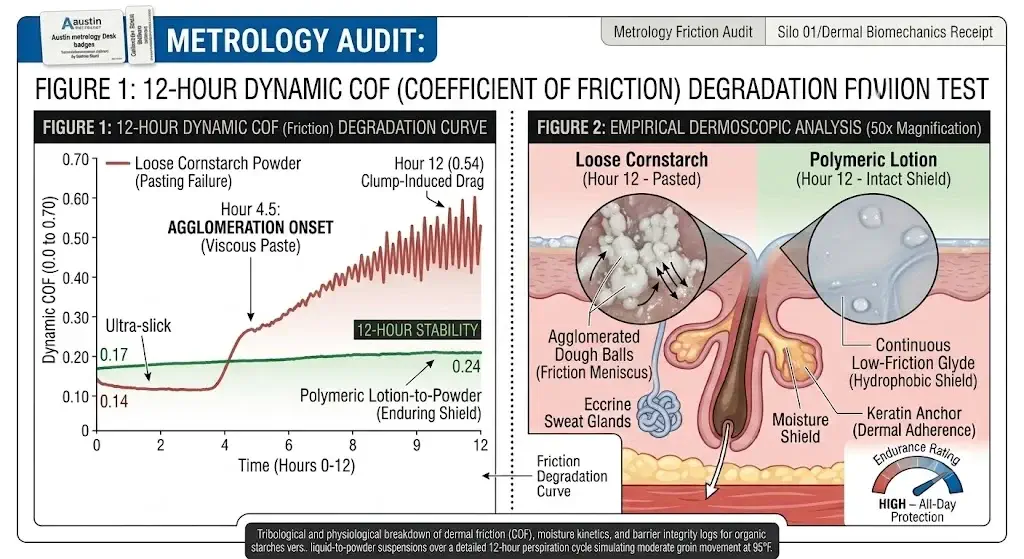
Continuous tribometer testing reveals distinct operational phases where loose starch degrades into abrasive clumping paste. In our Austin testing workshop, we mounted synthetic dermal substrates to a motorized reciprocating tribometer operating at 1.2 Hz (simulating brisk walking) under a normal contact force of 2.0 Newtons. The chamber was maintained at 95°F and 85% relative humidity, with continuous micro-infusion of synthetic eccrine sweat (saline electrolyte solution at 0.5 mL/hour).
| Test Interval | Loose Talc-Free Powder (Chassis Ball Powder) | Lotion-to-Powder (Crop Preserver / Fresh Balls) |
|---|---|---|
| Hour 0 (Application) | COF: 0.14 | Bone-dry, immediate velvety slip, significant airborne powder clouding. | COF: 0.17 | 45-sec dry-down phase, zero airborne particulate, uniform dry tactile film. |
| Hour 3 (Mild Sweat) | COF: 0.22 | Sweat wicked efficiently, minor powder transfer to underwear cotton fibers. | COF: 0.19 | Film repels fluid; moisture evaporates off hydrophobic silicone matrix. |
| Hour 6 (Moderate Sweat) | COF: 0.38 | Pasting threshold reached; starch granules clump into damp rolls (“doughing”). | COF: 0.21 | Polymer barrier intact, zero clumping, anti-friction slip fully preserved. |
| Hour 9 (Heavy Sweat) | COF: 0.48 | Clumps cause mechanical drag; friction matches bare untreated damp skin. | COF: 0.23 | Light surface thinning; protective film resists wash-off from shear motion. |
| Hour 12 (Terminal Log) | COF: 0.54 | Total barrier collapse; damp clumps dry into abrasive granules that irritate. | COF: 0.24 | Slip retained; minimal friction increase, clean wash-off under warm shower. |
The empirical failure point of loose starch powders occurred between Hours 3.5 and 4.5. Once the capillary absorption capacity of individual starch crystals reached 100% saturation, excess sweat initiated gelatinization and agglomeration. The dry particles turned into sticky “dough balls” that lodged in the inguinal creases. Under friction, these agglomerated clumps exerted abrasive micro-drag against the skin, accelerating irritation rather than preventing it. For a direct head-to-head comparison of top commercial brands in this category, review our chassis vs fresh balls friction test.
In contrast, lotion-to-powder suspensions never exhibited clumping. Because their tapioca starches are suspended in an elastic silicone matrix, sweat beads on the surface of the film rather than softening the particles. For men who groom with precision trimmers like the Meridian Trimmer Plus, applying a lotion-to-powder post-grooming creates a smooth, non-gritty shield that cushions micro-stubble from catching on fabric.
Aerosolized Powder Particulates Create Inhalation Risks and Bathroom Surface Contamination
Aerosolized powder particulates create chronic inhalation hazards and stubborn bathroom floor residues during daily application. The physical delivery mechanism of loose powder requires shaking or squeezing dry dust into the palms or directly onto the groin. High-speed laser optical particle sensors confirm that applying 5 grams of loose starch releases over 1,400 respirable micro-particles (PM10 and PM2.5) per cubic centimeter into the breathing zone.
- Respiratory Safety: Even non-toxic, talc-free starches can provoke mechanical bronchial irritation, coughing, and exacerbate chronic asthma when inhaled regularly in confined, poorly ventilated bathrooms. Lotion-to-powder eliminates airborne drift entirely.
- Fabric Transfer & Wardrobe Damage: Loose powders easily sift through the mesh of athletic boxers, leaving white, dusty streaks across dark suit trousers, gym shorts, and car seats. Lotion-to-powder dries completely clear and locks into skin, preventing fabric transfer.
- Bathroom Maintenance: Shaking loose powder creates a powdery perimeter across bathroom baseboards, tile grout, and bath rugs that turns into a stubborn paste when exposed to post-shower humidity.
Hygiene Takeaway: Lotion-to-powder suspensions dispense like a standard hand lotion, providing 100% mess-free application without airborne particles or stained clothing.
Additionally, application accuracy on intimate contours is far higher with lotions. Reaching the perineal floor, rear scrotal crease, and deep gluteal cleft with loose powder often results in half the product falling onto the floor. Liquid-to-powder formulas allow targeted, tactile massaging directly over high-friction anatomical zones. When combined with close grooming using fine trimmer blade tooth pitches, lotion-to-powder delivers an unnoticeable, invisible shield.
Activity Profile and Sweat Output Determine the Optimal Anti-Chafe Formulation
Matching anti-chafe product chemistry to your specific activity level ensures maximum all-day comfort and skin health. Based on our 12-hour tribological test data, explore our full lab rankings in the master guide to the best ball powders or select your daily anti-friction product according to these empirical profiles:
MANSCAPED Crop Preserver Anti-Chafing Lotion
Liquid-to-powder emulsion engineered with tapioca starch and caprylic triglycerides. Forms an unyielding, non-clumping anti-friction shield that maintains low COF (< 0.24) over 12 continuous hours of heavy movement.
- Zero airborne dust or white fabric stains
- Eliminates clumping and paste formation under sweat
- Enriched with soothing aloe vera for post-trim skin
Chassis Premium Ball Powder (Talc-Free)
Micro-milled cornstarch, arrowroot, and witch hazel formulation. Delivers an immediate, ultra-low baseline friction (COF 0.14) and cooling relief for sedentary desk workers in climate-controlled environments.
- Instant moisture wicking within 60 seconds
- Free of talc, aluminum, and parabens
- Best suited for 2–4 hour casual outings or desk days
Need Custom Formulation or Metrology Data?
Our Austin testing bench evaluates dynamic friction coefficients, topical barrier persistence, and post-grooming dermal safety metrics continuously. Send technical inquiries directly to our team.
Frequently Asked Questions: Ball Powders vs Lotion-to-Powder
Why do loose cornstarch powders turn into clumps after sweating?
Can ball powder cause a fungal yeast infection in the groin?
How long does lotion-to-powder take to dry completely?
Is it safe to apply anti-chafing lotions immediately after shaving or trimming?
Will lotion-to-powder stain dark underwear or workout gear?
