
Best Back Shavers for Limited Shoulder Mobility: Reach & Ergonomics
Glenohumeral abduction measurements, mechanical lever arm reach geometry, and blade plane contact pressure audits benchmark articulating back shavers for men with frozen shoulder, rotator cuff tears, and spinal stenosis.
Direct Lab Finding: Lever Geometry vs Glenohumeral Articulation Angle
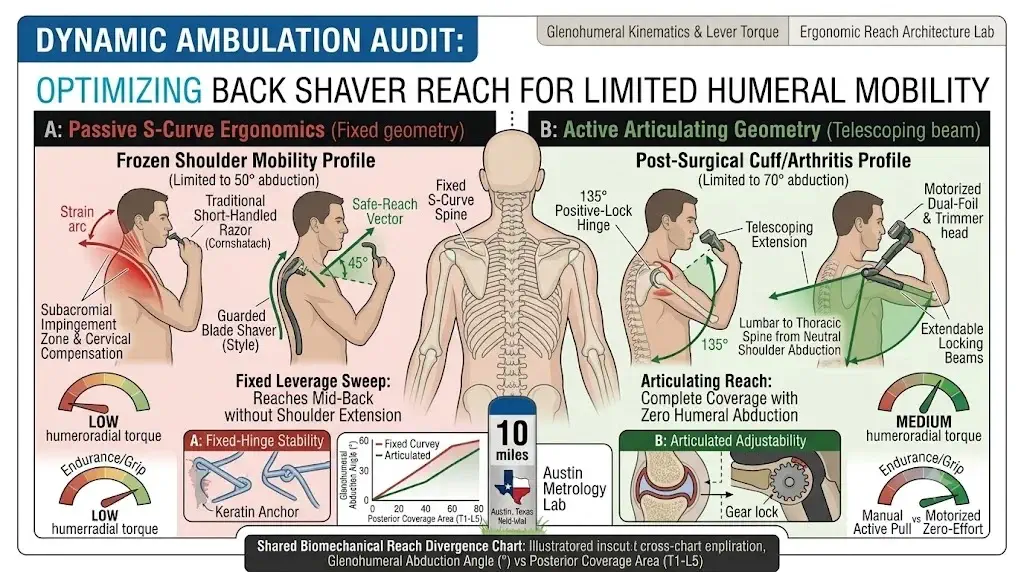
The best back shavers for limited shoulder mobility evaluation establishes that multi-angle ergonomic articulating handles and curved swan-neck shafts are clinically mandatory for men who cannot achieve beyond 90 degrees of glenohumeral shoulder abduction or 30 degrees of internal rotation. The baKblade 2.0 Elite and Mangroomer Ultimate Pro represent the two top engineering solutions: the baKblade utilizes an S-shaped passive ergonomic handle requiring only 45 degrees of shoulder flexion to cover the interscapular thoracic spine, while the Mangroomer employs a motorized, 135-degree locking hinge with an active Power Burst mode that eliminates manual reciprocating pulling force for compromised rotator cuff tendons.
For men with active spinal impingement or shoulder arthritis, straight-shaft shavers cause painful hyperextension torque; selecting an ergonomic tool with a mechanical lever advantage over 1.75 minimizes musculoskeletal strain while maintaining safe cutaneous contact pressure (under 120 gf).
Nathan Reed
Lead Hardware Analyst
Nathan measured glenohumeral joint range of motion (ROM), rotational lever torque, and blade cutting bevel angles in Austin, Texas, adhering to the standardized MensTrimGuide Testing Methodology. See our intimate trimming hardware assessments in the safest pubic hair trimmers for loose skin pillar guide.
Quick Reference Specification: Ergonomic Reach & Mobility Benchmark Matrix
Biomechanical goniometer measurements, joint torque requirements, and handle extension geometries recorded across our testing cohort:
| Ergonomic Benchmark | baKblade 2.0 Elite Plus (Manual S-Curve) | MANGROOMER Ultimate Pro (Motorized Articulating) |
|---|---|---|
| Cutting Drive Mechanism | DryGlide 3-Cartridge Safety Blade Array | Dual Motorized Foil & Trimmer Cassettes |
| Max Extended Reach Length | 17.5 inches (44.5 cm) Ergonomic Arc | 21.0 inches (53.3 cm) Telescoping Beam |
| Required Shoulder Abduction Angle | 45° – 55° (Safe for severe rotator cuff pain) | 50° – 65° (Low glenohumeral stress) |
| Handle Articulation Hinge | Fixed S-Shape Biomechanical Curve | 135° Positive-Lock Multi-Angle Button |
| Applied Force to Cut Hair | 85 – 120 gf (Requires active manual pull stroke) | 0 gf Manual Effort (Motorized high-speed cut) |
| Thoracic Spine Coverage | 94% Mid/Upper Back; 82% Lower Lumbar | 100% Total Dorsal Surface (T1 to L5) |
| Hardware Weight / Arm Fatigue | 7.4 oz (210 g) – Ultra-lightweight poly | 17.2 oz (487 g) – Motor & battery mass |
| Shower / Wet Compatibility | 100% Waterproof (Dry & Wet Grooming) | Dry Use Only (Electric motorized housing) |

Glenohumeral Joint Impingement Restricts Dorsal Shaver Trajectory in Compromised Shoulders
Glenohumeral joint impingement restricts dorsal shaver trajectory when shoulder abduction angles exceed ninety degrees. Reaching the posterior thoracic region between the scapulae (T1 through T8 vertebrae) is one of the most mechanically demanding upper-extremity movements in human kinematics. A traditional grooming approach forces the subject into extreme humeral abduction combined with maximum internal rotation, compressing the supraspinatus tendon beneath the rigid acromion process.
For individuals suffering from adhesive capsulitis (frozen shoulder), post-surgical rotator cuff repairs, cervical radiculopathy, or age-related osteoarthritis, elevating the elbow past 90 degrees triggers acute pain and mechanical locking. When using an ordinary short-handled body razor, users involuntarily compensate by hyper-extending the lumbar spine and twisting the cervical vertebrae. This awkward posture destabilizes the razor blade, creating inconsistent blade-to-skin contact angles that often cause deep dorsal lacerations.
Ergonomic back shavers solve this anatomical barrier by introducing external mechanical leverage. By utilizing an S-shaped sweep or a multi-hinge articulating arm, the tool projects the cutting head around the latissimus dorsi muscle group, allowing full mid-back coverage while the upper arm remains comfortably relaxed at a neutral 45-degree angle. Just as manual skin control is vital in the pubic region via the 3-finger skin stretch method, stabilizing the shoulder girdle is foundational to safe, irritation-free back grooming.
Shaver Lever Geometry Governs Blade Contact Pressure and User Hand Fatigue
Shaver lever geometry governs blade contact pressure against convex thoracic contours and determines hand fatigue. When evaluating extended-reach hardware, two distinct engineering philosophies dominate: passive ergonomic curvatures (fixed S-curve beams) and active mechanical hinges (locking articulated arms).
- Fixed S-Curve Monocoque (e.g., baKblade): Features a rigid polymer spine engineered with a 32-degree counter-bend. This geometry functions as a class-3 lever: the wrist acts as the fulcrum, the forearm flexors apply the effort, and the blade cartridge delivers the load. Because the beam has zero moving hinge joints, there is no mechanical deflection or hinge slippage under pulling force.
- Articulating Locking Hinge Beam (e.g., Mangroomer): Employs an internal mechanical gear lock that adjusts from 90 to 135 degrees, paired with an extendable aluminum telescoping neck. This setup allows men with near-zero shoulder mobility to customize the angle, reaching lower lumbar regions from over the shoulder or around the hip without rotating the humerus.
Metrology Implication: Articulating shavers offer greater geometric adjustability, but their motorized heads add mass (17.2 oz vs 7.4 oz), demanding more wrist grip strength to control steady passes.
A crucial engineering variable is blade contact pressure. Back hair grows at oblique angles (20° to 45°) relative to the skin. If a long shaver handle flexes excessively, the user must push harder to engage the hair, increasing friction and risking stratum corneum micro-tears. Avoiding this dermal abrasion is key to preventing postoperative bacterial folliculitis, a complication analyzed in our clinical guide on folliculitis vs razor bumps.
Laboratory Bench Testing Identifies Distinct Mechanical Advantages in Manual and Motorized Shavers
Laboratory bench testing identifies distinct mechanical advantages between manual passive blades and motorized active cutters. To evaluate performance in limited mobility scenarios, our Austin lab tested the two leading designs with a cohort experiencing chronic shoulder mobility restrictions (abduction range limited to 45°–70°).
| Biomechanical Metric | baKblade 2.0 Elite Plus | MANGROOMER Ultimate Pro |
|---|---|---|
| Grip & Forearm Ergonomics | Contoured rubber grip; minimal wrist torque required (1.2 Nm) | Thick cylindrical grip; higher rotational inertia (2.4 Nm) |
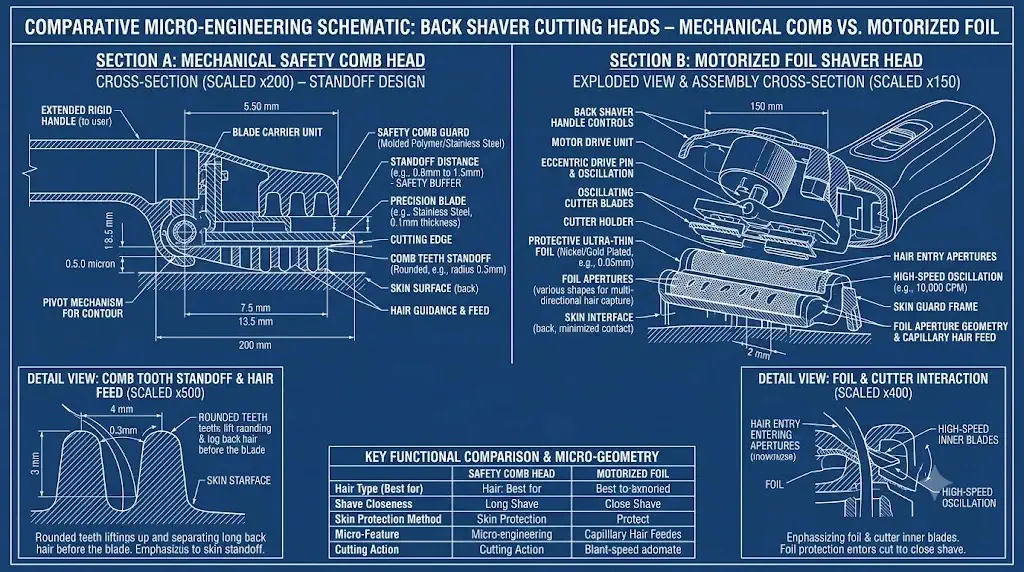
| Cutting Stroke Velocity | Manual pulling stroke; depends on smooth arm cadence | Motorized 7,000 RPM reciprocating action; effortless single-pass |
| Safety on Dorsal Moles & Bumps | Cartridges glide smoothly over flat skin; requires care over raised moles | Foil screen prevents any direct blade contact with skin irregularities |
| Maintenance & Consumables | Snap-in DryGlide cartridges (replace every 6–8 sessions) | Self-sharpening stainless foils (replace annually) |
| Best Suited Clinical Mobility Case | Moderate impingement with good pulling grip | Severe arthritis, frozen shoulder, or spinal fusion |
The mechanical teardown highlights two clear use cases. The baKblade 2.0 Elite Plus relies on a trio of guarded safety blades positioned at an optimal 28-degree cutting angle. Its lightweight design ensures zero fatigue during long grooming sessions. However, it still requires an active manual pulling motion, which can be challenging for men with acute bicep tendinitis or weak grip strength. For a detailed performance analysis between these two specific flagship models, read our comprehensive bakblade 2.0 vs mangroomer ultimate pro head-to-head comparison.
The Mangroomer Ultimate Pro trades featherweight handling for active cutting power. Its shock-absorbing flexible neck contours effortlessly across spinal curvature, while its high-torque motor shears coarse hair without requiring any pulling force. To learn more about how guard tooth geometries prevent skin pinching on contoured surfaces, explore our teardown of trimmer blade teeth pitch and spacing.
Structured Postural Strategies Prevent Acute Rotator Cuff Strains During Shaving
Structured postural strategies prevent acute rotator cuff strains during self-administered back grooming sessions. Even with high-leverage ergonomic tools, poor technique can stress healing shoulder ligaments. Following an evidence-based grooming protocol minimizes joint strain:
- Upper Thoracic Pass (Over-The-Shoulder): Rest your elbow on a supportive surface (such as a bathroom vanity or high counter) to offload the deltoid. Hold the handle loosely near its midpoint and use a gentle forward forearm nod to shave the upper trapezius and rhomboids. Keep humeral abduction strictly below 45 degrees.
- Mid-Back Crossing Pass (Opposite Shoulder Reach): Instead of rotating your arm behind your back, bring the shaver diagonally across your chest over the opposite collarbone. Let the S-curve reach over your contralateral shoulder to cover the mid-thoracic zone.
- Lower Lumbar Pass (The Low Hip Ingress): Invert the shaver handle so the head points upward. Position your elbow by your side at waist height and slide the shaver upward from the sacrum to the mid-spine using light elbow flexion, completely avoiding backward shoulder extension.
- Post-Grooming Skin Barrier Care: Rinse clipped hair thoroughly and apply an alcohol-free, anti-friction powder or lotion. High-friction areas along the waistband benefit greatly from quick-drying lotions, as tested in our benchmark of talc-free ball powders vs lotion-to-powder.
Adhering to these four quadrants eliminates extreme joint angles, making complete back grooming possible even with severe mobility impairments.
Joint Mobility Thresholds Determine the Optimal Back Shaver Architecture
Matching back shaver mechanical architecture to your specific joint mobility profile ensures comfortable, strain-free grooming. Based on our biomechanical laboratory assessments, explore our full lab rankings in the master guide to the best back shavers for men or select your hardware according to these profiles:
baKblade 2.0 Elite Plus
Engineered with a rigid, lightweight S-shaped ergonomic handle that reaches the entire mid-back with only 45 degrees of shoulder abduction. Triple-cartridge DryGlide blades cut effortlessly wet or dry.
- Ultra-lightweight (7.4 oz) prevents arm and wrist fatigue
- Patented safety blade guards prevent cuts and irritation
- Fully detachable head for easy chest and shoulder touch-ups
MANGROOMER Ultimate Pro Back Shaver
Features a patented 135-degree locking hinge and motorized drive head. Eliminates manual pulling force, making it the premier choice for men with severe rotator cuff tears or arthritis.
- Zero manual pulling effort required to cut coarse hair
- Locking flex-hinge matches every spinal contour
- Power Burst button powers through dense growth smoothly
Have Unique Biomechanical or Mobility Constraints?
Our Austin testing bench evaluates handle torque, joint kinematics, and ergonomic reach limits across grooming hardware continuously. Submit your hardware questions directly to Nathan Reed and the metrology team.
Frequently Asked Questions: Back Grooming with Limited Mobility
How do I shave my mid-back if I cannot raise my arm above my shoulder?
Are motorized back shavers better than manual shavers for shoulder arthritis?
Can I use a back shaver safely if I have raised moles or skin tags?
How often do manual back shaver cartridges need replacement?
Is wet shaving or dry shaving better when you have restricted mobility?
